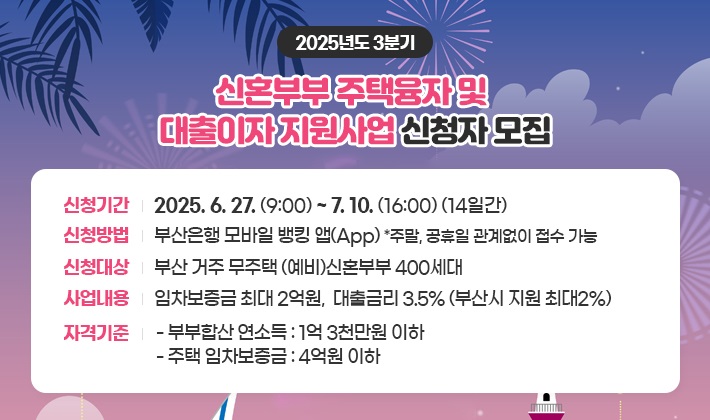
Busan Metropolitan City has announced the results for the third quarter (additional) selection of beneficiaries for its 2025 newlywed housing loan and interest support program, as confirmed by official municipal sources. The initiative, administered by the Women and Family Bureau’s Childcare Support Division, aims to alleviate financial burdens for newly married couples purchasing homes in the city through subsidized loans and interest payments.
According to the Busan Metropolitan City policy bulletin released on March 18, 2025, the program is part of the city’s broader 2025 Childcare Business Implementation Plan, which outlines strategic support measures across marriage, childbirth, parenting, and family welfare domains. The housing loan support specifically targets eligible newlywed households seeking to settle in Busan, with benefits structured to reduce long-term financing costs associated with home purchases.
The selection results for the third quarter (additional) round were formally announced through the city’s official policy notice board, continuing a quarterly review process designed to allocate limited municipal funds efficiently. Applicants who met the established criteria—including residency requirements, marriage registration timelines, and income thresholds—were notified of their approval status via the city’s housing support portal.
This initiative aligns with broader national and local efforts to address declining birth rates and housing affordability challenges, particularly in South Korea’s major metropolitan areas. Busan’s approach integrates housing finance support with complementary policies such as childcare subsidies, parental leave incentives, and young couple housing programs, as detailed in the city’s annual policy guidance materials.
In April 2025, Busan City published a comprehensive policy guidebook covering 95 distinct initiatives across six key sectors, including newlywed housing support, pregnancy and childbirth assistance, parenting services, caregiving, work-life balance, and multi-child family benefits. The guidebook, made available for public viewing online, highlights eight newly introduced measures and revisions to existing programs, reflecting updated eligibility criteria and expanded funding where applicable.
Among the related measures referenced in the city’s planning documents is the “Lifelong Together Youth All-(家)” housing cost support program, which provides rental assistance to young households, and the children’s daycare operational expense support, aimed at reducing barriers to early childhood education access. Additional components include Busan-type postpartum care cost subsidies, exemptions for pregnant women using public parking facilities, and financial incentives for multi-child households purchasing electric vehicles.
The city’s Women and Family Bureau continues to coordinate these efforts through interdepartmental collaboration, particularly with the Housing Authority and Social Welfare Bureau, to ensure seamless delivery of benefits. Officials emphasize that all disbursements are subject to annual budget approvals and performance evaluations, with funding levels adjusted based on demand and fiscal capacity.
For prospective applicants, the city maintains an online application system through its integrated welfare services platform, where guidelines, required documentation, and selection timelines are published in advance of each quarterly review cycle. Updates on future rounds, including the fourth quarter 2025 schedule, are expected to be announced through the same official channels later in the year.
As part of its commitment to transparency, Busan Metropolitan City provides public access to aggregated statistics on program participation, approval rates, and fund utilization through its open data portal. These reports are typically released semi-annually and include breakdowns by district, applicant age group, and household composition.
Moving forward, the next official checkpoint for the housing loan and interest support program is anticipated to be the release of the fourth quarter 2025 selection results, which will follow the established quarterly timeline barring any administrative adjustments. Interested residents are encouraged to consult the Women and Family Bureau’s announcements page or contact the division directly at the published inquiry line for the most current information.
For those seeking to understand how such municipal support programs fit into South Korea’s broader family policy framework, official explanations are available through the Ministry of Gender Equality and Family’s national portal, which details complementary national-level initiatives such as the New Deal for Housing and the Comprehensive Childcare Support Act.
World Today Journal will continue to monitor developments in urban housing policy and family support measures in major global cities, providing verified, context-rich reporting on initiatives that impact socioeconomic stability and quality of life.
Readers are invited to share insights or experiences related to housing assistance programs in their communities in the comments section below. Your perspectives assist deepen the global conversation on equitable access to affordable housing and family-friendly urban planning.
- 2026 Hybrid & Electric Car Guide: Best MPV Comparisons, Powertrain Types & Choices
- Seoul City and CU Launch Low-Sugar, High-Protein Health Meals
- Why New York Suburbs Offer Great Housing, Art, and Culture (news-usa.today)
- DHHS Reveals Supplemental Nutrition Assistance Program Performance Metrics (archyde.com)