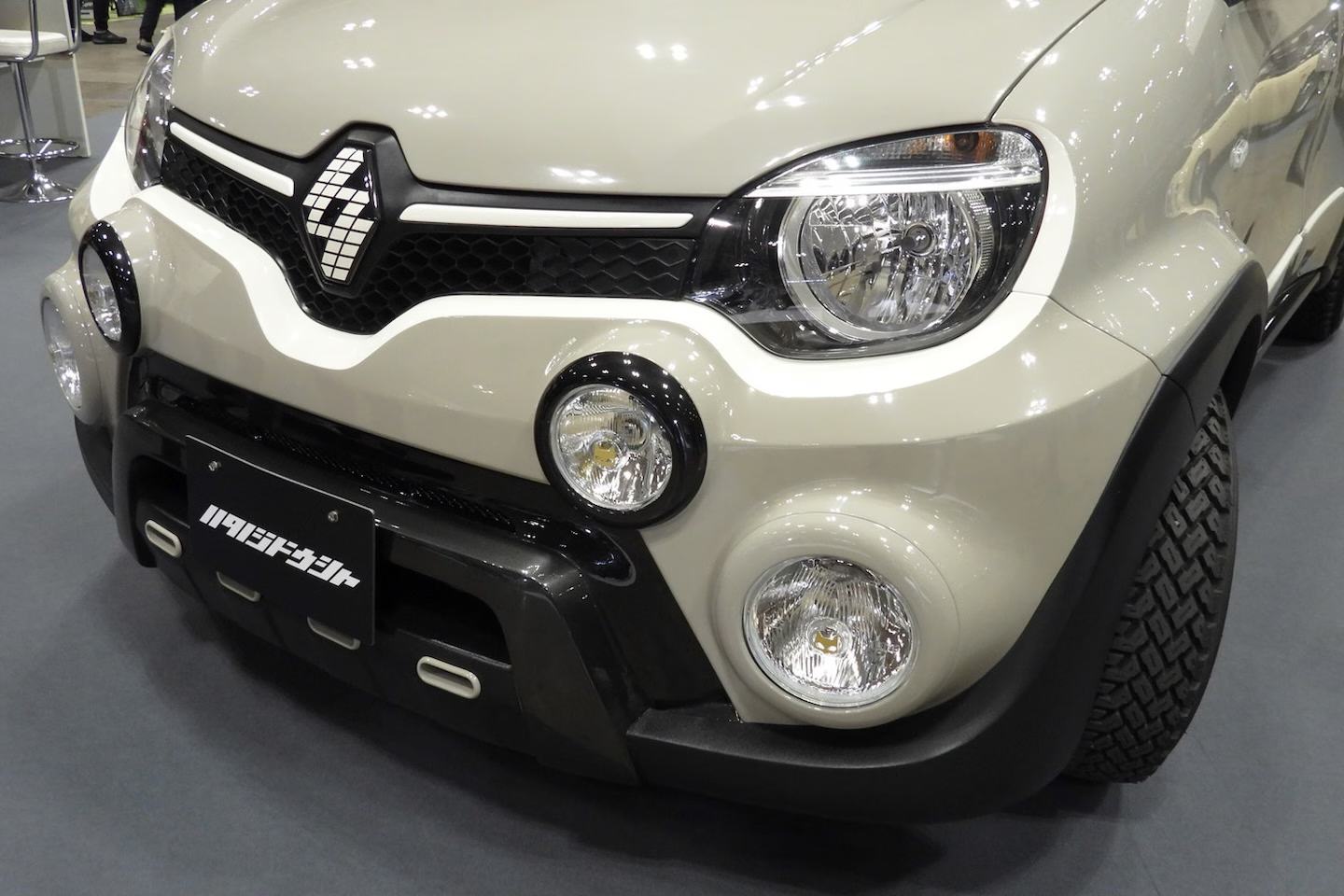
When a Japanese tuning house decides to transform a modest city hatchback into something that evokes both Porsche’s Dakar-winning rally legend and the fiery spirit of a Renault 5 Turbo, the result is bound to turn heads. That is precisely what Hatano Automobile has done with its latest creation: the C’eLavie Cross, a heavily modified version of the third-generation Renault Twingo. Unveiled in April 2026, this urban-focused off-road reinterpretation blends retro styling cues with modern tuning expertise, offering a nostalgic yet contemporary take on the hot hatch genre.
The project begins with the outgoing third-generation Renault Twingo, specifically the rear-wheel-drive, turbocharged three-cylinder variant producing 90 horsepower. Hatano Automobile did not stop at aesthetic enhancements; the tuner also offers mechanical upgrades, including an optional engine tune that boosts output to 138 horsepower using a Nissan-sourced block, paired with Bilstein dampers for improved handling. These modifications position the C’eLavie Cross as more than just a showpiece—it aims to deliver a driving experience inspired by rally cars, albeit tailored for city streets and light gravel paths.
Visually, the C’eLavie Cross features widened fenders, reinforced bumper guards, and a prominent roof spoiler that contribute to its rugged, adventure-ready appearance. Rally-style round lights are integrated into the front bumper, even as elevated suspension and underbody protection plates further enhance its off-road pretensions. Hatano has also released an asphalt-focused variant, the C’eLavie 1985, which adopts a blue-and-orange livery and carbon fiber accents to evoke track-day aesthetics rather than desert racing.
Despite its aggressive styling, the tuner acknowledges that the vehicle’s actual off-road capability may be limited. As noted in early reports, the modifications are primarily cosmetic and dynamic in nature, with true terrain performance likely ending at light gravel or pavement excursions. Nevertheless, the attention to detail—ranging from custom badging to bespoke interior trim—underscores Hatano’s commitment to creating a niche product that appeals to enthusiasts of retro-futuristic design and automotive individualism.
Exclusivity is a key aspect of the C’eLavie Cross project. Hatano Automobile plans to produce only 20 units in total, five of which have already been claimed as of the April 2026 announcement. The base price for the visual tuning package starts at approximately 1.35 million Japanese yen (around 3 million Hungarian forints), though adding mechanical upgrades can easily double that cost—and that figure does not include the price of the donor Twingo itself. This places the finished vehicle firmly in the realm of high-end boutique modifications, targeting collectors and enthusiasts willing to pay a premium for uniqueness.
The timing of the announcement coincides with a broader resurgence of interest in retro-styled city cars, particularly the latest generation of the Renault Twingo, which has gained popularity for its nostalgic design cues and compact urban footprint. By drawing inspiration from iconic rally machines like the Porsche 911 Dakar and Renault 5 Turbo—both celebrated for their blend of performance, durability, and distinctive styling—Hatano taps into a wellspring of automotive heritage while reimagining it for a modern, city-conscious audience.
While the C’eLavie Cross remains a low-volume, specialist project, it reflects a growing trend among boutique tuners to reinterpret everyday vehicles through the lens of motorsport history and adventure culture. Similar movements have appeared elsewhere in the automotive world, from lifted Fiat 500s styled as mini-Safaris to Dacia-based builds echoing the Renault Alaskan’s rugged ethos. What sets Hatano’s approach apart is its focus on emotional resonance over outright capability, prioritizing the feeling of adventure over extreme off-road prowess.
As of now, Hatano Automobile has not announced plans for international distribution or homologation of the C’eLavie Cross for markets outside Japan. Interested buyers are advised to contact the tuner directly for availability, specifications, and commissioning details. With production limited to just 20 units, the opportunity to own one of these reimagined Twingos is expected to be fleeting.
For enthusiasts of unconventional automotive projects, the C’eLavie Cross serves as a reminder that innovation does not always require entirely modern platforms—sometimes, the most compelling transformations begin with a familiar city car and a bold vision.
Worth a look