Unveiling Solar Tornadoes: A New Frontier in Space Weather Prediction & National Security
For decades,space weather forecasting has primarily focused on the sun – monitoring flares and coronal mass ejections (CMEs) for potential disruptions to Earth’s technological infrastructure. However, groundbreaking research from the University of Michigan reveals a critical blind spot in our current understanding: the formation and impact of “solar tornadoes” – intermediate-sized flux ropes within the solar wind that pose a notable, and often undetected, threat. This article delves into the science behind these phenomena, the limitations of current forecasting methods, and a proposed solution poised to revolutionize space weather prediction and safeguard critical systems.
Understanding the Solar wind & the Threat of Space Weather
The sun constantly emits a stream of charged particles known as the solar wind,creating a dynamic surroundings throughout the solar system. This isn’t a constant breeze; it fluctuates in intensity and direction, creating what we call “space weather.” Large-scale eruptions like CMEs – massive expulsions of plasma traveling at millions of miles per hour – are well-known drivers of severe space weather events. These events can induce geomagnetic storms,disrupting power grids,damaging satellites,and interfering with communication systems.
Though, recent observations have revealed a more nuanced picture. Scientists are now recognizing the prevalence of smaller, yet possibly risky, structures within the solar wind: flux ropes ranging from 3,000 to 6 million miles in width. These swirling vortices of plasma, resembling terrestrial tornadoes, are too small to be reliably captured by conventional CME simulations (which typically focus on features exceeding 7 million miles) and yet too large to be adequately studied with models designed for smaller-scale magnetic field interactions.
The Limitations of Current Forecasting & the Rise of the “Hidden Threat”
Current space weather forecasting relies heavily on observing the sun directly. Telescopes track solar flares and CMEs, providing warnings when these events are aimed towards Earth. Though, this approach is fundamentally limited when it comes to flux ropes.
“If there are hazards forming out in space between the sun and Earth, we can’t just look at the sun,” explains Mojtaba Akhavan-Tafti, Associate Research Scientist at the University of Michigan’s Climate and Space Sciences and Engineering department. “A solar eruption aimed away from Earth, or with a northward-pointing magnetic field, might still generate these southward-pointing magnetic field vortices and hurl them towards us.”
The critical factor is magnetic field orientation. Geomagnetic storms are triggered when the solar wind’s magnetic field aligns southward. Current spacecraft, positioned at the L1 Lagrange point (approximately 1 million miles from Earth), measure solar wind speed and magnetic field strength and direction. However, these single-point measurements are insufficient to detect the full structure of these flux ropes, particularly if they are not directly in the path of the L1 probes.
As Dr. Manchester eloquently puts it, “Imagine if you could only monitor a hurricane remotely with the measurements from one wind gauge.You’d see a change in the measurements, but you wouldn’t see the storm’s entire structure. That’s the current situation with single-spacecraft systems.”
A National Security Imperative: Proactive Detection & Prediction
The implications of undetected solar tornadoes extend beyond technological disruptions. The vulnerability of critical infrastructure – including the electric grid, airline navigation, and agricultural systems – makes accurate space weather forecasting a matter of national security.
“This is a matter of national security,” Akhavan-Tafti emphasizes. “We need to proactively find structures like these earth-bound flux ropes and predict what they will look like at Earth to make reliable space weather warnings for electric grid planners,airline dispatchers and farmers.”
SWIFT: A Multiprobe Solution for Complete space Weather Monitoring
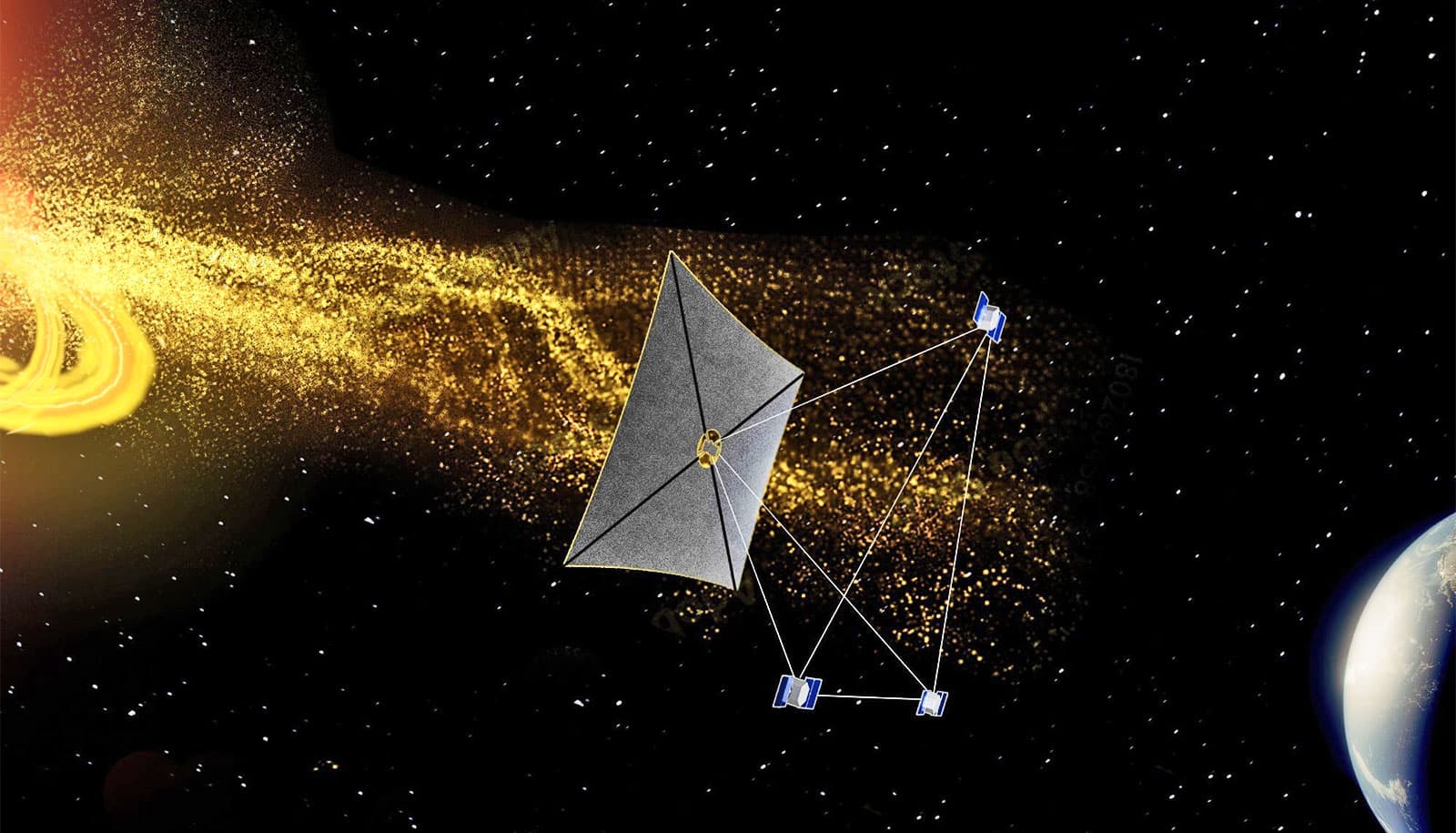
to address this critical gap in our understanding, researchers are advocating for a revolutionary approach: a constellation of spacecraft known as the Space Weather Investigation Frontier (SWIFT). This mission concept, spearheaded by Akhavan-Tafti, proposes a network of four probes strategically positioned to provide a multi-dimensional view of the solar wind.
The proposed configuration features:
* A Triangular-Pyramid Formation: Three identical probes would form the base of the pyramid, positioned in a plane around the L1 Lagrange point, approximately 200,000 miles apart.
* A hub Spacecraft: A fourth probe, located beyond L1, would serve as the pyramid’s apex, continuously pointing towards the sun.
* Enhanced Warning Times: This configuration would allow SWIFT to track changes in the solar wind as it travels towards Earth, potentially providing space weather warnings up to 40%
Related reading