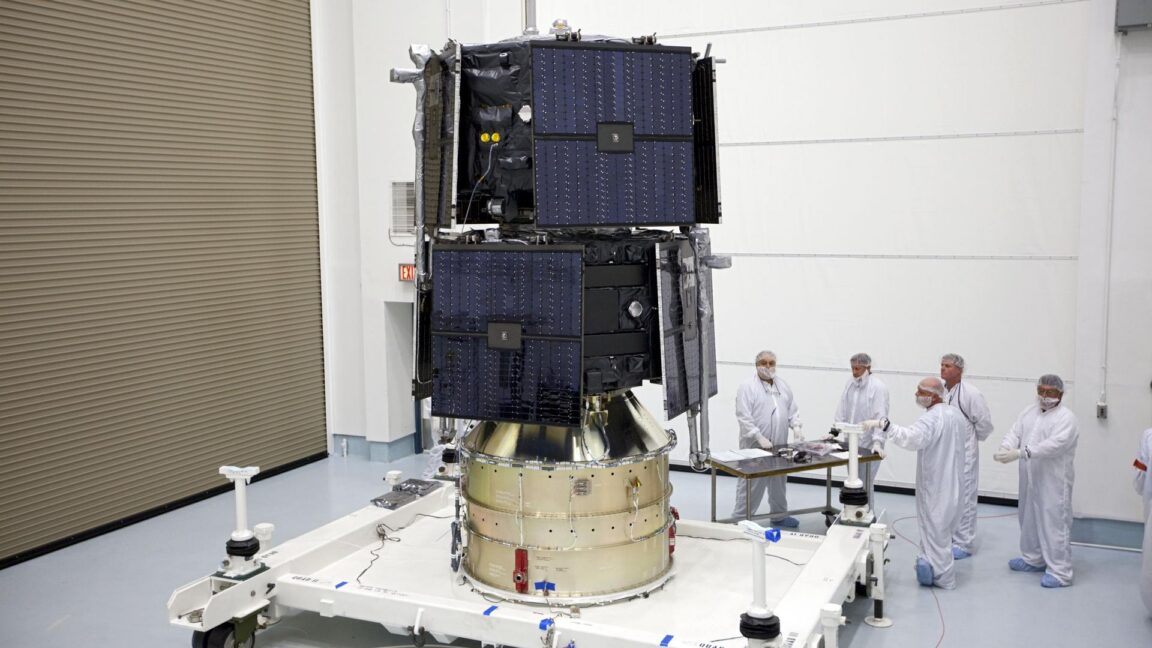
The aging NASA Van Allen Probe A is poised to re-enter Earth’s atmosphere on Tuesday, March 10, 2026, almost 14 years after its launch in 2012. While the vast majority of the spacecraft is expected to burn up upon reentry, NASA acknowledges a slight risk – approximately 1 in 4,200 – that some components may survive and reach the ground. This event highlights the growing challenge of managing orbital debris and the complexities of ensuring the safe disposal of space hardware.
The Van Allen Probes, A and B, were instrumental in deepening our understanding of Earth’s radiation belts, doughnut-shaped regions encircling the planet that trap energetic charged particles. These belts, discovered by James Van Allen in 1958, pose a hazard to satellites and astronauts and understanding their dynamics is crucial for protecting space-based infrastructure. The probes’ seven-year mission, concluding in 2019, provided unprecedented data on how these particles are gained and lost, revealing phenomena like a transient third radiation belt that forms during periods of intense solar activity. This discovery, and others made by the probes, are vital for predicting and mitigating the effects of space weather.
The impending reentry is occurring sooner than initially predicted. NASA originally anticipated the probe would remain in orbit until around 2034. However, increased solar activity has caused the Earth’s atmosphere to swell, creating more drag on the satellite and accelerating its descent. The U.S. Space Force currently predicts reentry will occur around 7:45 p.m. EDT, with a margin of error of plus or minus 24 hours. This uncertainty underscores the difficulty in precisely forecasting the reentry path of decaying satellites.
Understanding the Reentry Risk
While NASA emphasizes the low probability of harm, the possibility of surviving debris reaching the ground is not zero. The 1,323-pound spacecraft is constructed of various materials, some of which are designed to withstand extreme temperatures. According to NASA, some components are expected to survive the fiery plunge through the atmosphere. The spacecraft’s orbital inclination of 10 degrees limits the potential impact zone to a relatively narrow swath of the tropics, but the exact location of any potential debris fall remains uncertain. What we have is due to the unpredictable nature of atmospheric drag and the satellite’s tumbling motion as it descends.
This event isn’t unique. Several other NASA satellites have reentered the atmosphere with similar, albeit often lower, risk profiles. The Rossi X-ray Timing Explorer (RXTE), which reentered in 2018, carried a 1-in-1,000 risk of causing harm. No injuries were reported from that reentry, but it illustrates the inherent challenges of deorbiting spacecraft safely. RXTE’s reentry occurred shortly after NASA issued its first standard on orbital debris mitigation and reentry risk management in 1995, highlighting the evolving nature of space debris protocols.
The Growing Problem of Space Debris
The Van Allen Probe A reentry is a stark reminder of the increasing amount of space debris orbiting Earth. This debris, ranging from defunct satellites and rocket stages to tiny fragments from collisions, poses a growing threat to operational spacecraft and future space missions. The European Space Agency (ESA) tracks over 33,000 pieces of space debris larger than 10 cm, with millions of smaller, untrackable fragments also present. Even small pieces of debris can cause significant damage due to the high velocities involved in orbital mechanics.
The issue extends beyond NASA. Other spacefaring nations also contribute to the problem. Between 2020 and 2022, China launched four heavy-lift Long March 5B rockets, deliberately leaving their massive core stages in orbit to fall back to Earth uncontrolled. These core stages, each weighing approximately 24 tons, reentered the atmosphere on two occasions, with wreckage landing in the Ivory Coast and Borneo. While no injuries were reported, these events raised concerns about the lack of responsible deorbiting practices. Ars Technica reported on the concerns surrounding these uncontrolled reentries.
Mitigation Strategies and Future Regulations
Addressing the space debris problem requires a multi-faceted approach. International guidelines, such as those developed by the Inter-Agency Space Debris Coordination Committee (IADC), recommend minimizing debris creation and ensuring the safe disposal of spacecraft at the end of their missions. These guidelines include designing spacecraft for demisability – ensuring they break up completely during reentry – and implementing controlled deorbit maneuvers. However, these guidelines are not legally binding, and compliance varies among nations.
NASA is actively developing and implementing technologies to mitigate the risk of space debris. These include designing spacecraft with shorter operational lifetimes, incorporating propulsion systems for controlled deorbiting, and exploring active debris removal technologies. Active debris removal, which involves capturing and removing existing debris from orbit, is a particularly challenging but potentially crucial aspect of long-term space sustainability. The agency is also working to improve its tracking and prediction capabilities to better assess reentry risks and provide timely warnings.
What Happens Next?
NASA and the U.S. Space Force will continue to monitor the Van Allen Probe A’s descent and provide updates as the reentry date approaches. The agency is coordinating with international partners to track the debris and assess any potential risks. While the probability of harm remains low, NASA is taking all necessary precautions to ensure public safety. The reentry of Van Allen Probe B is currently predicted to occur no earlier than 2030, and will likely present a similar risk profile.
The lessons learned from the Van Allen Probe A reentry, and similar events, will inform future spacecraft design and operational practices. The need for international cooperation and enforceable regulations to address the growing problem of space debris is becoming increasingly urgent. The long-term sustainability of space activities depends on responsible stewardship of the orbital environment.
Key Takeaways:
- NASA’s Van Allen Probe A is expected to re-enter Earth’s atmosphere on March 10, 2026, with a low but non-zero risk of debris reaching the ground.
- Increased solar activity has accelerated the probe’s reentry, occurring earlier than initially predicted.
- The event highlights the growing challenge of managing space debris and the need for responsible deorbiting practices.
- International cooperation and enforceable regulations are crucial for ensuring the long-term sustainability of space activities.
Stay tuned to World Today Journal for further updates on the Van Allen Probe A reentry and the ongoing efforts to address the issue of space debris. We encourage you to share this article and join the conversation about the future of space exploration and sustainability.
Related reading