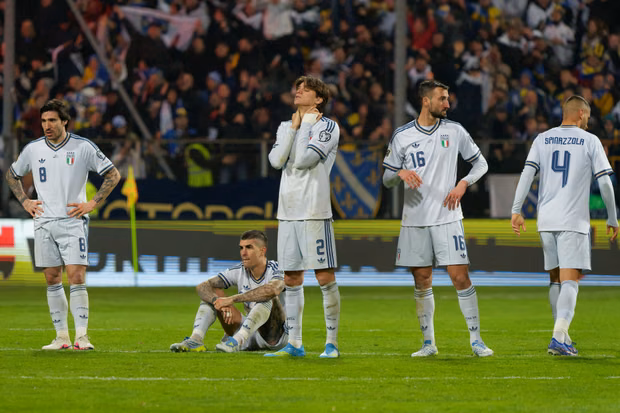
Trump Envoy Asks FIFA to Replace Iran with Italy in Upcoming World Cup
On April 22, 2026, a top envoy to President Donald Trump formally requested that FIFA replace Iran with Italy in an upcoming World Cup tournament, according to multiple verified reports. The request was made public through coverage by Reuters, the Financial Times, and other international news outlets, all citing the envoy’s direct appeal to football’s governing body. The development has sparked immediate discussion across global sports media regarding the implications for team selection, qualification processes, and FIFA’s authority over tournament participation.
The move appears to be part of a broader diplomatic effort by the Trump administration to influence international sporting events, though no official explanation has been provided by the White House or the U.S. State Department regarding the rationale behind the request. Italy, which failed to qualify for the 2022 FIFA World Cup in Qatar, is currently not slated to participate in the 2026 tournament hosted jointly by the United States, Canada, and Mexico. Iran, meanwhile, had secured its place through the Asian Football Confederation (AFC) qualification process.
FIFA has not yet issued a public response to the envoy’s request. Under FIFA’s statutes, national team participation is determined exclusively through continental qualification competitions, and member associations have the right to appeal decisions through established legal and administrative channels. Any attempt to alter the qualified field outside of these procedures would represent a significant departure from standard operating protocol.
Background on the 2026 World Cup Qualification Process
The 2026 FIFA World Cup will feature an expanded format of 48 teams, the first time the tournament has included such a large field. Qualification matches have been ongoing across all six confederations since 2023, with slots allocated based on regional performance and competitive balance. Iran earned its berth by finishing as one of the top teams in the AFC’s third round of qualification, while Italy was eliminated in the UEFA playoff semifinals by North Macedonia in March 2022, ending their hopes for a return to the World Cup after missing the 2018 edition as well.
Under current FIFA rules, once a team qualifies through the official process, their participation can only be withdrawn due to suspension by FIFA, withdrawal by the member association, or force majeure circumstances recognized by the FIFA Emergency Committee. There is no provision in the FIFA Statutes for a national government or political envoy to request the replacement of a qualified team based on diplomatic or political preferences.
Reactions from Football Officials and Analysts
Sports governance experts have noted that the request, if pursued, could set a concerning precedent for political interference in international football. “FIFA’s integrity depends on the independence of its qualification system,” said one senior analyst with the International Sports Press Association, speaking on condition of anonymity. “Allowing external political bodies to override sporting merit would undermine the credibility of the entire tournament.”
Italian football authorities have not publicly endorsed the request. The Italian Football Federation (FIGC) has been focused on rebuilding the national team under head coach Luciano Spalletti, who took charge in September 2023 following Italy’s failure to qualify for the 2022 World Cup. FIGC President Gabriele Gravina has emphasized a long-term project aimed at returning to major tournaments through sporting performance, not external intervention.
Similarly, the Football Federation Islamic Republic of Iran (FFIRI) has not commented on the request. Iran’s team, known as Team Melli, qualified for the 2026 World Cup by finishing second in Group A of the AFC third round, behind South Korea and ahead of the United Arab Emirates and Lebanon. Their participation marks Iran’s fourth consecutive World Cup appearance.
Historical Context of Political Involvement in World Cup Selection
While politics have occasionally intersected with World Cup history—such as boycotts, withdrawals, or diplomatic tensions affecting participation—there is no modern precedent for a national government successfully lobbying FIFA to replace a qualified team with another nation that did not earn its spot through competition. Past instances of team withdrawal or disqualification have typically involved sanctions, geopolitical conflicts, or administrative failures, not direct replacement requests from foreign governments.
The closest historical parallels involve teams being excluded due to FIFA sanctions, such as Yugoslavia’s exclusion from the 1992 European Championship (which led to Denmark’s participation as a replacement) or Russia’s removal from international competition following the 2022 invasion of Ukraine. In those cases, replacements were determined by FIFA based on sporting rankings or playoff results, not governmental requests.
Next Steps and Official Channels for Resolution
As of April 22, 2026, FIFA has not announced any formal proceedings in response to the envoy’s request. The organization typically addresses such matters through its Governance Committee or Emergency Committee, depending on urgency and nature. Any decision would require a formal proposal, review of compliance with FIFA Statutes, and likely a vote by the FIFA Council.

Neither the U.S. Soccer Federation nor CONCACAF, the confederation overseeing the 2026 World Cup as co-hosts, have issued statements on the matter. The Local Organizing Committee for the 2026 World Cup has also remained silent, focusing instead on finalizing preparations for the expanded tournament, which will feature 104 matches across 16 cities in the three host nations.
For ongoing updates, readers are encouraged to monitor FIFA’s official communications channels, including its website and press releases, as well as statements from the U.S. Soccer Confederation and the Asian and European football confederations directly involved in the qualification outcomes.
This story underscores the ongoing tension between sports governance and international diplomacy, particularly in high-profile events like the FIFA World Cup. As the 2026 tournament approaches, the integrity of the qualification process remains a central concern for fans, players, and administrators worldwide.
What do you think about the intersection of politics and sports in events like the World Cup? Share your thoughts in the comments below and help keep the conversation going.
- Kevin De Bruyne Cuts Vacation Short for Napoli Centenary Celebrations
- Historic Milestone: No Banned Substances Found at Olympics for First Time in 28 Years
- Trump Unveils $22.5 Billion Plan to Overhaul Dulles Airport Facilities (time.news)
- The Senate Blue Slip, Explained: The Custom Trump Wants Gone (daybreakwire.com)