
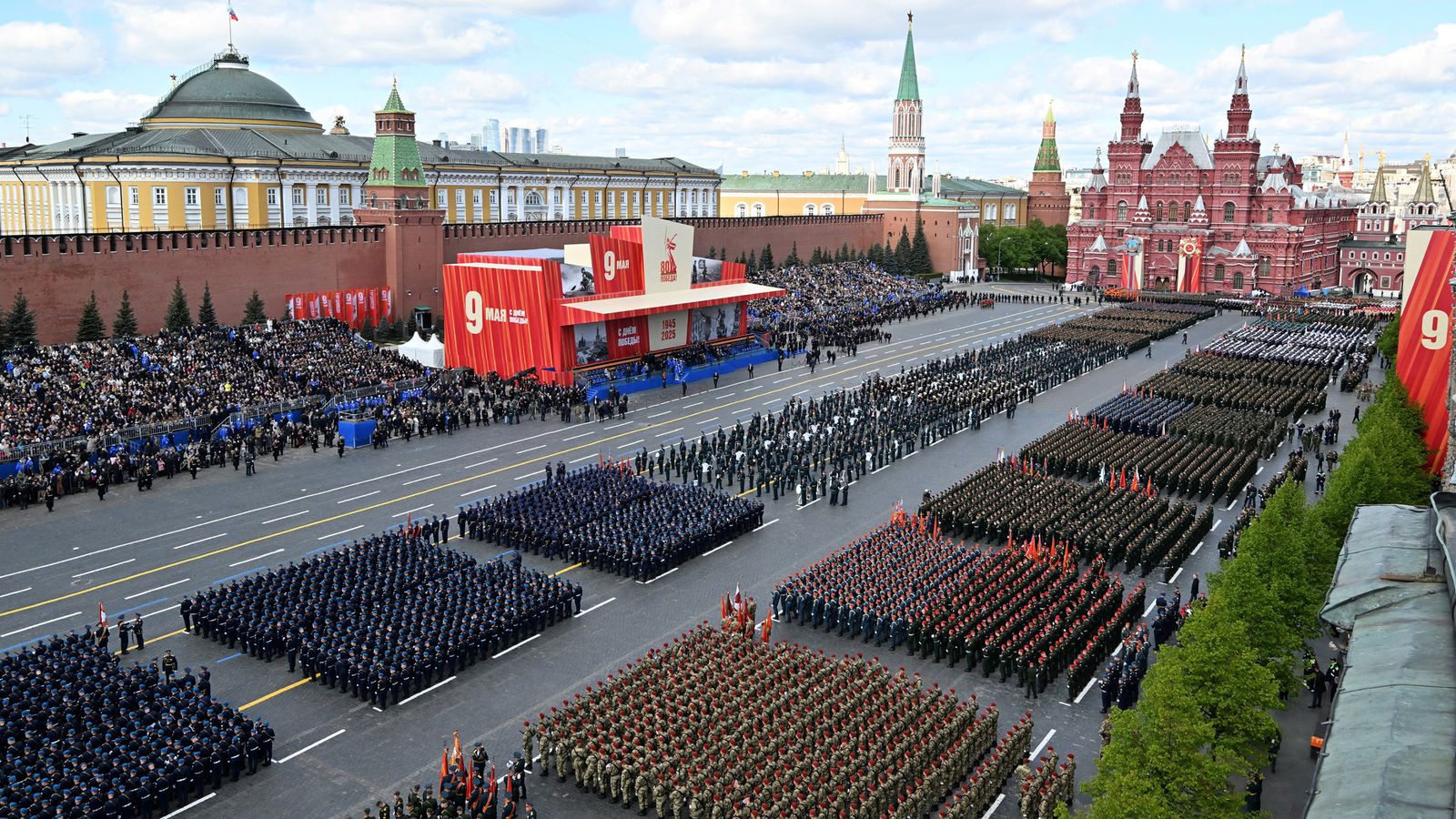
Moscow’s Red Square is traditionally the stage for one of the world’s most imposing displays of military might, but today, May 9, 2026, the atmosphere is markedly different. The annual Victory Day parade, which commemorates the Soviet Union’s triumph over Nazi Germany in World War II, has been significantly diminished in scale, leaving a void where rows of heavy armor and thousands of marching cadets usually stand.
The decision to hold a scaled-back Victory Day parade Moscow residents and global observers are witnessing today comes amid a heightened security environment. The Kremlin has stripped the event of its most signature elements—the heavy military vehicles and the presence of cadets—citing a “terrorist threat” from Ukraine and the pressures of the ongoing conflict.
For a leadership that has long used the May 9 commemorations to project strength and national unity, the absence of tanks and missile launchers on the cobblestones of Red Square marks a pragmatic, if sobering, shift in optics. While the parade proceeded, the focus has moved from a demonstration of “growing defence capability” to a controlled exercise in risk mitigation.
This year’s downsizing is particularly stark when contrasted with the lavish celebrations held just one year ago. In 2025, Russia marked the 80th anniversary of the Nazi defeat with an expansive array of modern weaponry, including drones and tanks, attended by more than 20 world leaders. Today’s event, by comparison, is a lean operation designed to maintain tradition without exposing high-value assets or personnel to potential risk.
Security Concerns and the ‘Operational Situation’
The primary justification for the reduced scale of the festivities is the current security climate. According to the Russian military, the absence of military vehicles and cadets is a direct result of the “current operational situation.” This phrasing underscores the volatility of the conflict in Ukraine, which has now entered its fifth year since the full-scale invasion began.
The Kremlin has been explicit in attributing the scale-back to external threats. Dmitry Peskov, the spokesman for President Vladimir Putin, stated that “all measures are being taken to minimise the danger” in the face of what he described as “terrorist activity” launched by the “Kyiv regime.” Peskov further asserted that the Ukrainian government is “losing ground on the battlefield every day” and has consequently pivoted toward these tactics as reported by the BBC.
This security-first approach reflects a growing vulnerability. Ukraine has recently intensified its long-range strikes deep within Russian territory, targeting military infrastructure and logistics hubs. While Kyiv maintains that it is striking legitimate military targets, Moscow views these actions as a direct threat to its domestic stability and the safety of its high-profile public events.
The Strategic Absence of Heavy Hardware
Since 2008, President Putin has revived the Soviet-era practice of parading heavy military hardware in the heart of Moscow. This tradition was intended to serve as a visual testament to Russia’s modernization and its status as a global military superpower. By removing these assets from the 2026 parade, the Kremlin is acknowledging a shift in the utility of such displays.

The removal of heavy hardware serves two primary purposes:
- Risk Mitigation: Reducing the concentration of high-value military equipment and leadership in a single, predictable location during a period of intensified Ukrainian strikes.
- Resource Allocation: Ensuring that active-duty equipment and personnel remain deployed in operational theaters rather than being diverted for ceremonial duties.
A Legacy of Victory Amidst Modern Conflict
Despite the reduced scale, the essence of Victory Day remains central to the Russian state’s identity. The 2026 parade still included representatives from all branches of the Russian armed forces and featured a “colourful fly-past,” ensuring that the symbolic link to the 1945 victory over Nazi Germany was maintained. The event continues to serve as a primary vehicle for the Kremlin to link current military efforts in Ukraine to the historical struggle of the Great Patriotic War.
However, the contrast between the 80th anniversary in 2025 and the current 2026 event highlights the evolving nature of the war. Last year’s celebrations were a victory lap of sorts, emphasizing global alliances and technological superiority. This year’s event is an exercise in endurance and defensive caution.
The Geopolitical Friction
The rhetoric surrounding the parade reflects the deepening divide between Moscow and Kyiv. While the Kremlin frames the scale-back as a necessary response to “terrorist threats,” Ukraine continues to accuse Moscow of targeting civilians and committing war crimes. This cycle of accusation and escalation has turned a day of historical remembrance into a reflection of contemporary geopolitical friction.
For the global community, the scaled-back nature of the parade is a data point in assessing Russia’s internal security posture. The decision to prioritize “minimising danger” over the traditional display of power suggests a higher level of concern regarding the reach of Ukrainian intelligence and strike capabilities than has been seen in previous years.
What Which means for Future Commemorations
The 2026 Victory Day parade may set a precedent for how Russia handles major public gatherings for the foreseeable future. If the “operational situation” does not stabilize, the Kremlin may continue to prioritize security over spectacle. The shift from a “demonstration of capability” to a “minimization of danger” indicates that the domestic cost of projecting strength has become too high.
Observers will be watching to see if other national holidays or military anniversaries are similarly affected. The psychological impact on the domestic population—seeing a diminished parade in the heart of the capital—could be significant, as it subtly acknowledges the pressures and risks associated with the ongoing “special military operation.”
| Feature | 2025 (80th Anniversary) | 2026 |
|---|---|---|
| Military Hardware | Extensive (Tanks, Drones, Missiles) | None (Removed for security) |
| Personnel | Full contingent including cadets | Representatives of armed forces only |
| International Presence | 20+ World Leaders | Significantly reduced/Not highlighted |
| Primary Objective | Display of global power and modernization | Commemoration with risk mitigation |
| Aerial Component | Full fly-past | Maintained “colourful fly-past” |
As the events of May 9 conclude, the focus returns to the front lines. The scaled-back parade is a vivid reminder that while the history of 1945 remains a cornerstone of Russian national pride, the realities of 2026 are dictated by the immediate and pressing threats of a modern, high-intensity conflict.
The next confirmed checkpoint for the Kremlin’s military communication will be the official updates regarding the progress of the “special military operation” and any subsequent adjustments to national security protocols for public events in the summer months.
We invite our readers to share their perspectives on the shifting nature of these commemorations in the comments below.