
The proposed expansion of the Santiago 1 prison facility, a cornerstone of the Chilean government’s strategy to address systemic overcrowding within the penitentiary system, has hit a significant legal roadblock. The Office of the Comptroller General of the Republic (Contraloría General de la República) has formally declined to “take cognizance” (tomar razón) of a decree issued by the Ministry of Housing and Urbanism (MINVU). This procedural rejection effectively halts the immediate progression of the project, which aims to increase capacity at the high-security complex located in the capital.
For those following the intersection of public policy and urban planning in Chile, this development is more than a bureaucratic delay; it represents a deepening rift between central government authorities and municipal leadership regarding the location and management of correctional infrastructure. The Office of the Comptroller General, acting as the independent oversight body responsible for the legality of administrative acts, has scrutinized the decree, finding that it fails to meet the necessary regulatory requirements to proceed in its current form.
The Regulatory Hurdle and Administrative Friction
The decision by the Contraloría stems from a lack of alignment between the Ministry of Housing’s urban planning instruments and the specific requirements for prison infrastructure development. In the context of the Santiago 1 expansion, the government sought to bypass certain local zoning restrictions to expedite construction. However, the Comptroller’s ruling underscores the necessity for strict adherence to existing urban regulatory frameworks, even when the state argues for the urgency of public security needs.
This institutional friction has exacerbated tensions between Santiago’s municipal leaders and national cabinet members, most notably Minister of Justice and Human Rights Luis Cordero—often referenced in local discourse alongside the broader ministerial team—and the Mayor of Santiago, Mario Desbordes. Desbordes has emerged as a vocal critic of the plan, arguing that the expansion of the facility within the current urban radius is detrimental to the surrounding community. According to reports verified by the Library of the National Congress of Chile, urban planning laws in the Metropolitan Region require rigorous impact assessments for projects of this magnitude, a step that the municipality argues has been insufficient in this case.
Political Standoff: Urban Planning vs. Security Mandates
The dispute has evolved into a high-stakes political debate. Mayor Desbordes has publicly challenged the administration’s narrative, specifically questioning the assertion that Notice no suitable alternative locations for the expansion. His position centers on the argument that the current urban density of the Santiago 1 area makes it an inappropriate site for further correctional growth. He has repeatedly called for the government to consider sites outside the city’s dense residential and commercial zones, citing the potential for negative externalities on local neighborhoods.
The Ministry of Justice, however, maintains that the expansion is critical to maintaining order within the penal system. As of early 2024, the Gendarmería de Chile—the national prison service—reported that inmate populations in the Metropolitan Region have reached record levels, necessitating immediate interventions to prevent further instability. The government’s attempt to use a special decree was intended to circumvent the lengthy standard permitting processes that typically stall infrastructure projects in Chile for years.
Key Stakeholders and Community Impact
The local population remains divided on the issue. While some community organizations express concern over safety and the potential for increased traffic and security presence, others acknowledge the necessity of a functioning, non-overcrowded prison system to prevent criminal spillover into the streets. The “El Arenal” site, often mentioned in local media as a potential point of contention for related projects, serves as a focal point for these debates, illustrating the difficulty of balancing national security needs with local urban livability.
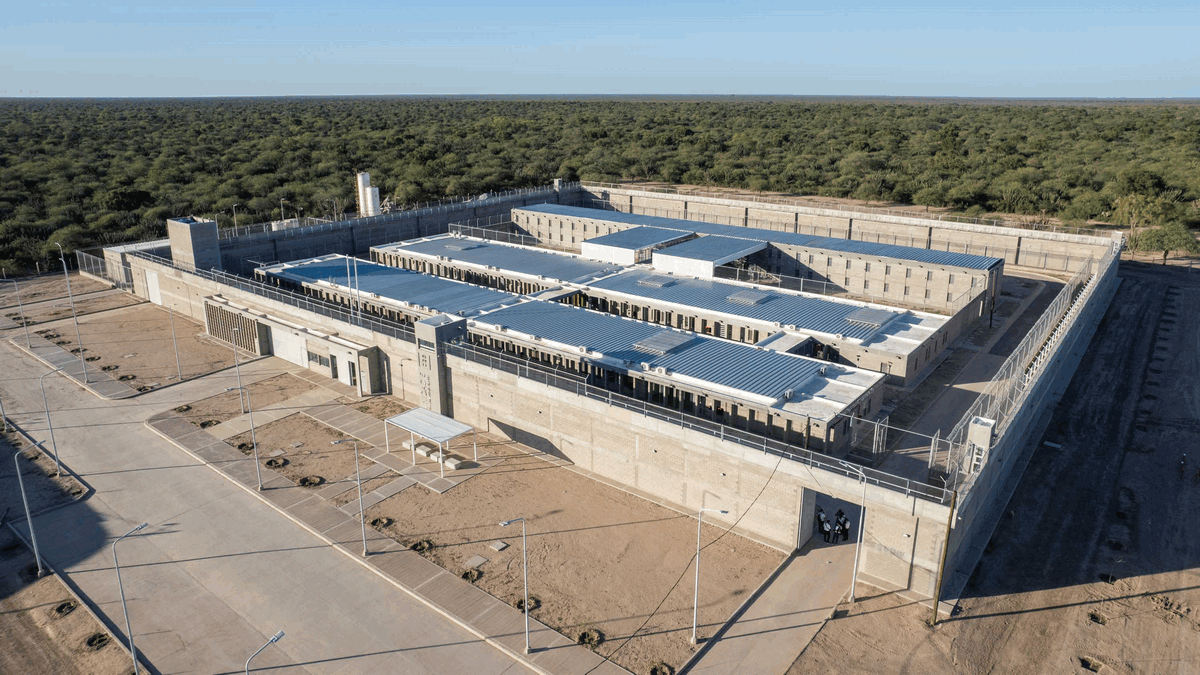
- The Government Position: The Ministry of Justice argues that the expansion is a “state necessity” (necesidad de estado) to combat overcrowding and improve security protocols.
- The Municipal Position: Mayor Desbordes and municipal representatives argue that the project violates urban density regulations and risks the long-term quality of life for Santiago residents.
- The Oversight Role: The Contraloría serves to ensure that no administrative decree violates the principle of legality, regardless of the perceived urgency of the underlying policy.
For citizens and stakeholders, the next stage of this process is critical. The Ministry of Housing and the Ministry of Justice must now decide whether to amend the decree to satisfy the Comptroller’s observations, re-submit the proposal with additional documentation, or abandon the current plan in favor of a new site selection process. The Ministry of Housing and Urbanism (MINVU) has not yet released a formal timeline for a revised submission, but the legal requirement remains that any future attempt must undergo the same rigorous oversight process.
Looking Ahead: The Path to Resolution
As the situation stands, the project is in a state of limbo. The government is expected to engage in further discussions with municipal authorities to find a compromise, though the public nature of the disagreement suggests that a quick resolution is unlikely. Observers are now looking toward the next scheduled session of the relevant legislative committees and any subsequent announcements from the Executive branch regarding potential site alternatives.
Readers interested in tracking the legal progress of this decree can monitor the Contraloría’s official database of rulings, where the specific observations regarding the MINVU decree will be cataloged once they are finalized for public record. We will continue to follow this story as it develops, providing updates on the legal and political maneuvers that will ultimately determine the future of the Santiago 1 facility.
What are your thoughts on balancing urban development with the urgent need for prison reform? We invite our readers to share their perspectives in the comments section below as we continue to track this evolving story.