Beyond the Iron: How AI Data Centers and Automation are Driving Caterpillar to Record Highs
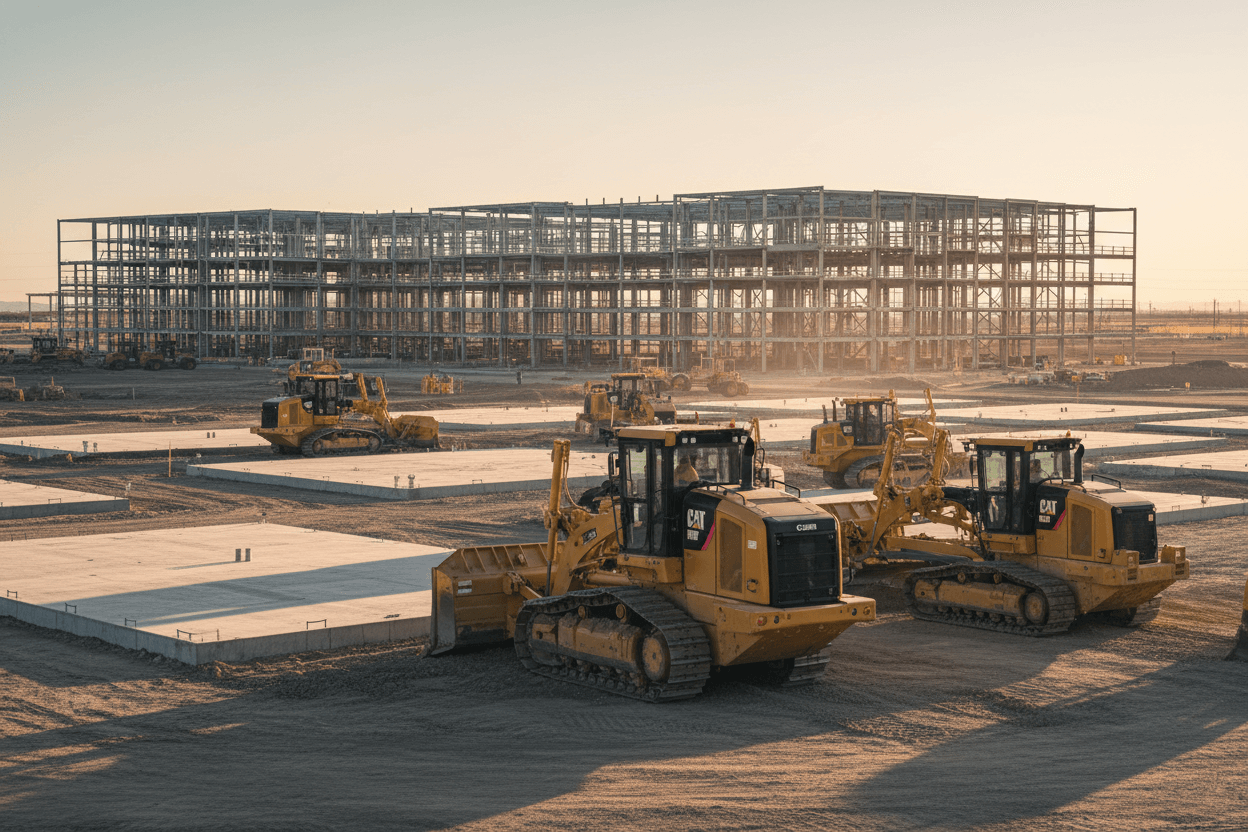
For decades, the image of Caterpillar Inc. (CAT) was defined by heavy, yellow steel—massive excavators and bulldozers churning through earth on construction sites and mining pits. However, a fundamental shift is occurring in the market’s perception of this industrial titan. As the artificial intelligence (AI) revolution accelerates, Caterpillar is no longer being viewed solely as a traditional heavy machinery manufacturer; it is increasingly being recognized as a critical infrastructure provider for the digital age.
The company’s stock has recently flirted with record highs, a phenomenon that has caught the attention of investors who typically look toward semiconductor or software firms to play the AI trend. This surge is not driven by software code, but by the physical reality of the AI boom: the staggering demand for massive, reliable power infrastructure and the increasing necessity of autonomous, data-driven heavy equipment.
Caterpillar is currently navigating a “perfect storm” of industrial tailwinds. On one side, the exponential growth of generative AI is forcing a massive expansion of global data center capacity. On the other, the push for operational efficiency in mining and construction is driving a rapid transition toward automation and digitalization. By positioning itself at the intersection of these two trends, Caterpillar is proving that the “old economy” is becoming indispensable to the “new economy.”
The Power Behind the Intelligence: Data Centers and Energy Solutions
While the headlines of the AI era focus on GPUs and large language models, the underlying physical requirement is much simpler: electricity. AI workloads are notoriously energy-intensive, requiring data centers to operate at much higher power densities than traditional cloud computing facilities. This surge in demand has created a critical need for sophisticated power management and, crucially, massive backup power systems to ensure “five-nines” (99.999%) reliability.
This is where Caterpillar’s Energy & Transportation segment has become a silent beneficiary of the tech boom. Caterpillar provides high-capacity diesel and gas-powered reciprocating engines and generator sets that serve as the backbone of data center backup power. As hyperscalers like Microsoft, Google, and Amazon expand their physical footprints to accommodate AI training and inference, the demand for Caterpillar’s heavy-duty power solutions has scaled accordingly.
The transition toward “microgrids”—localized energy systems that can manage various power sources—is another area where Caterpillar is finding significant traction. These systems are essential for data centers looking to integrate renewable energy sources while maintaining the absolute stability required for high-performance computing. The company’s ability to provide integrated power solutions, rather than just standalone engines, has solidified its role in the AI supply chain.
The Rise of ‘Smart Iron’: Automation and Autonomous Mining
Beyond the power grid, Caterpillar is undergoing a technological metamorphosis within its core product lines. The industry is moving away from purely mechanical machines toward “smart iron”—equipment that is integrated with sensors, IoT connectivity, and AI-driven decision-making software. This shift is most visible in the mining sector, where Caterpillar has long been a leader in Autonomous Haulage Systems (AHS).
Autonomous mining is no longer a futuristic concept; it is a commercial reality. Caterpillar’s autonomous trucks can operate 24/7 with precision that often exceeds human capability, optimizing fuel consumption, reducing tire wear, and significantly enhancing site safety by removing operators from hazardous environments. These machines rely on a complex stack of technologies, including high-precision GPS, LiDAR, and sophisticated edge computing to navigate and interact with their surroundings in real-time.
This digitalization extends to “site intelligence.” Through platforms like Cat MineStar, the company provides operators and fleet managers with real-time data analytics. This allows for predictive maintenance—identifying a potential component failure before it causes an unscheduled shutdown—and optimized dispatching, which ensures that every piece of equipment is working at peak efficiency. For mining companies facing fluctuating commodity prices and rising labor costs, this level of automation is not just a luxury; it is a requirement for long-term competitiveness.
Comparing Traditional vs. Modern Caterpillar Operations
| Feature | Traditional Model | Modern (AI/Digital) Model |
|---|---|---|
| Primary Value | Mechanical Durability | Operational Intelligence |
| Operator Role | Manual Control | Remote Monitoring/Supervision |
| Maintenance | Reactive (Fix when broken) | Predictive (Data-driven) |
| Data Usage | Minimal/Mechanical | Extensive (IoT & Edge AI) |
Financial Implications: A New Class of Investor
The market’s reaction to Caterpillar’s strategic pivot is reflected in its financial metrics and investor profile. Traditionally viewed as a cyclical stock—highly sensitive to the ebbs and flows of the global construction and mining sectors—Caterpillar is seeing a diversification of its revenue streams. The stability provided by long-term service contracts and recurring software-as-a-service (SaaS) revenue from its digital platforms is beginning to offset the volatility of pure hardware sales.
Market analysts have noted that the company’s ability to maintain strong margins despite inflationary pressures is partly due to this high-value technological integration. As Caterpillar embeds more software and intelligence into its machines, it moves higher up the value chain, commanding premium pricing that is less susceptible to the commoditization seen in standard heavy equipment.
the stock’s performance has been bolstered by robust earnings reports that highlight strength in the Energy & Transportation segment. For investors, Caterpillar now represents a unique “hedge” play: a way to gain exposure to the massive infrastructure requirements of the AI boom without the extreme volatility often associated with pure-play semiconductor stocks.
The Macro Trend: Digitalization as a Survival Mechanism
Caterpillar’s trajectory is emblematic of a broader trend across the global industrial landscape. We are witnessing a massive wave of “industrial digitalization” where legacy manufacturers are investing heavily in software and automation to secure their future. This is not merely about adding gadgets to machines; it is a fundamental re-engineering of how industrial value is created and delivered.
The drivers for this shift are clear:
- Labor Shortages: A global shortage of skilled heavy equipment operators is making automation a necessity for project continuity.
- Efficiency Mandates: In an era of tightening margins, the ability to squeeze a few percentage points of efficiency out of a fleet through data optimization is worth millions of dollars.
- Sustainability Goals: Digitalization allows for better fuel management and optimized engine performance, helping companies meet increasingly stringent ESG (Environmental, Social, and Governance) targets.
As traditional manufacturers like Caterpillar, Komatsu, and John Deere race to lead this digital frontier, the winners will be those who can successfully bridge the gap between rugged, mechanical reliability and sophisticated, data-driven intelligence.
Key Takeaways
- Dual Growth Engines: Caterpillar is benefiting from both the AI-driven demand for data center power and the industrial demand for autonomous machinery.
- Infrastructure Essentiality: The company has moved from being a “builder” to a “provider” of critical digital infrastructure.
- Margin Expansion: Digital services and high-tech power solutions provide higher-margin, more stable revenue streams than traditional hardware alone.
- Market Re-rating: Investors are beginning to value Caterpillar not just as a cyclical industrial, but as a tech-adjacent infrastructure play.
The next major checkpoint for Caterpillar will be its next quarterly earnings announcement, where analysts will be looking closely at segment-specific growth in Energy & Transportation and the adoption rates of its autonomous and digital service platforms. As the AI era matures, the companies providing the physical foundation for this digital world will likely remain at the center of the global economy.
What do you think about the convergence of heavy industry and AI? Is Caterpillar a legitimate tech play, or is it still just a machinery company? Let us know in the comments below and share this article with your network.