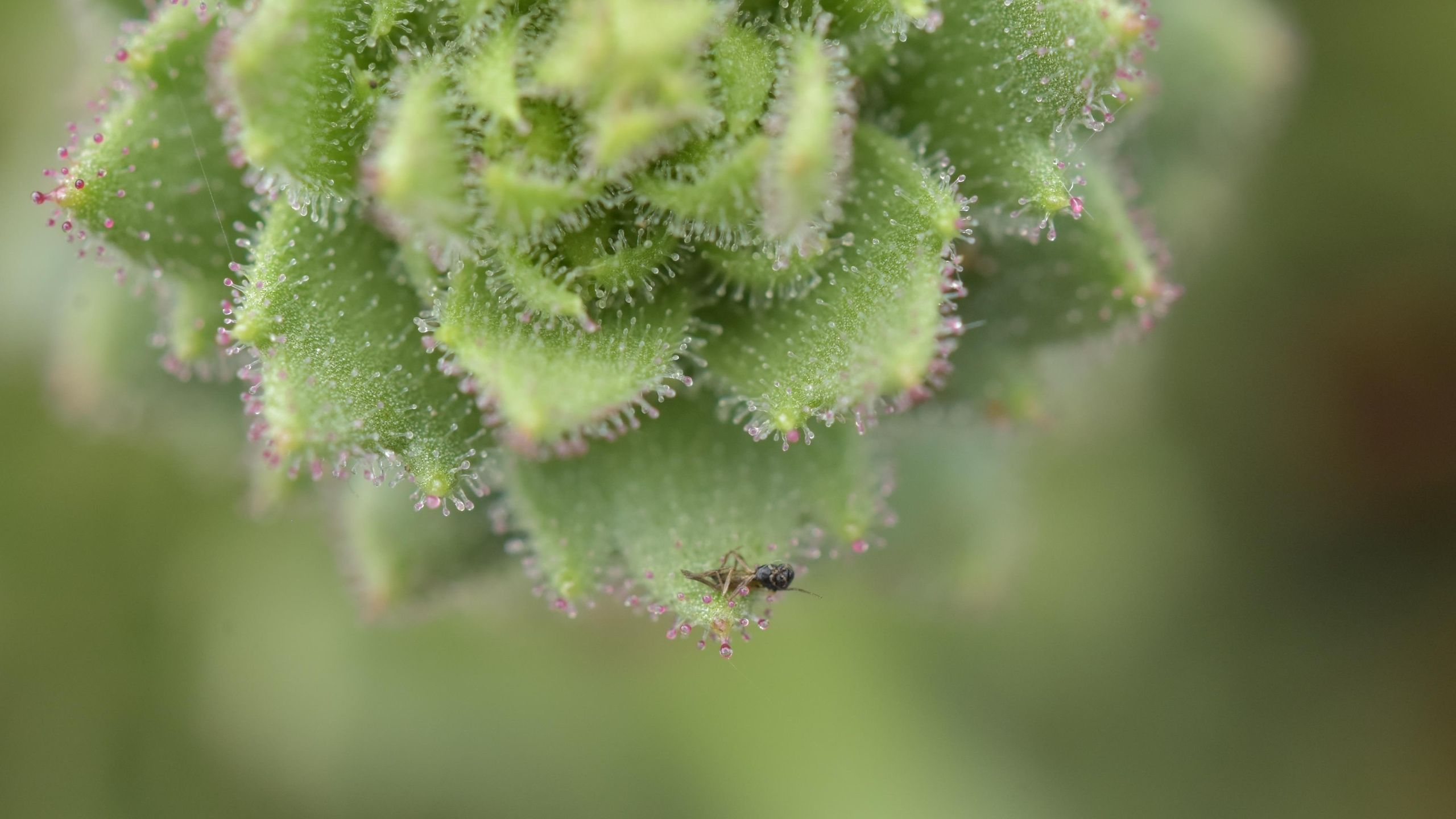
Scientists have confirmed that the alpine flowering plant Saxifraga candelabrum is carnivorous, resolving a 150-year-old botanical mystery first proposed by Charles Darwin in 1875. Researchers published findings in Nature Communications showing the species traps, digests, and absorbs nutrients from insects using modified glandular hairs in nitrate-poor soils.
Charles Darwin suspected that certain alpine flowering plants supplemented their diets by catching insects on sticky leaf hairs, but 19th-century science lacked the tools to prove it. More than a century later, an international research team has settled the question. Botanists confirmed that Saxifraga candelabrum is fully carnivorous, marking the first demonstrated case of plant carnivory within the saxifrage group.
Testing Darwin’s 1875 Hypothesis on the Qinghai-Tibet Plateau
The species grows at elevations above 8,200 feet in the Hengduan Mountains, a rugged terrain connecting the southeastern Tibetan Plateau to the Yunnan-Guizhou Plateau in China. In 1875, Darwin theorized that related species possessing sticky glandular hairs—specifically Saxifraga rotundifolia and Saxifraga umbrosa—might consume trapped insects. However, he could never demonstrate that the plants actually digested prey and absorbed those nutrients.
Without proof of digestion and nutrient absorption, a plant is typically classified only as protocarnivorous
, meaning it catches and kills insects or other small animals without processing them for sustenance. Researchers set out to cross that scientific threshold with S. candelabrum.
Field observations and herbarium surveys conducted by the study team revealed that insect trapping is remarkably common across the population. Surveys of existing plant samples showed that 43 out of 45 specimens had insect prey stuck to their glandular hairs. Mature plants displayed an average of 71 trapped insects, predominantly nonbiting midges caught on the viscous secretions of the stems and branches.
Enzymes, Stable Isotopes, and Genetic Analysis
Proving active carnivory required moving beyond counting trapped bugs. The researchers deployed multidisciplinary evidence to track how the plant handles its prey. First, they used fluorescence tagging to visualize phosphatase activity—a digestive enzyme widely found in carnivorous species—glowing under a specialized microscope. This confirmed the plant secretes the necessary chemistry to break down organic matter.
To verify actual nutrient uptake, the team fed fruit flies labeled with a stable isotope of nitrogen to the plants. This led to a marked rise in stable nitrogen levels within S. candelabrum and a known carnivorous control species. A non-carnivorous control plant showed no such increase, proving the botanical host absorbs nutrients straight from digested insects.
“Although untested at the time, Darwin’s hypothesis provided an important inspiration for our study.”
Hang Sun, researcher in the Chinese Academy of Sciences’ Kunming Institute of Botany
Genetic sequencing reinforced the physiological and isotopic findings. The analysis uncovered genes shared with other independently evolved carnivorous plants, specifically those responsible for prey attraction, enzymatic digestion, and nutrient assimilation.
Evolutionary Trade-Offs in Nitrate-Poor Alpine Soils
Most carnivorous plants thrive in wet, boggy environments like peat bogs and marshes. Saxifraga candelabrum carved out a different ecological niche by adapting to dry, high-altitude stone crevices.
According to study co-author Douglas Soltis, a distinguished professor of biology at the Florida Museum of Natural History, these are all nitrate poor soils—that’s why this carnivorous habit has evolved a number of times
to supply vital nutrients missing from the local dirt. The plant converted defenses originally designed to deter herbivores into active insect traps.
Evolution also preserved a delicate ecological balance. Larger insects required for pollination rarely get stuck in the sticky secretions, ensuring the plant can feed on midges without sabotaging its own reproduction.
Broader Implications for Plant Biology
Researchers suggest this discovery may redefine how common plant carnivory is across alpine families. Because other genera within the Saxifragaceae family also feature sticky glandular hairs covered in insects, further investigation could uncover additional carnivorous lineages.
“I would not be surprised if other members of the family are also carnivorous — as Darwin predicted.”
Douglas Soltis, distinguished professor of biology at the Florida Museum of Natural History
The findings were published in the journal Nature Communications by authors including Xin-Jian Zhang, Tao Deng, Ning Lin, and their colleagues, validating a century-and-a-half-old scientific hunch about the resourcefulness of alpine flora.
Keep reading