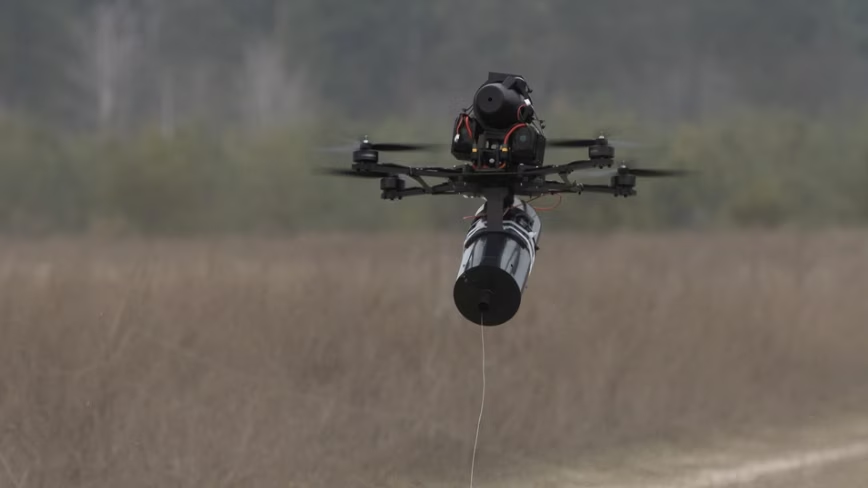
Prague-based technology company Neuron Soundware has developed an artificial intelligence-powered acoustic monitoring system designed to detect unmanned aerial vehicles (UAVs) by identifying the unique sound signatures of their engines. The system, which the company calls Sound Shield, utilizes microphone sensors priced between €100 and €150 per unit to provide a passive, low-cost alternative to traditional radar-based drone detection methods, according to company documentation. The startup is currently focusing its deployment strategy on protecting critical energy infrastructure, including power grids, from unauthorized drone incursions.
As unmanned aerial vehicles become increasingly common in both commercial and private sectors, concerns regarding the security of sensitive facilities have intensified. Traditional radar systems, while effective, often involve significant capital expenditure and complex installation requirements. By leveraging machine learning to differentiate the specific acoustic frequencies produced by drone rotors from background environmental noise, Neuron Soundware aims to offer a scalable solution for monitoring low-flying objects over urban centers, industrial sites, and government installations.
Acoustic Detection as a Passive Security Alternative
The primary advantage of the Sound Shield technology lies in its reliance on passive sensors rather than active radio frequency emissions. Active radar systems are often detectable and can be susceptible to interference, whereas acoustic sensors listen for vibrations in the air without transmitting signals. According to the company’s technical specifications, the system’s AI models are trained to recognize the distinct audio profiles of various drone models, allowing for identification even in environments with high levels of ambient noise. This capability is particularly relevant for the protection of electrical substations and high-voltage power lines, which are often targets for security monitoring due to their role in regional stability.

The hardware architecture centers on low-cost microphones that can be deployed in a distributed network. By placing these sensors in a mesh configuration, the system can triangulate the position of a drone based on the time-of-arrival difference of the sound waves reaching each unit. This approach reduces the cost of coverage compared to high-end radar, which typically requires line-of-sight and expensive specialized hardware. The company notes that its software can be integrated into existing security platforms, allowing facility managers to receive real-time alerts when a drone enters a pre-defined perimeter.
Focusing on Infrastructure and Grid Stability
Neuron Soundware’s decision to prioritize power grids for its initial rollout addresses a critical vulnerability in modern utility management. Power infrastructure is often spread across vast, remote areas, making constant physical surveillance difficult and expensive. Acoustic sensors offer a way to create a “virtual fence” around these assets. Because the sensors are relatively inexpensive at the €100–€150 price point, utility operators can theoretically deploy them at a high density, ensuring that even small, low-flying drones cannot approach critical equipment undetected.

The application of AI in this context is not limited to simple detection. The software is designed to minimize false positives—a common issue in acoustic monitoring where wind, traffic, or wildlife might be mistaken for a drone’s motor. By continuously updating its machine learning library with new sound signatures, the system attempts to maintain high accuracy rates in diverse acoustic environments. This adaptability is essential for long-term deployments where environmental conditions change seasonally.
Comparative Limitations and Future Integration
While acoustic detection offers cost efficiency, industry experts note that it faces limitations that radar does not. Acoustic systems are inherently affected by atmospheric conditions, such as wind speed and temperature gradients, which can distort sound travel. Furthermore, the range of an acoustic sensor is limited by the sound pressure level of the drone’s motors; very quiet drones may prove difficult to detect until they are in close proximity. Consequently, many security architects suggest that acoustic systems serve best as one layer of a multi-modal security strategy, potentially paired with optical cameras or radio frequency (RF) analyzers.
The company has indicated that its roadmap includes further refinements to the sensor’s range and signal processing capabilities. As regulatory frameworks regarding drone operations continue to evolve, the demand for passive detection tools is expected to grow, particularly in jurisdictions where the use of active jamming or radar is restricted. For facility operators, the next milestone for this technology will be the publication of long-term field performance data from current pilot projects at utility sites. Interested stakeholders can monitor the startup’s official updates through their corporate communications portal for details on upcoming hardware iterations and pilot program results.
For further information on drone detection trends and regulatory updates, readers are encouraged to visit the official website of the European Union Aviation Safety Agency (EASA), which provides comprehensive guidelines on drone operations and security protocols across Europe.
Keep reading