
For the past few years, the global conversation around artificial intelligence has been dominated by a binary of extremes: the utopian promise of a post-labor society or the dystopian fear of an algorithmic takeover. But as a physician and journalist, I have observed a more subtle, perhaps more insidious, shift occurring not in our infrastructure, but in our synapses. We are currently navigating a transition where the tools we use to enhance our intelligence may, if left unchecked, begin to replace the extremely processes that make us sentient.
This tension is the central theme of the discourse surrounding AI and human cognition. It is a question of whether we are using generative AI to “think better” or simply to “stop thinking.” When we outsource our critical analysis, our memory, and our creative synthesis to a large language model, we aren’t just saving time; we are potentially altering the architecture of our minds. The risk is not that AI will become sentient and overthrow us, but that we will become so reliant on it that we surrender our cognitive agency—effectively putting our minds on “borrowed” status.
The danger is rarely a sudden crash. Instead, it resembles the “boiling frog” syndrome: a gradual increase in reliance that feels comfortable in the moment but leads to a systemic decline in ability over time. In the medical field, we call this a loss of clinical intuition; in the broader world, it is a crisis of cognitive autonomy. To understand how to avoid this trap, we must look at the intersection of innovation theory, cognitive science, and the growing movement toward digital mindfulness.
The Paradox of Cognitive Offloading: Efficiency vs. Erosion
In psychology, “cognitive offloading” is the use of physical action to reduce the mental effort required to perform a task. Writing a phone number on a piece of paper or using a GPS to navigate a city are classic examples. For decades, this has been a survival mechanism that allows humans to free up mental bandwidth for higher-order problem solving. However, the scale and nature of offloading provided by generative AI are fundamentally different from a notepad or a map.

When we use AI to summarize a complex medical paper or draft a strategic memo, we are not just offloading the execution of the task; we are often offloading the synthesis. The act of struggling with a difficult text is where learning happens. It is where the brain forms new connections and integrates new information into existing knowledge maps. By bypassing the struggle, we bypass the growth. This creates a “borrowed” intelligence—the output looks sophisticated, but the intellectual capacity to produce that output independently begins to atrophy.
This phenomenon is closely linked to what researchers call “digital amnesia” or the “Google Effect,” where the brain chooses to forget information that it knows can be easily found online. As AI becomes the primary interface for information, the risk extends beyond simple facts to the loss of critical thinking and the ability to hold contradictory ideas in one’s mind simultaneously. We risk moving from a state of cognitive enhancement to one of cognitive surrender.
AI “Brain Fry” and the Workplace Crisis
The impact of this shift is already manifesting in the professional world, particularly in high-stakes corporate environments. While AI is marketed as a cure for burnout, emerging data suggests it may be creating a new form of psychological exhaustion. A study conducted by the Boston Consulting Group (BCG) explored the impact of AI on professional performance, noting that while AI can significantly boost productivity for certain tasks, it can also lead to a decrease in accuracy when users over-rely on the tool without sufficient critical oversight.
This “AI brain fry” occurs when the human-in-the-loop stops actually thinking and starts merely auditing. The cognitive load shifts from the creative act of generation to the tedious act of verification. When workers are overwhelmed by the volume of AI-generated content, they often experience decision overload. This leads to a paradoxical result: the tool designed to save time increases the rate of errors and contributes to a sense of alienation from one’s own work, sometimes leading to increased intentions to leave the workforce.
In healthcare, this is particularly perilous. The patient-physician relationship relies on “clinical gaze”—the ability of a doctor to synthesize a patient’s history, physical symptoms, and subtle non-verbal cues into a diagnosis. If a clinician relies solely on an AI-generated summary of a patient’s chart, they may miss the nuance that leads to a life-saving discovery. The human in the loop is only valuable if they are actively engaging their cognitive faculties; otherwise, they are merely a rubber stamp for an algorithm.
Reclaiming Agency: From User to Author
If the trajectory of AI adoption leads toward cognitive surrender, how do we pivot toward cognitive agency? The answer lies in becoming “authors” of our own minds rather than passive consumers of algorithmic output. This requires a shift in how we view AI: not as a superpower that replaces human effort, but as a scaffold that supports it.
To maintain mental sharpness, we must intentionally introduce “productive friction” back into our lives. Which means choosing to solve a problem manually before asking an AI for the answer, or writing a first draft by hand to engage the brain’s motor and cognitive pathways before using AI for polishing. By treating AI as a collaborator rather than a surrogate, we ensure that the “human in the loop” remains the dominant intelligence.
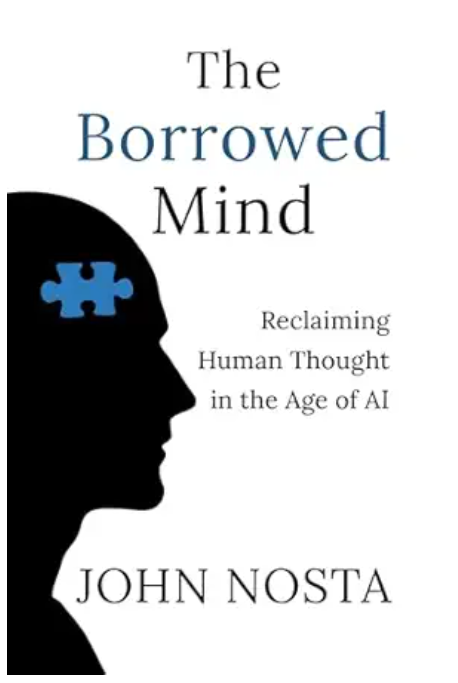
This approach mirrors the philosophy found in John Nosta’s work, *The Borrowed Mind: Reclaiming Human Thought in the Age of AI*, where the emphasis is placed on the necessity of intellectual rigor. The goal is to use AI to fill “cracks in knowledge maps” and support lifelong learning, rather than allowing the AI to draw the map for us. When we use technology to liberate our minds from rote tasks so One can engage in deeper, more complex ideation, we are practicing cognitive offload. When we use it to avoid the effort of thinking entirely, we are practicing cognitive surrender.
The Necessity of the “Offline Club” and Digital Detox
Beyond the tactical use of AI, there is a systemic need for digital detoxing to preserve brain health and longevity. The constant stream of algorithmic stimulation—from social media feeds to AI assistants—keeps the brain in a state of high-frequency, low-depth engagement. This fragmented attention span is the antithesis of the “deep work” required for true innovation and emotional connection.
There is a growing global movement toward “offline” living, emphasizing face-to-face socialization and the reclamation of analog spaces. Whether through structured retreats or simple daily boundaries, stepping away from the digital interface allows the brain to enter the “default mode network,” a state associated with creativity, self-reflection, and the processing of complex emotions. For those of us focused on longevity, this is as critical as diet and exercise. We must consider our “joyspan”—the quality and frequency of genuine, unaugmented human connection—as a primary metric of health.
The intersection of brain health and AI requires us to be mindful of our “cognitive diet.” Just as we monitor the nutrients we put into our bodies, we must monitor the quality of the intellectual inputs we allow into our minds. A diet of purely AI-generated summaries and algorithmic recommendations leads to a malnourished intellect. A balanced diet includes challenging books, difficult conversations, and the silence required for independent thought.
Practical Strategies for Mindful AI Integration
For professionals and individuals seeking to leverage AI without sacrificing their cognitive agency, I recommend the following framework for “Mindful Integration”:
- The “First-Draft” Rule: Always attempt to outline or conceptualize a project independently before engaging an AI. This ensures the core logic and creative direction originate from your own cognition.
- Active Verification: Treat every AI output as a hypothesis, not a fact. The act of verifying a claim via a primary source is a cognitive exercise that prevents the “boiling frog” effect.
- Scheduled Analog Windows: Designate “AI-free zones” in your day and week. Use these times for deep reading, strategic thinking, or personal connection without the mediation of a screen.
- Cognitive Stretching: Regularly engage in activities that AI cannot replicate—such as learning a new physical skill, engaging in complex debate, or practicing mindfulness meditation—to maintain neuroplasticity.
Key Takeaways for the AI Era
- Cognitive Offload vs. Surrender: Use AI to handle routine tasks (offload) but never to replace critical synthesis or moral judgment (surrender).
- The Human-in-the-Loop: The value of human oversight is zero if the human is not actively thinking and questioning the output.
- Digital Detox: Intentional offline time is essential for brain health, creativity, and the maintenance of deep social bonds.
- Intellectual Authorship: Strive to be the author of your thoughts, using AI as a tool for refinement rather than a source of origin.
Looking Ahead: The Future of Human Intelligence
As we move further into the era of generative AI, the divide between those who are “borrowed” and those who are “agentic” will likely become a defining characteristic of professional and personal success. The ability to think critically, synthesize complex information independently, and maintain deep focus will become rare and highly valuable skills in a world of automated mediocrity.
The goal is not to reject AI—which would be an exercise in futility—but to integrate it with a sense of cautious intentionality. We must be like Michelangelo, who saw the statue already inside the stone and used his tools to liberate it. Similarly, we should use AI to liberate our highest human capacities—empathy, complex ethics, and visionary creativity—rather than letting the tools carve us into something simpler and more predictable.
The next major milestone in this conversation will likely be the implementation of more robust regulatory guardrails regarding AI in healthcare and education, as governments grapple with how to protect cognitive autonomy in the classroom and the clinic. We can expect further updates from bodies such as the World Health Organization (WHO) and various national health ministries as they refine guidelines for the ethical use of AI in clinical decision-making.
We want to hear from you: Have you noticed a change in how you approach problem-solving since integrating AI into your workflow? Do you feel more empowered, or do you feel a sense of cognitive fatigue? Share your experiences in the comments below and join the conversation on how we can reclaim our minds in the age of algorithms.