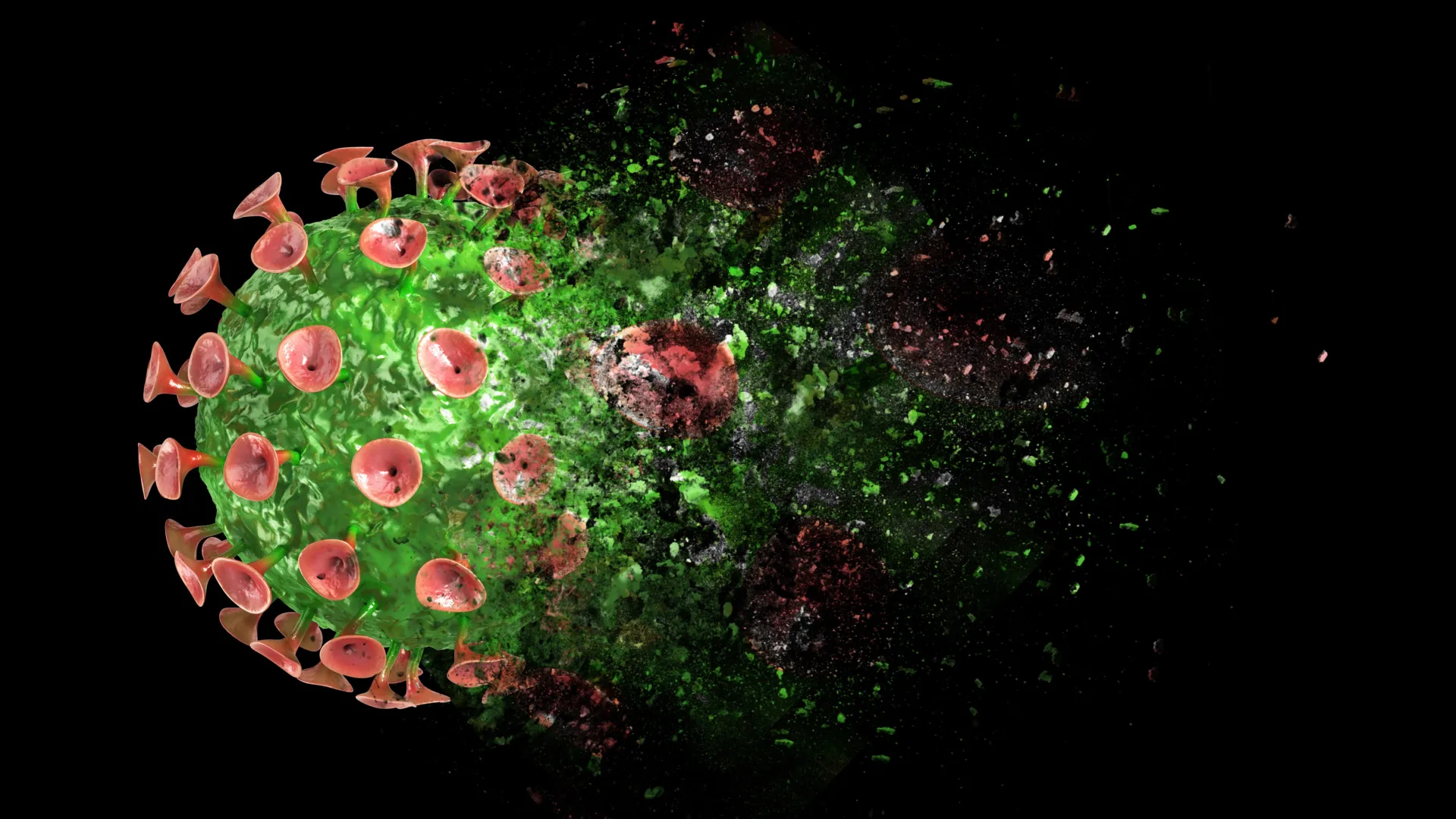
Blocking Viral Entry: A Novel Antiviral Strategy Using AI and Molecular Simulations
For decades, developing effective antiviral therapies, particularly for widespread viruses like herpes, has proven remarkably challenging. A recent breakthrough from Washington State University researchers offers a promising new direction: identifying and disrupting a critical molecular interaction that allows viruses to enter cells, effectively preventing infection. This research, published in Nanoscale, leverages the power of artificial intelligence and detailed molecular simulations to pinpoint a key vulnerability in viral fusion proteins.
The Challenge of Viral Entry
Viruses are masters of cellular invasion. The process isn’t random; it relies on a complex series of interactions between viral proteins and host cell receptors.However, not all interactions are created equal. Many are inconsequential “background noise,” while a select few are absolutely critical for the virus to successfully merge with and enter a cell – a process known as viral fusion. understanding this fusion process is paramount to developing effective antiviral strategies, but the sheer complexity of the proteins involved has historically hindered progress.
Herpes viruses, in particular, utilize a large and intricate fusion protein.The subtle conformational changes this protein undergoes to facilitate cell entry have remained largely elusive, contributing to the difficulty in creating broadly effective vaccines and treatments. Conventional experimental methods, while valuable, are incredibly time-consuming. Testing even a single potential interaction can take months, making a systematic approach to identifying crucial vulnerabilities impractical.
AI-Powered Finding: Pinpointing the Critical weakness
The WSU team, comprised of researchers from the School of Mechanical and Materials engineering and the Department of Veterinary Microbiology and Pathology, adopted a novel strategy. They harnessed the capabilities of artificial intelligence and advanced molecular simulations to accelerate the discovery process.
Professors Prashanta Dutta and Jin Liu developed an algorithm to analyse thousands of potential interactions between amino acids – the fundamental building blocks of proteins – within the viral fusion protein. Machine learning techniques were then applied to sift through this vast dataset, identifying the interactions most likely to be essential for viral entry. This computational approach dramatically narrowed the field, focusing experimental efforts on a single, highly promising target.
“Viruses are very smart, and the whole process of invading cells is very complex,” explains Professor Liu. “The use of simulations and machine learning was essential because experimentally testing even a single interaction can take months. Narrowing down the most critically important interaction ahead of time made the experimental work far more efficient.”
Experimental Validation: Blocking Viral Fusion
Following the AI-driven prediction, the research team, led by Anthony Nicola, conducted laboratory experiments to validate their findings. They introduced a targeted mutation to the identified key amino acid within the viral fusion protein. The results were striking: the mutated virus was unable to successfully fuse with cells, effectively blocking its ability to infect. This confirmed the critical role of this specific interaction in the viral entry process.
This success demonstrates the power of combining computational modeling with experimental validation. As Professor Liu notes, “It was just a single interaction from thousands of interactions. If we don’t do the simulation and instead did this work by trial and error, it coudl have taken years to find. The combination of theoretical computational work with the experiments is so efficient and can accelerate the discovery of these important biological interactions.”
Future Directions and Implications for Antiviral Advancement
While this research represents a important step forward, several questions remain. The team is now focused on understanding how the identified mutation impacts the overall structure and function of the viral fusion protein. They plan to continue utilizing simulations and machine learning to map the ripple effects of this small molecular change at larger scales.
“There is a gap between what the experimentalists see and what we can see in the simulation,” Professor Liu explains. “The next step is how this small interaction affects the structural change at larger scales. That is also very challenging for us.”
This research not only provides a potential new target for antiviral therapies but also showcases a powerful methodology for accelerating drug discovery. By leveraging the capabilities of AI and molecular simulations,scientists can efficiently navigate the complexities of viral mechanisms and identify critical vulnerabilities that would or else remain hidden. This approach holds promise for developing effective treatments against a wide range of viral infections, offering a beacon of hope in the ongoing fight against viral diseases.
Frequently Asked Questions (FAQ)
1. How does this research differ from traditional antiviral development? Traditional antiviral development often relies on extensive trial-and-error experimentation. This study utilizes artificial intelligence and molecular simulations to predict critical viral interactions, substantially accelerating the discovery process and focusing experimental efforts on the most promising targets.
2. What is “viral fusion” and why is it critically important to block? Viral fusion is the process by which a virus merges with a host cell, allowing it to enter and begin replicating. Blocking viral fusion prevents the virus from infecting cells, effectively stopping the spread of the disease. It’s a crucial step in the viral lifecycle to interrupt.
3. Can this research lead to a new herpes virus vaccine? While this research doesn’t directly create a vaccine,
Related reading