
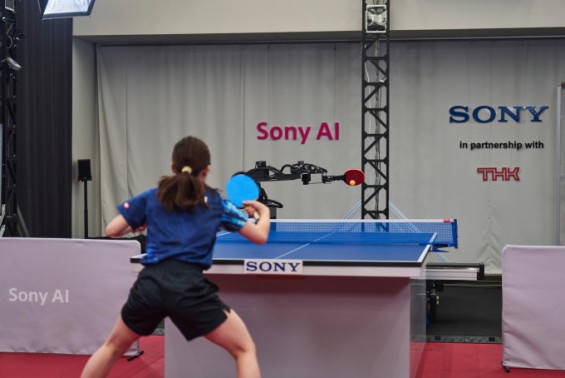
On April 23, 2026, Sony AI announced that its table tennis robot, named ‘Ace,’ had defeated human professional players in official matches sanctioned by the Japan Table Tennis Association (JTTA). This milestone followed earlier victories against elite amateur players with over a decade of experience, marking a significant advancement in the application of artificial intelligence to physical sports.
The robot’s success was documented in a research paper published in the scientific journal Nature, where Sony AI researchers detailed how Ace evolved through repeated training and hardware upgrades to compete at progressively higher levels of play. Initially tested against skilled amateur athletes who trained more than 20 hours per week, the robot won multiple matches before advancing to face licensed professionals.
According to reports from Korean and Japanese media outlets covering the development, Ace first competed against five elite players with over ten years of experience, defeating three of them in official JTTA-sanctioned games. Subsequently, the robot faced two top-tier professional athletes—Ando Minami and Sone Kakeru—losing the first series of matches but later securing victories after further refinements to its AI-driven motor control and real-time ball-tracking systems.
Sony AI’s approach combined high-speed vision processing, predictive trajectory modeling, and adaptive robotic arm movement to return serves and execute spins with precision matching or exceeding human reaction times. The system was trained using vast datasets of professional match footage, enabling it to anticipate shot patterns and adjust its positioning dynamically during rallies.
The achievement has drawn attention from robotics and sports science communities as a benchmark for embodied AI—systems that must perceive, decide, and act in real time within unpredictable physical environments. Unlike board games such as chess or Go, table tennis demands split-second timing, spatial awareness, and mechanical dexterity, making it a formidable challenge for machine learning models.
Industry experts note that the technologies developed for Ace could have broader applications beyond sports, including manufacturing automation, assistive robotics, and real-time hazardous environment response. Sony has not announced plans to commercialize the robot but continues to use it as a research platform for advancing dynamic control in AI systems.
As of the latest reports, no official date has been set for additional public demonstrations or peer-reviewed updates beyond the Nature publication. Researchers involved in the project have indicated that future work will focus on improving the robot’s adaptability to unconventional playing styles and increasing its durability during extended play sessions.
For ongoing coverage of breakthroughs in AI-driven robotics and their implications for industry and society, readers are encouraged to follow updates from peer-reviewed journals and official announcements from leading technology research labs.
Share your thoughts on the future of AI in sports and robotics in the comments below, and help spread awareness of this milestone by sharing the article with your network.