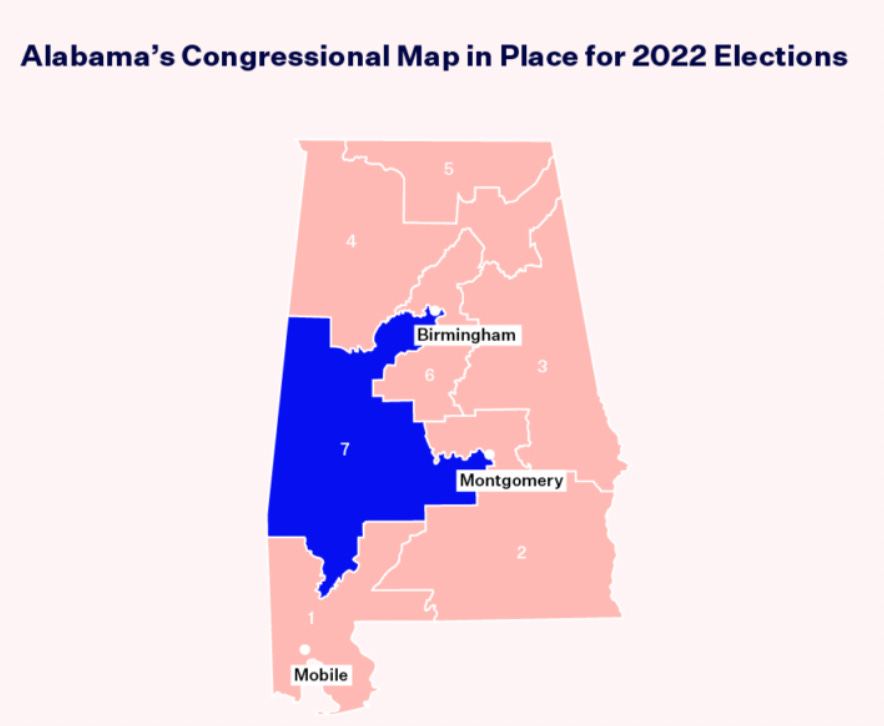
A federal court has struck down Alabama’s newly drawn congressional district map, ruling that the Republican-led legislature’s plan unconstitutionally dilutes the voting power of Black residents in violation of the Voting Rights Act of 1965. The decision, announced May 11, 2026, blocks the state from using the disputed map in the upcoming midterm elections and sends the case back to a lower court for further review.
The ruling marks a significant setback for Alabama Republicans, who had pushed for a map with only one majority-Black district out of seven total seats—a sharp reduction from the two majority-Black districts the state had previously maintained. Legal experts say the decision could have broader implications for redistricting battles across the U.S., where conservative-led states have increasingly sought to limit minority representation through gerrymandering.
Alabama Attorney General Steve Marshall, a Republican, condemned the ruling in a statement, calling it “another example of activist judges overruling the will of the people.” Meanwhile, voting rights advocates hailed the decision as a victory for fair representation, arguing that the state’s map deliberately fragmented Black voting blocs to weaken Democratic candidates.
Background: A High-Stakes Redistricting Fight
Alabama’s redistricting battle has unfolded against the backdrop of a Supreme Court decision in late April that weakened protections under the Voting Rights Act. In a landmark ruling, the Court narrowed the scope of Section 2 of the Act, making it harder for plaintiffs to challenge racial gerrymandering. The Alabama case was one of several redistricting disputes the Court has intervened in recently, including cases in Louisiana, Texas, and California.
Alabama’s Republican-led legislature approved the controversial map in 2023, arguing that it reflected the state’s current demographics. However, civil rights groups and Democratic lawmakers immediately challenged the plan, alleging it was designed to minimize Black political influence. A lower federal court initially blocked the map, but Alabama officials appealed directly to the Supreme Court, which declined to intervene—paving the way for the May 11 ruling.
According to the Alabama State Government website, the state’s population stands at approximately 5.16 million as of 2024, with Black residents comprising about 27% of the population. Despite this demographic reality, the rejected map would have ensured that only one of Alabama’s seven congressional districts had a Black majority.
Legal Ruling: What the Court Said
The federal court’s decision cited evidence that Alabama’s map “creates a significant risk of retrogression” for Black voters, meaning it reduces their ability to elect candidates of choice compared to previous maps. The ruling explicitly states that the state failed to demonstrate a compelling justification for the drastic reduction in majority-Black districts.
“The evidence shows that the state’s actions were motivated by a desire to maintain Republican control rather than by any legitimate redistricting principle,” the court’s opinion reads. “This violates the equal protection guarantees of the Fourteenth Amendment and the anti-discrimination provisions of the Voting Rights Act.”
The decision does not yet determine the final shape of Alabama’s congressional districts but requires the state to redraw the map in compliance with federal law. Legal analysts suggest that any new map will likely need to include at least two majority-Black districts to satisfy the court’s requirements.
Political Ramifications: Who Wins and Who Loses?
The ruling has immediate political consequences for Alabama’s 2026 midterm elections, which are now less than six months away. The state’s primary elections are scheduled for June 2026, leaving little time for a redraw process. However, voting rights groups have filed emergency requests asking courts to extend deadlines to allow for a fair redistricting process.
For Republicans, the decision is a blow to their efforts to secure a lasting majority in Alabama’s congressional delegation. The GOP currently holds six of the state’s seven seats, but the loss of a majority-Black district could weaken their hold on those seats in future elections. Democrats, who have struggled to gain traction in Alabama’s congressional races, see the ruling as an opportunity to increase their representation.
Beyond Alabama, the decision could embolden voting rights advocates in other states facing similar challenges. In Virginia, Democrats have also asked the Supreme Court to intervene in their state’s redistricting process, arguing that their proposed map unfairly dilutes minority voting power. The Alabama ruling may set a precedent for how courts interpret the Voting Rights Act in the wake of the Supreme Court’s recent narrowing of its protections.
What Happens Next?
The case will now return to the lower federal court for further proceedings, including potential hearings on a revised redistricting plan. Alabama officials have indicated they will appeal the decision, possibly taking it back to the Supreme Court. Meanwhile, voting rights organizations are preparing to monitor the state’s next steps closely to ensure compliance with the court’s order.
The next critical deadline is June 2026, when Alabama’s primary elections are scheduled. If the state fails to produce a compliant map in time, it could trigger a legal battle over whether the elections should proceed with the old map or be delayed. Legal experts warn that the uncertainty could lead to chaos for voters and candidates alike.
Key Takeaways
- Federal court blocks Alabama’s GOP-drawn congressional map, ruling it violates the Voting Rights Act by reducing Black voting power.
- Alabama’s map would have created only one majority-Black district, down from two in previous maps, despite Black residents making up nearly 27% of the state’s population.
- The ruling follows a Supreme Court decision that weakened protections under the Voting Rights Act, making it harder to challenge racial gerrymandering.
- Alabama’s primary elections are scheduled for June 2026, leaving little time for a redraw process if the state appeals the decision.
- Voting rights groups are pushing for extended deadlines to allow a fair redistricting process, while Republicans vow to appeal the ruling.
- The decision could influence similar cases in other states, including Virginia, where Democrats are also challenging redistricting plans.
As the legal battle continues, Alabama voters—and those across the country watching closely—will be left wondering whether the courts or the state legislature will have the final say in how the state’s congressional districts are drawn.
What are your thoughts on this ruling? Should states have more flexibility in drawing district lines, or is federal oversight necessary to prevent discrimination? Share your views in the comments below.