
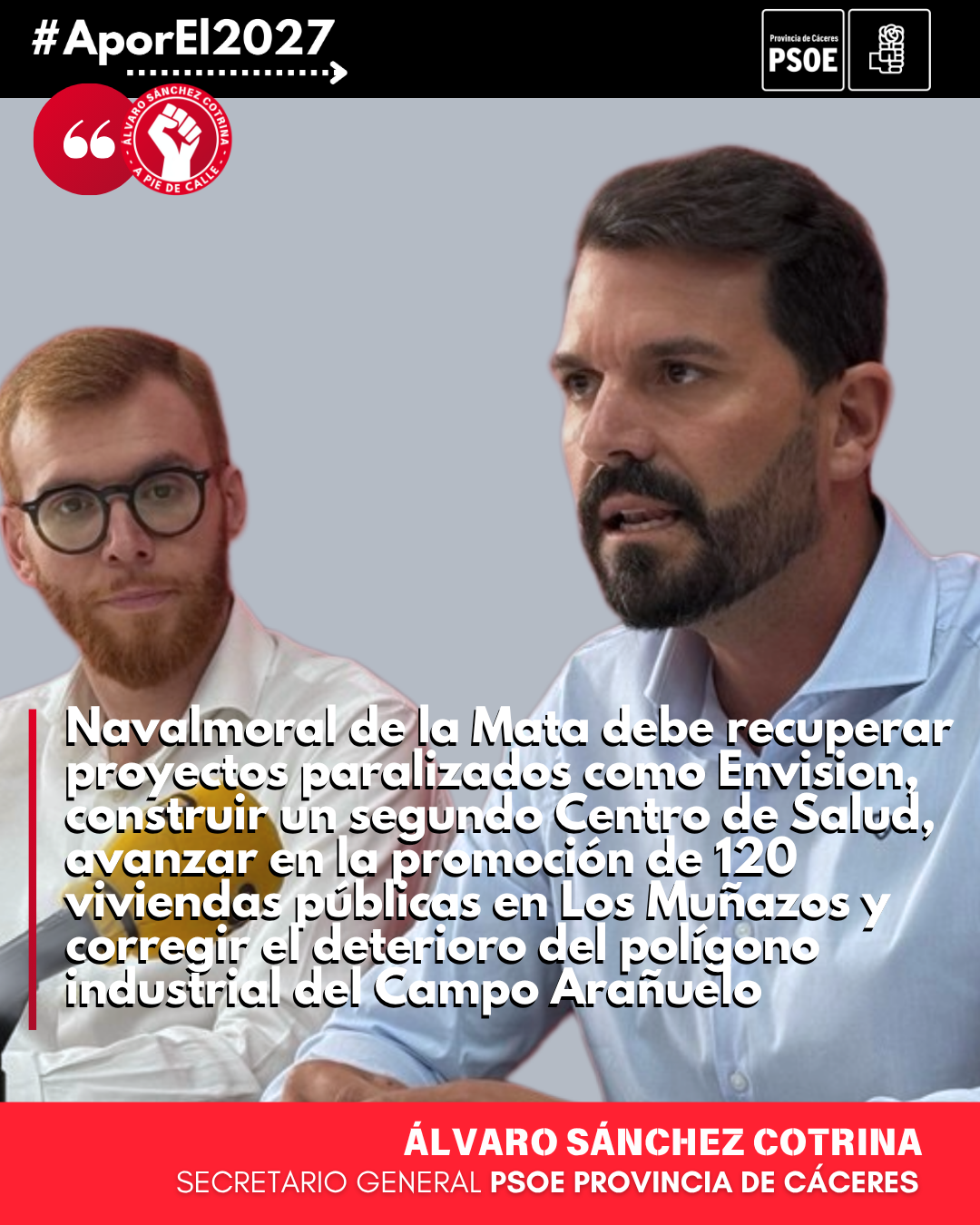
The political landscape in Extremadura has reached a critical inflection point following the ascent of Álvaro Sánchez Cotrina as the new Secretary General of the PSOE (Spanish Socialist Workers’ Party) in the region. In a series of pointed critiques, Sánchez Cotrina has targeted the governing dynamics of the region, specifically the alliance between the People’s Party (PP) and the right-wing Vox, framing the agreement not merely as a political disagreement, but as a fundamental breach of legal and ethical standards.
At the center of the controversy is the leadership of María Guardiola, the President of Extremadura. Sánchez Cotrina has characterized the pact between the PP and Vox as illegal, inmoral y una humillación para Guardiola
(illegal, immoral and a humiliation for Guardiola), suggesting that the reliance on Vox to maintain power undermines the dignity of the regional presidency and the stability of the autonomous community. This rhetoric marks a sharp shift in the Socialist opposition’s approach, moving toward a more aggressive confrontation of what they term the ultraderechista
(far-right) agenda.
The timing of these statements coincides with Sánchez Cotrina’s recent ratification as the regional leader. Having secured 88% of the votes from delegates during the 16th Regional Congress, the new Secretary General has prioritized a strategy of internal unity and organic renewal. By distancing the party from previous internal conflicts, he aims to position the PSOE as a cohesive force capable of challenging the current administration’s legitimacy and its legislative priorities.
The Legal and Moral Challenge to the PP-Vox Alliance
Sánchez Cotrina’s primary contention is that the pact between the PP and Vox is not only politically problematic but potentially inconstitucional
(unconstitutional). According to reports from Press Digital, he has warned that should the pact fully materialize in certain forms, it would be illegal and, more importantly, immoral. This legal challenge focuses on the potential for the alliance to implement policies that conflict with the Spanish Constitution or regional statutes.
The Socialist leader argues that the inclusion of Vox in the regional power structure introduces a specific ideological agenda that is incompatible with democratic norms. He has described the agreement as an enmienda a la totalidad a la historia de Extremadura
(a total amendment to the history of Extremadura), particularly in how it relates to the region’s long history of emigration and social struggle. By framing the pact as a humillación
(humiliation) for María Guardiola, Sánchez Cotrina suggests that the PP leader has sacrificed political autonomy to appease a junior partner with more radical views.
The moral dimension of this critique extends to the treatment of vulnerable populations. The PSOE leadership has expressed deep concern over the region becoming a laboratorio para echar a los migrantes
(laboratory for expelling migrants), suggesting that the influence of Vox is pushing the regional government toward restrictive and inhumane immigration policies. This position is intended to contrast the Socialist vision of social inclusion with the restrictive policies associated with the far-right.
A New Era for the PSOE in Extremadura
Beyond the external conflict with the PP and Vox, Sánchez Cotrina is tasked with the internal reconstruction of the PSOE in Extremadura. His victory at the 16th Regional Congress, where he was ratified with 88% of the delegate vote as reported by Infoprovincia, provides him with a strong mandate to move past the legacy of previous leaderships.
The new Secretary General has explicitly stated that the era of internal disputes is over, declaring that se acabaron los líos internos
(the internal messes are over). His vision for the party focuses on three core pillars:
- Autonomy: Creating a regional party that is more independent and critical, rather than merely following national directives.
- Proximity: Returning the party to the
pie de calle
(street level) to engage directly with the problems of the Extremaduran people. - Constructive Opposition: While remaining a fierce critic of the PP-Vox pact, he intends to offer an opposition that focuses on tangible regional issues rather than purely partisan warfare.
This strategic pivot is designed to attract a broader segment of the electorate that may be disillusioned by the perceived instability of the current regional government. By emphasizing unity and regional identity, Sánchez Cotrina seeks to rebuild the PSOE’s image as a viable alternative for governance in the community.
Institutional Blockage and the Demand for Stability
A recurring theme in Sánchez Cotrina’s recent appearances is the accusation of institutional blockage. In press conferences following the first Regional Executive meeting, he has questioned the delays in the formation and stabilization of the regional government. He has publicly challenged María Guardiola, asking ¿A qué espera la señora Guardiola para formar gobierno y dar estabilidad a Extremadura?
(What is Mrs. Guardiola waiting for to form a government and provide stability to Extremadura?).

This line of questioning highlights a perceived vacuum of leadership. The PSOE argues that the complexities of the PP-Vox relationship have led to a stalemate that hinders the delivery of essential services and the implementation of necessary regional reforms. By framing the issue as a lack of stability, Sánchez Cotrina is attempting to shift the narrative from ideological conflict to administrative competence.
The impact of this political friction is felt most acutely in the policy areas where Vox’s influence is most prominent. The Socialist party continues to warn that the agenda ultraderechista
is being integrated into regional governance, which they believe will lead to a rollback of civil liberties and social protections. This conflict is expected to intensify as the regional legislature moves forward with its budget and policy priorities for the coming year.
Key Takeaways of the Political Shift
- Leadership Change: Álvaro Sánchez Cotrina has assumed leadership of the PSOE in Extremadura with an 88% mandate, focusing on party unity.
- Legal Challenges: The Socialist party is framing the PP-Vox alliance as potentially unconstitutional and illegal.
- Moral Critique: The pact is described as a humiliation for President María Guardiola and a threat to migrant rights.
- Strategic Goal: The PSOE aims to move from internal conflict to a position of a unified, autonomous regional opposition.
- Institutional Demand: There is an urgent call for the regional government to resolve its internal contradictions to end institutional blockage.
As the political tension rises in Extremadura, the focus now shifts to the upcoming regional legislative sessions. The next critical checkpoint will be the presentation and debate of the regional budget, where the viability and the “morality” of the PP-Vox pact will be tested against the demands of the opposition and the needs of the citizenry. The Socialist party has signaled that it will use these sessions to further challenge the legality of the current governing arrangement.
World Today Journal encourages readers to share their perspectives on the balance between political pragmatism and ideological purity in regional governance in the comments below.