
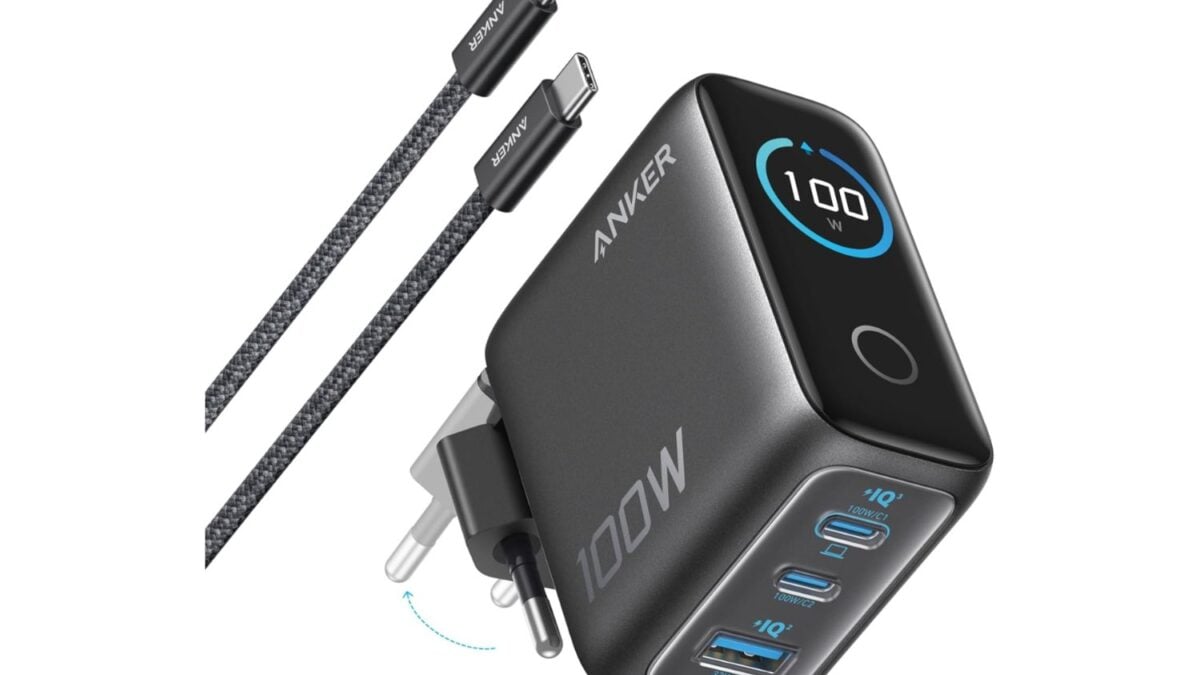
For most of us, the daily struggle with technology isn’t about the complexity of the software, but the fragility of the battery. We have all experienced the anxiety of a 5% warning during a critical work call or the clutter of carrying three different power bricks for a laptop, a tablet, and a smartphone. While these peripherals are often overlooked, a high-quality power solution is the invisible backbone of a productive digital workflow.
Currently, a significant Anker 100W USB-C charger deal has emerged on Amazon, with prices dropping to as low as 45.99 € in certain markets. This price point represents a substantial discount for a high-wattage adapter capable of powering everything from a high-end MacBook Pro to a pair of wireless earbuds. In an era where USB-C has finally become the near-universal standard for charging, owning a single, powerful “brick” that replaces multiple proprietary chargers is no longer just a convenience—it is a strategic upgrade for any mobile professional.
As an editor with a background in computer science, I have tracked the evolution of power delivery for years. The shift we are seeing now isn’t just about the price; it is about the transition to Gallium Nitride (GaN) technology. This material allows chargers to be smaller, more efficient, and run cooler than traditional silicon-based chargers. When a brand like Anker—a leader in the global smart hardware industry—drops the price of its 100W solutions, it often signals a market shift toward making high-speed GaN charging the baseline for all consumers.
Why 100W is the ‘Sweet Spot’ for Modern Hardware
To understand why this specific deal matters, one must understand the physics of Power Delivery (PD). Not all USB-C ports are created equal; some are designed merely for data transfer, while others are engineered for high-wattage power intake. A 100W charger is particularly valuable because it hits the upper threshold of what most consumer laptops can actually utilize.
For instance, most 13-inch and 14-inch laptops require between 60W and 96W for quick charging. A 100W adapter ensures that the laptop can charge at its maximum possible speed even while the user is running resource-heavy applications like video editing software or IDEs. Most Anker 100W models feature multiple ports, meaning the charger can intelligently distribute that power. If you plug in a laptop and a phone simultaneously, the charger uses a dynamic power allocation system to ensure both devices receive the optimal voltage without overheating.
This efficiency is driven by Anker’s charging technology, which focuses on reducing energy loss during the conversion process. By using GaN, Anker can pack 100W of output into a form factor that is often half the size of the bulky power bricks provided by laptop manufacturers. For those who travel or work from cafes, this reduction in bulk is a tangible improvement in quality of life.
The Impact of GaN Technology on Consumer Electronics
For the uninitiated, the “GaN” label found on these chargers is not just marketing jargon. Gallium Nitride is a wide-bandgap semiconductor that can conduct electrons more efficiently than silicon. In practical terms, this means less energy is wasted as heat. When a charger runs cooler, it can be made smaller without risking thermal throttling or safety hazards.
This technological leap has allowed Anker Innovations to expand its portfolio into diverse areas, from the Anker Prime series to portable power stations. The democratization of GaN technology means that high-speed charging is moving out of the “enthusiast” category and into the mainstream. When a 100W charger hits a price point of 45.99 €, it becomes an impulse buy rather than a calculated investment, accelerating the phase-out of slow, outdated charging bricks.
Beyond the speed, these chargers typically include advanced safety protocols. Most Anker high-wattage adapters utilize proprietary systems to monitor temperature and current in real-time, preventing overcharging and protecting the long-term health of your device’s lithium-ion battery. This is a critical consideration for users who invest thousands of dollars in flagship hardware and want to avoid the degradation caused by unstable power sources.
Key Technical Advantages of High-Wattage USB-C Charging
| Feature | Standard Silicon Charger | Anker GaN 100W |
|---|---|---|
| Physical Size | Bulky, heavy | Compact, travel-friendly |
| Heat Generation | Higher thermal output | Lower, more efficient cooling |
| Versatility | Usually single-device | Multi-device (Laptop + Phone + Tablet) |
| Charging Speed | Slow to Moderate | Ultra-Fast (Power Delivery 3.0/3.1) |
Is Now the Right Time to Buy?
When analyzing an Anker 100W USB-C charger deal, the primary question is whether to buy now or wait for the next generation. In the world of consumer electronics, the law of diminishing returns eventually kicks in. While 140W and 240W chargers exist for specialized gaming laptops or massive workstations, 100W remains the optimal balance for 90% of users.
The current price drop on Amazon makes this an ideal entry point for those still relying on the chargers that came in the box with their devices. Most OEM (Original Equipment Manufacturer) chargers are single-port and single-purpose. Replacing them with a multi-port 100W GaN adapter simplifies your cable management and ensures you are prepared for future hardware upgrades.
However, buyers should be cautious and ensure they are purchasing from verified sellers on Anker’s official Amazon store to avoid counterfeit products. Counterfeit chargers often lack the necessary safety certifications and can pose a genuine risk to your devices through voltage spikes.
Practical Tips for Maximizing Your Charger’s Potential
- Pair with E-Marked Cables: To actually achieve 100W delivery, you must use a USB-C cable with an “E-Marker” chip. Standard cables are often limited to 60W; without the correct cable, your 100W charger will be throttled.
- Understand Power Distribution: Remember that if you use multiple ports, the 100W is shared. For example, it may split into 65W for a laptop and 30W for a phone. Always check the manual for the specific distribution logic of your model.
- Avoid Extreme Heat: While GaN runs cooler, avoid covering your charger with blankets or placing it in unventilated spaces during a full-speed charge to maintain maximum efficiency.
The Broader Context: Anker’s Evolution
This pricing strategy is part of a larger trajectory for Anker Innovations. The company has transitioned from being a “battery and cable” brand to a comprehensive smart hardware ecosystem. By aggressively pricing its core charging components, Anker creates a gateway for users to enter its wider ecosystem, which now includes AI-driven security via eufy and high-fidelity audio through soundcore.

The shift toward “Smart Charging” is evident in their latest product lineups, which prioritize not just the speed of the charge, but the intelligence behind it. We are seeing a trend where chargers are becoming “aware” of the device they are powering, adjusting the wattage in real-time to preserve battery longevity—a feature that is becoming standard in their high-end Prime series.
For the global consumer, this means that the “boring” gadget—the power brick—is actually one of the most rapidly innovating pieces of hardware in the modern workspace. The ability to consolidate power sources reduces electronic waste and simplifies the nomadic lifestyle of the modern professional.
The next major milestone for the company is its upcoming global launch event, scheduled for May 21, 2026, at 7 P.M. ET, live from New York City. This event is expected to unveil further advancements in their product lineup, potentially introducing new standards in energy storage and charging efficiency that could further disrupt the current market.
Do you still carry multiple chargers for your devices, or have you made the switch to a single GaN solution? Share your experience with high-wattage charging in the comments below.