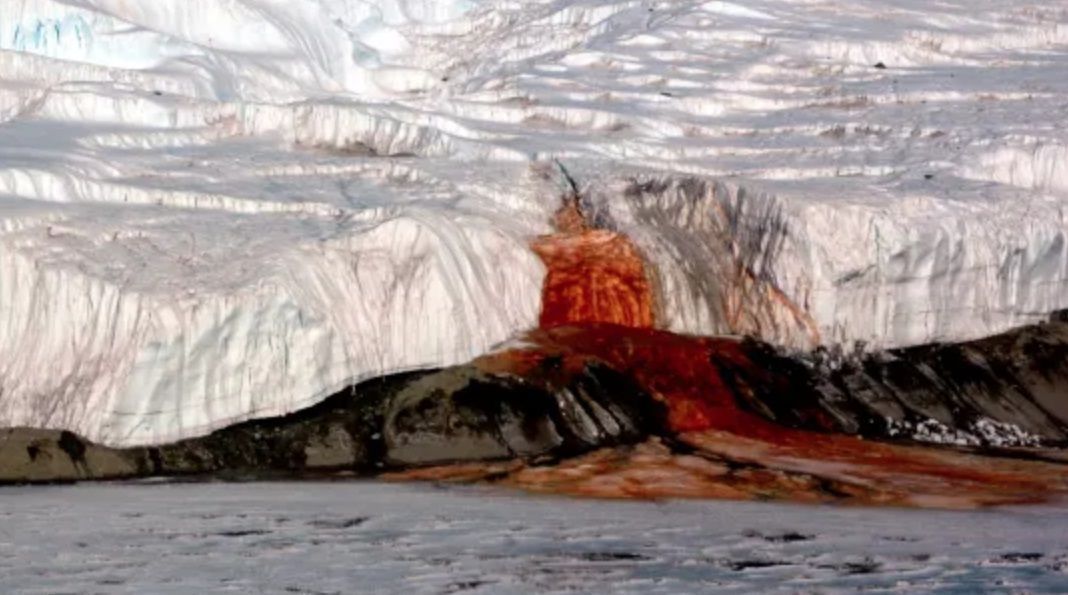
The Blood Falls of Antarctica: Unraveling a Subglacial Mystery
In the stark, white expanse of Taylor Valley, Antarctica, a scene straight from science fiction unfolds: a dark, thick, reddish liquid cascades down the face of the Taylor Glacier, flowing towards the icy surface of Lake Bonney. Known as the “Blood Falls,” this visually striking phenomenon isn’t, as the name suggests, a sign of extraterrestrial activity or ancient remains, but rather a brine saturated with iron. The source of this unusual outflow has long been understood – it’s highly saline, iron-rich water trapped beneath the glacier – but the mechanics of its eruption and its impact on the surrounding environment remained largely unknown. Now, a recent study published in Antarctic Science details, for the first time, the fascinating natural engineering behind these eruptions and how they affect the physics of the ice and the delicate ecosystem around it.
The mystery surrounding Blood Falls extends beyond its dramatic appearance. Scientists have long sought to understand the processes within the glacier that lead to these periodic releases of ancient, isolated water. The Taylor Glacier, located in one of the McMurdo Dry Valleys, is a unique environment, and understanding its behavior provides valuable insights into glacial dynamics and the potential impacts of climate change on these fragile polar regions. The Dry Valleys themselves are considered one of the most extreme deserts on Earth, offering a unique analog for studying conditions on Mars. The recent research, leveraging a rare convergence of monitoring equipment, has begun to unlock the secrets hidden within this icy landscape.
A Rare Convergence of Scientific Tools
A comprehensive understanding of Blood Falls emerged from a fortunate alignment of scientific instrumentation during September and October of 2018. Researchers were able to record a single, prolonged leakage event using three simultaneous data streams. A time-lapse camera focused on the base of the Blood Falls captured the visual progression of the outflow. Simultaneously, a GPS system installed directly on the glacier’s surface meticulously measured its movement and elevation. Finally, a network of thermal sensors submerged in Lake Bonney tracked water temperature at various depths. This multi-faceted approach provided an unprecedented level of detail, allowing scientists to correlate changes within the glacier with the effects on the surrounding environment.
The Glacial Pressure Cooker: Why the Glacier Sinks and Slows
The time-lapse imagery confirmed that, starting on September 10, 2018, the brine began to flow intermittently, continuing for approximately a month. Crucially, the GPS data revealed a significant change in the glacier’s behavior during this period. The massive ice mass of the Taylor Glacier subsided by 15 millimeters, and its rate of movement decreased by nearly 10%, slowing from 5.0 to 4.6 meters per year. This correlation between the brine release and the glacier’s physical changes was a key finding of the study.
Beneath the glacier, water plays a dual role. It acts as a hydraulic cushion, supporting the weight of the ice above, and as a lubricant, facilitating the glacier’s slide over the underlying bedrock. Over time, the pressure of the trapped brine beneath the glacier builds until it finds pathways to the surface. When the Blood Falls event occurs, it’s akin to releasing the valve on a pressure cooker. This continuous release of fluids empties the hidden reservoir, dramatically reducing the water pressure beneath the glacier. Without this pressurized cushion, the glacier’s surface yields, causing the 15mm subsidence, and loses the lubrication that enabled its faster movement, resulting in the slowdown. This process demonstrates a complex interplay between subglacial hydrology and glacial dynamics.
Impact on the Depths of the Lake
Whereas the glacier adjusted physically, a third phenomenon unfolded unseen beneath the surface. The thermal sensors in Lake Bonney registered sudden temperature drops of up to -1.5°C. This occurred due to a fascinating interplay of densities. The icy brine emerging from the Blood Falls is exceptionally heavy and saline. Upon entering the lake, it sinks until it encounters a layer of water with the same density. At a specific depth of approximately 17.89 meters, the subglacial water spreads, creating significant cold anomalies. This process, described as a “density-driven plume” by researchers, highlights the interconnectedness of the glacial and aquatic environments.
These episodic injections of cold, salty water disrupt the temperature stratification of Lake Bonney, potentially altering nutrient transport throughout the water column. In an environment as extreme as the McMurdo Dry Valleys, this has a direct impact on the microscopic life that depends on this fragile ecosystem. Lake Bonney, permanently ice-covered, harbors a unique microbial community adapted to these harsh conditions. Changes in water temperature and nutrient availability could have cascading effects on this delicate food web. Further research is needed to fully understand the long-term consequences of these brine releases on the lake’s ecosystem.
The Taylor Valley, and specifically the area around Blood Falls, is a designated Antarctic Specially Managed Area (ASMA), recognizing its unique scientific value. The ASMA designation imposes restrictions on activities to protect the environment and ensure the integrity of ongoing research. The ongoing monitoring of Blood Falls and Lake Bonney is crucial for understanding the broader implications of glacial melt and subglacial processes in a rapidly changing climate. The region serves as a natural laboratory for studying the interactions between ice, water, and life in extreme environments, offering valuable insights applicable to other glacial regions around the world.
Key Takeaways
- The “Blood Falls” are not caused by blood, but by iron-rich brine released from a subglacial reservoir.
- The release of this brine causes a temporary subsidence and slowdown of the Taylor Glacier.
- The cold, dense brine creates temperature anomalies in Lake Bonney, potentially impacting the lake’s ecosystem.
- The study highlights the complex interplay between subglacial hydrology, glacial dynamics, and aquatic environments in Antarctica.
The research conducted in 2018 provides a crucial baseline for future monitoring efforts. Scientists plan to continue observing Blood Falls and Lake Bonney to track changes in brine flow rates, glacial movement, and water temperature. Continued data collection will be essential for assessing the long-term impacts of these processes and for predicting how they might respond to future climate change. The next major data collection effort is scheduled for the austral summer of 2027, contingent on funding and logistical feasibility.
What are your thoughts on this fascinating Antarctic phenomenon? Share your comments below, and please share this article with anyone who might discover it interesting!