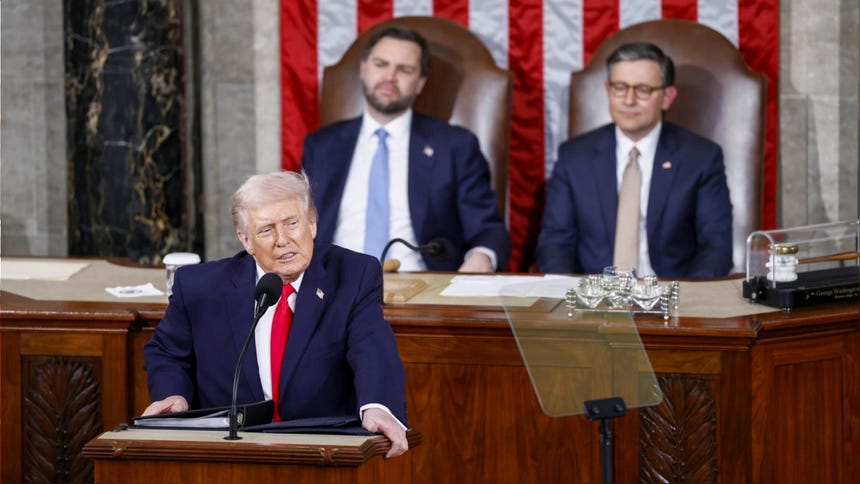
Washington D.C. – President Donald Trump delivered a State of the Union address on Tuesday that, at 107 minutes, became the longest in U.S. History, surpassing his own record from the previous year. The extended address, delivered before a joint session of Congress, was marked by a focus on perceived economic achievements, a strong nationalist tone, and pointed criticism of political opponents. The length of the speech, exceeding the typical timeframe for such addresses, drew considerable attention and commentary.
The extended duration of President Trump’s address—over an hour and forty-five minutes—immediately became a focal point of media coverage. According to reports, Trump had signaled his intention to deliver a lengthy speech the day prior. This year’s address surpassed his 2023 State of the Union, which clocked in at 99 minutes, setting a fresh benchmark for presidential addresses to Congress. The sheer length raised questions about strategy and messaging, with some observers suggesting it was a deliberate tactic to dominate the news cycle and control the narrative. The speech occurred against a backdrop of ongoing political polarization and upcoming midterm elections, adding to its significance.
A Focus on Economic Accomplishments and Border Security
Throughout his address, President Trump emphasized what he characterized as successes during his administration. He highlighted efforts to combat illegal immigration and drug trafficking, framing these as key priorities for national security. The President also touted economic gains, claiming progress in controlling inflation and lowering gasoline prices. He further asserted that his administration’s imposition of tariffs on imported goods would ultimately replace the income tax system, a claim that requires further scrutiny and economic analysis. These assertions were presented as evidence of a thriving economy under his leadership, a central theme of his political messaging.
The President’s claims regarding economic performance are subject to ongoing debate and analysis. While some economic indicators have shown positive trends during his term, others present a more complex picture. For example, the Bureau of Labor Statistics reported in February 2026 that the unemployment rate remained relatively low, but inflation, while moderating, was still above the Federal Reserve’s target rate. The Bureau of Labor Statistics provides detailed data on employment, wages, and inflation, offering a comprehensive view of the U.S. Economic landscape. The impact of tariffs on the U.S. Economy has also been a subject of considerable debate among economists, with varying assessments of their effectiveness and potential consequences.
Attacks on Democrats and Voting Integrity
A significant portion of the President’s speech was dedicated to criticizing the Democratic Party. He specifically attacked Democrats for opposing a proposed bill that would require all voters to certify their citizenship before casting a ballot. Trump argued that such a measure was necessary to combat voter irregularities, a claim he has repeatedly made, particularly following the 2020 presidential election. He alleged that these irregularities cost him the election, though these claims have been widely debunked by election officials and courts. The President’s rhetoric on this issue reflects a broader effort to cast doubt on the integrity of the U.S. Electoral system.
The President also criticized Democrats for what he described as funding cuts to the Department of Homeland Security, the agency responsible for immigration enforcement. He claimed that these cuts were hindering efforts to secure the border and address the issue of illegal immigration. However, the situation surrounding funding for the Department of Homeland Security is more nuanced. A partial government shutdown had been ongoing for 11 days due to a disagreement between the President and Congress over funding for border security measures. Democrats had demanded changes to protocols used by immigration agents, including prohibiting the use of masks and requiring judicial warrants for searches, following incidents in Minnesota where two U.S. Citizens died during immigration enforcement operations. The Department of Homeland Security provides information on its budget, policies, and operations, offering a detailed perspective on the challenges and priorities facing the agency.
Political Context and Upcoming Midterm Elections
The timing of the State of the Union address is particularly significant given the upcoming midterm elections in November. These elections will determine control of both the Senate and the House of Representatives. Republicans are hoping to maintain their current minority positions in both chambers, while Democrats are aiming to regain control. The President’s speech served as a rallying cry for his supporters and an attempt to energize the Republican base ahead of the elections. The outcome of the midterm elections will have a significant impact on the President’s ability to advance his agenda during the remainder of his term.
Recent polling data indicates a close race in many key midterm election contests. According to a February 2026 report by the Pew Research Center, President Trump’s approval rating stands around 40%, a figure that has remained relatively stable in recent months. The Pew Research Center provides nonpartisan data and analysis on a wide range of social and political issues, offering valuable insights into public opinion. The midterm elections are expected to be highly competitive, with both parties investing heavily in key races. The results will likely be influenced by a variety of factors, including the state of the economy, national security concerns, and the level of voter turnout.
Hawaii’s Congressional Delegation Responds
The President’s address also drew reactions from members of Congress, including Hawaii’s congressional delegation. Representatives from Hawaii expressed concerns over the President’s rhetoric and policies, particularly regarding immigration and environmental issues. They emphasized the importance of upholding American values and protecting the rights of all citizens. Hawaii News Now reported on the delegation’s response, highlighting their criticisms of the President’s policies and their commitment to representing the interests of their constituents.
Senator Mazie Hirono stated, “The President’s speech was filled with misleading statements and divisive rhetoric. We must reject this approach and work together to address the challenges facing our country.” Representative Kai Kahele echoed these sentiments, emphasizing the need for a more inclusive and compassionate approach to immigration policy. The delegation’s response reflects a broader pattern of opposition to the President’s policies from many Democratic lawmakers.
Nvidia Results Shift Investor Focus
Interestingly, following the State of the Union address, investor attention quickly shifted to the latest earnings results from Nvidia, a leading technology company. News reports indicate that Nvidia’s strong financial performance has boosted investor confidence, overshadowing the political fallout from the President’s speech. This shift in focus highlights the importance of economic factors in shaping market sentiment.
The contrast between the political discourse of the State of the Union address and the market’s reaction to Nvidia’s earnings demonstrates the complex interplay between politics and economics. While the President’s speech aimed to influence public opinion and set the stage for the midterm elections, investors appear to be more focused on the fundamentals of the economy and the performance of key companies. This divergence suggests that economic considerations may ultimately outweigh political factors in shaping the direction of the U.S. Economy.
Looking ahead, the focus will likely remain on the upcoming midterm elections and the potential impact on the President’s agenda. The results of these elections will have far-reaching consequences for the future of American politics and policy. The economic outlook will also be closely watched, as investors and policymakers alike assess the risks and opportunities facing the U.S. Economy. Stay informed about these developments by following reputable news sources and engaging in constructive dialogue about the issues that matter most.
Related reading