
Apple has moved to integrate external artificial intelligence models into its ecosystem, confirming that its latest software architecture for Apple Intelligence is designed to support a variety of foundation models, including those developed by Google. This strategic shift allows the company to offer users access to third-party generative AI capabilities while maintaining its own privacy-focused infrastructure. The move, detailed in recent technical documentation, marks a departure from a strictly proprietary model approach, signaling a broader commitment to flexible AI deployment across its hardware lineup.
According to Apple’s official documentation on its Apple Foundation Models, the company has developed its own large language models (LLMs) optimized for on-device and server-side processing. However, the architecture is now explicitly built to be model-agnostic. This means that while Apple’s proprietary models handle core system tasks, the framework can route complex queries to external providers like Google Gemini when a user requests advanced reasoning or creative tasks that exceed the scope of local models.
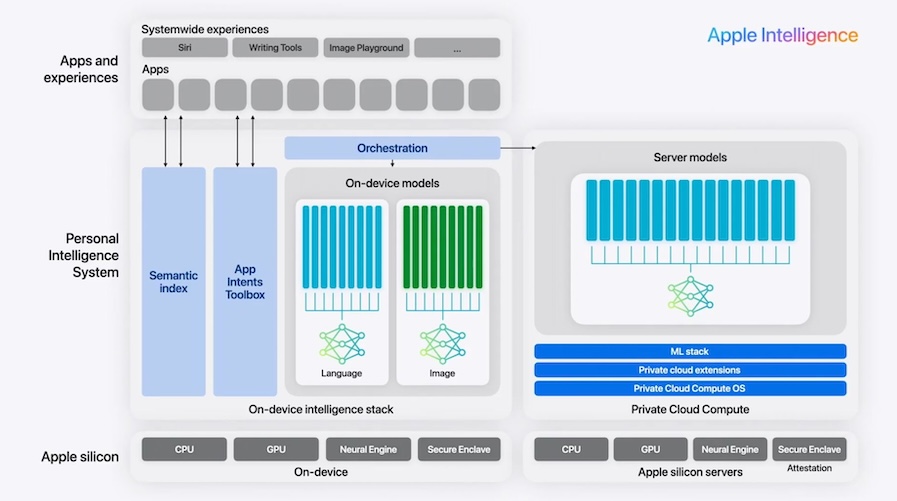
The integration is part of a larger Apple Intelligence rollout that began in late 2024. By utilizing an “orchestration layer,” the software determines whether a task should be executed on the device using a smaller, private model or offloaded to a cloud-based server. When offloaded, the system can leverage more powerful models, such as those within the Gemini family, provided the user gives explicit consent for the request to be processed by a third party.
How Apple’s Orchestration Layer Functions
At the heart of this new architecture is the Private Cloud Compute (PCC) system. Apple introduced this framework to ensure that when data leaves an iPhone, iPad, or Mac, it remains protected by the same security standards as on-device processing. According to the Apple Security Research blog, the company uses verifiable cryptographic proofs to ensure that the cloud environment does not retain user data or allow unauthorized access to the models processing the requests.

The architecture functions by prioritizing on-device execution for common tasks like email summarization, text correction, and notification management. For more intensive requests, the orchestration layer triggers the Private Cloud Compute system. If the user chooses to engage with a third-party model, the system facilitates an API-based bridge to that model’s infrastructure. This setup allows Apple to maintain its privacy claims while offering the high-performance capabilities associated with models like Gemini.
Comparing Proprietary Models and External Partnerships
Apple’s strategy contrasts with competitors who rely heavily on single-vendor ecosystems. For instance, Google’s integration of its own Gemini models into the Android platform is deeply ingrained at the operating system level. In contrast, Apple’s approach is modular. The company maintains its own suite of Foundation Models—which are trained on licensed and publicly available data—while treating external models as supplemental “tools” that a user can opt into.
The following table outlines the current approach to model deployment as confirmed by Apple’s technical disclosures:
| Feature | Apple Foundation Models | Third-Party Integration (e.g., Gemini) |
|---|---|---|
| Primary Location | On-device (local) | Private Cloud Compute (server) |
| Privacy Protocol | Hardware-encrypted local storage | Private Cloud Compute (verifiable) |
| User Control | Default/Always on | Opt-in/Consent required |
Why Modular AI Architecture Matters
The decision to build a modular architecture is driven by the rapid evolution of generative AI. By not tethering its software to a single model provider, Apple ensures that its products can remain relevant as AI technology advances. If a specific model from a partner like Google or OpenAI undergoes a significant performance upgrade, Apple can integrate that capability into its existing framework without needing a full system redesign.
Furthermore, this approach addresses the technical limitations of mobile hardware. While on-device models are faster and more private, they lack the parameter count of massive cloud-based models. By offering a hybrid experience, Apple provides users with the speed and security of local processing for daily tasks and the deep analytical power of large-scale models for more complex creative or technical work.
Future Developments and Official Updates
As of mid-2024, the rollout of these features is ongoing, with additional language support and model integrations expected in subsequent software updates. Users can track the availability of these capabilities through Apple’s official newsroom and developer documentation. The company has stated that it will continue to refine its Private Cloud Compute architecture to include more models as the ecosystem matures.

The next major milestone for this architecture will be the expansion of Apple Intelligence into additional global markets and the potential integration of further third-party LLMs. We encourage our readers to share their experiences with these new AI features in the comments section below and stay tuned for our upcoming deep dive into the performance metrics of these models in real-world scenarios.
Keep reading