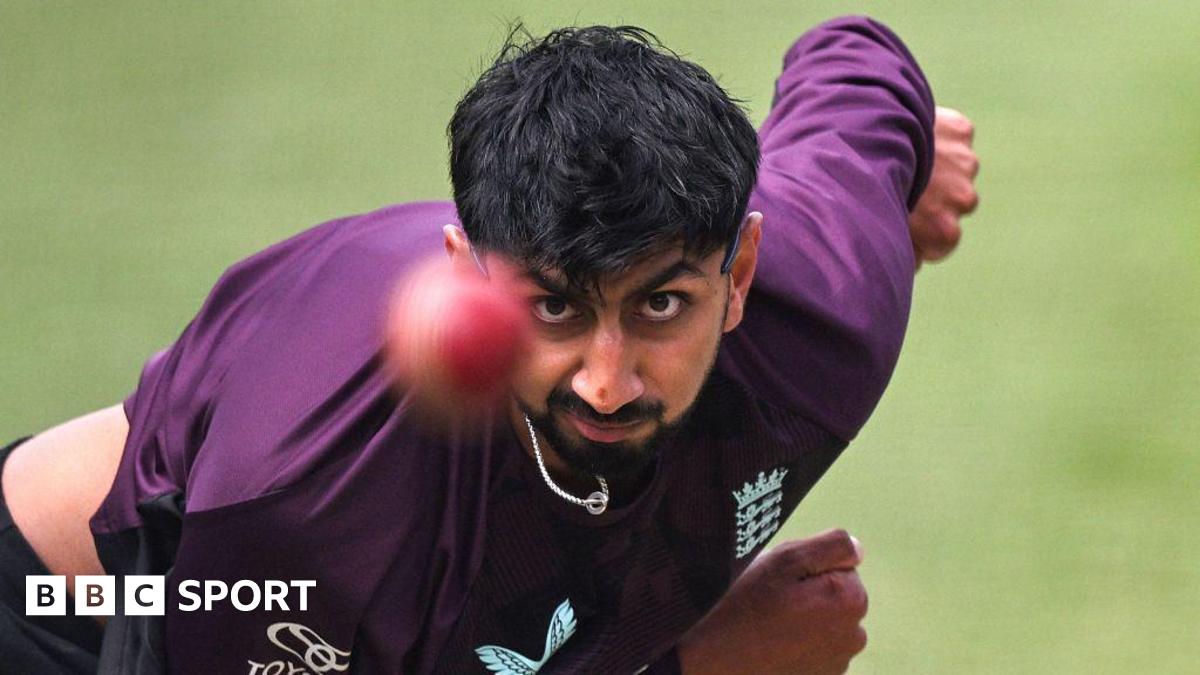
Shoaib Bashir: Unpacking the Potential and Challenges of England’s Rising Spin Star
England’s recent selection of Shoaib Bashir has captivated cricket fans, pulling the spinner from relative obscurity into the international spotlight. But what’s behind this bold move, and what challenges does the young talent face as he establishes himself on the world stage? This article delves into Bashir’s journey, analyzing his strengths, pinpointing areas for growth, and exploring why his impact hasn’t yet fully materialized, particularly during the challenging Ashes series.
From Social Media Discovery to the Test Arena
The story of Bashir’s rise is remarkably modern. Captain Ben Stokes first noticed him bowling for somerset – not in person, but through a clip circulating on social media. He immediatly shared the footage with ECB managing director Rob Key and head coach Brendon McCullum, sparking a swift chain of events. Soon after, Bashir found himself in the england squad, despite having only a handful of first-class appearances under his belt.
This rapid ascent naturally raises questions. Is he ready for the pressures of Test cricket? And what unique qualities did Stokes and the coaching staff see in him? Let’s examine the data.
A Statistical Look at Bashir’s Performance
Through 19 test matches, Bashir has demonstrated promising potential, claiming 68 wickets at an average of 39. His economy rate of 3.78 suggests a capacity to control scoring, while a strike rate of 61.7 indicates a reasonable ability to take wickets. Though, raw numbers only tell part of the story.
One immediately noticeable attribute is his exceptionally high release point – 2.35m. This ranks as the third-highest recorded among spinners, offering a notable advantage: increased bounce. More bounce can trouble batsmen and create challenging angles. But, as any seasoned spin bowler will tell you, bounce is just one piece of the puzzle.
The Nuances of Spin Bowling: Beyond Bounce
While bounce is a valuable asset, it doesn’t guarantee success. According to analysis from CricViz, Bashir currently doesn’t generate the same level of drift and turn compared to prosperous off-spinners in Australia over the past five years, or even compared to off-spinners globally. This suggests a need for refinement in his technique to maximize spin generation.
Furthermore, his natural length may be a contributing factor to his inconsistent performance. Understanding optimal length is crucial for any spinner.
Decoding Bashir’s Optimal Length
CricViz analyst Srinivas Vijaykumar highlights a key insight: Bashir’s most successful deliveries fall within the 4-5 meter length range, where he averages 25.9 with a strike rate of 48. though, this contrasts with the historical performance of off-spinners in Australia. They tend to be more effective in the 5-6 meter length zone.
Interestingly,when Bashir pushes the length slightly shorter,into the 5-6 meter range,his average jumps to 45.4.Globally, the disparity in effectiveness between the 4-5m and 5-6m length ranges isn’t as pronounced for off-spinners as it is for Bashir.This suggests a specific adjustment is needed to thrive in Australian conditions.
What Does This Mean for Bashir’s Future?
Clearly, Shoaib Bashir possesses raw talent and a unique physical attribute in his high release point.However, maximizing his potential requires focused development in several key areas. He needs to enhance his ability to generate drift and turn, particularly in Australian conditions. Moreover, refining his length control, specifically targeting the 5-6 meter range, could unlock a new level of effectiveness.
You, as a cricket enthusiast, can expect to see bashir working closely with England’s coaching staff to address these areas. His journey is a testament to the evolving landscape of talent identification in cricket, and his story is far from over.
Evergreen Insights: The evolution of Spin Bowling
Spin bowling has always been a game of subtle variations and tactical intelligence. Throughout cricket history,successful spinners have adapted their techniques to exploit conditions and outwit batsmen. From the classical leg-spin of Shane Warne to the finger spin of Muttiah Muralitharan,the art of spin continues to evolve.