
The Gordie Howe International Bridge, a critical infrastructure link connecting Detroit, Michigan, and Windsor, Ontario, is currently progressing toward a projected opening in 2025. Managed by the Windsor-Detroit Bridge Authority (WDBA), the multi-billion dollar project aims to modernize the North American trade corridor by providing a dedicated crossing for commercial vehicles, thereby reducing congestion at the existing Ambassador Bridge.
The massive engineering undertaking is designed to facilitate the seamless movement of goods between the United States and Canada, two of the world’s largest trading partners. By creating a more efficient border crossing, the project is expected to bolster supply chain resilience, particularly within the highly integrated automotive manufacturing sectors of both nations.
While construction continues at a significant pace, the project remains a focal point of binational cooperation and logistical planning. The WDBA has maintained that the 2025 timeline is the current objective, as crews work to complete the complex structural components and the necessary customs facilities on both sides of the border.
What is the current status of the Gordie Howe International Bridge?
Construction of the Gordie Howe International Bridge is currently in an intensive phase, with major structural elements, including the bridge towers and main spans, nearing key milestones. According to the Windsor-Detroit Bridge Authority (WDBA), the project is being executed by the Bridging Windsor Inc. consortium, which includes major international engineering and construction firms.
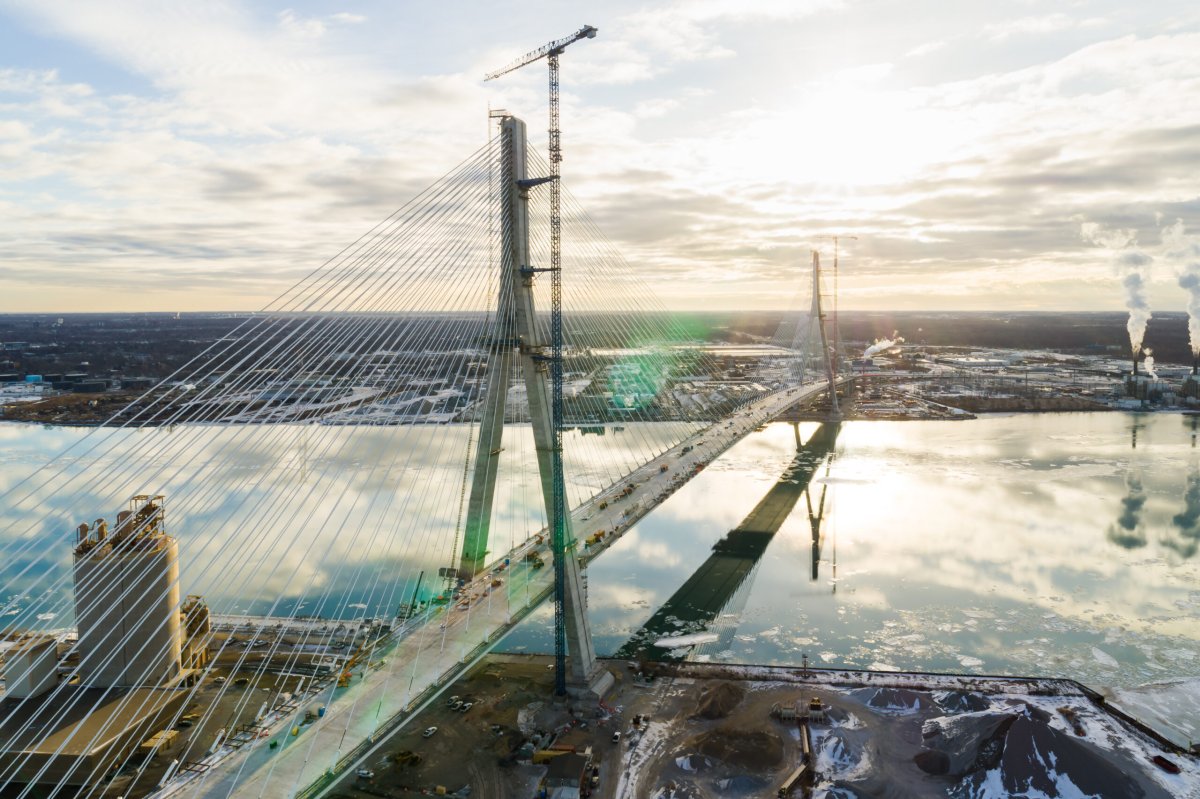
As of recent progress reports, the project has successfully moved through several foundational stages, including the installation of massive concrete piers and the assembly of the steel superstructure. The construction involves not only the bridge itself but also extensive approach roads, customs plazas, and environmental mitigation measures designed to protect the local Detroit River ecosystem.
The project is being managed under a Public-Private Partnership (P3) model. In this arrangement, the Canadian federal government provides the primary funding, while the private consortium, Bridging Windsor Inc., is responsible for the design, construction, financing, and long-term maintenance of the bridge. This model is intended to transfer much of the construction and operational risk from the public sector to the private partners.
Why is the Detroit-Windsor crossing critical for North American trade?
The Detroit-Windsor corridor serves as one of the busiest commercial gateways in North America. The Ambassador Bridge, which currently handles the vast majority of truck traffic between the two countries, often faces significant congestion that can disrupt just-in-time manufacturing processes. The Gordie Howe International Bridge is intended to act as a relief valve for this pressure.

The economic significance of this crossing is rooted in the deeply integrated supply chains of the automotive industry. Parts and finished vehicles frequently cross the border multiple times during the production cycle. Any delay at the border can result in cascading costs for manufacturers, logistics providers, and consumers across the continent. By providing a dedicated, high-capacity route for commercial transit, the new bridge is expected to enhance the fluidity of these essential trade flows.
Beyond the automotive sector, the bridge will support a diverse range of goods, including agricultural products, consumer retail, and industrial components. The ability to move these goods more reliably is a key component of regional economic stability and competitive advantage for both the Great Lakes region of the United States and the province of Ontario in Canada.
How is the Gordie Howe International Bridge being funded?
The Gordie Howe International Bridge is a heavily subsidized infrastructure project, with the vast majority of the capital investment originating from the Canadian federal government. The total estimated cost of the project is approximately $5.7 billion CAD, according to official project documentation provided by the WDBA.
The funding structure is designed to ensure that the bridge is built, operated, and maintained without placing an immediate, heavy burden on local municipal taxpayers. Under the P3 agreement, the private consortium provides the upfront capital necessary to complete construction, which is then recouped through long-term availability payments from the Canadian government. This ensures that the bridge meets specific performance and maintenance standards throughout its operational life.
This financial arrangement is a hallmark of modern large-scale infrastructure projects in North America, allowing governments to deliver essential services while managing long-term fiscal commitments. The involvement of Canadian federal funds underscores the project’s status as a matter of national and international economic priority.
What are the expected economic impacts on the automotive sector?
Industry analysts suggest that the completion of the Gordie Howe International Bridge will provide a substantial boost to the North American automotive manufacturing ecosystem. Because the Detroit-Windsor corridor is the heart of the continental auto industry, the bridge’s ability to reduce border wait times directly translates to lower operational costs for logistics companies and manufacturers.
The reduction in idling time and transit uncertainty allows for more precise “just-in-time” manufacturing schedules. This efficiency is critical in an era where supply chain volatility has become a major concern for global corporations. By stabilizing the flow of components, the bridge helps mitigate the risks of production halts that can occur due to border bottlenecks.
Furthermore, the new crossing is expected to attract further investment in the regional manufacturing hubs. Improved infrastructure often acts as a catalyst for industrial development, encouraging companies to locate their facilities within close proximity to reliable trade routes. This could lead to job creation and increased economic activity in both the Michigan and Ontario regions.
Project Milestone Timeline
| Milestone Phase | Status/Target Date | Key Objective |
|---|---|---|
| Project Agreement Signed | Completed | Formalized P3 agreement between WDBA and Bridging Windsor Inc. |
| Foundational Construction | Completed | Installation of piers and riverbed support structures. |
| Superstructure Assembly | In Progress | Erection of bridge towers and main steel spans. |
| Customs & Infrastructure | In Progress | Construction of US and Canadian border plazas and approach roads. |
| Projected Opening | 2025 | Full commencement of commercial and passenger vehicle transit. |
Summary of Key Project Details
- Project Name: Gordie Howe International Bridge
- Connecting Locations: Detroit, Michigan (USA) and Windsor, Ontario (Canada)
- Primary Authority: Windsor-Detroit Bridge Authority (WDBA)
- Estimated Total Cost: Approximately $5.7 billion CAD
- Primary Funding Source: Canadian Federal Government
- Target Completion: 2025
The next major checkpoint for the project will be the completion of the main span connections and the commencement of testing for the integrated customs and tolling systems. Official updates regarding construction progress and specific opening dates are expected to be released periodically by the WDBA as the project enters its final stages.
What are your thoughts on the impact of this new bridge on North American trade? Share this article and join the conversation in the comments below.