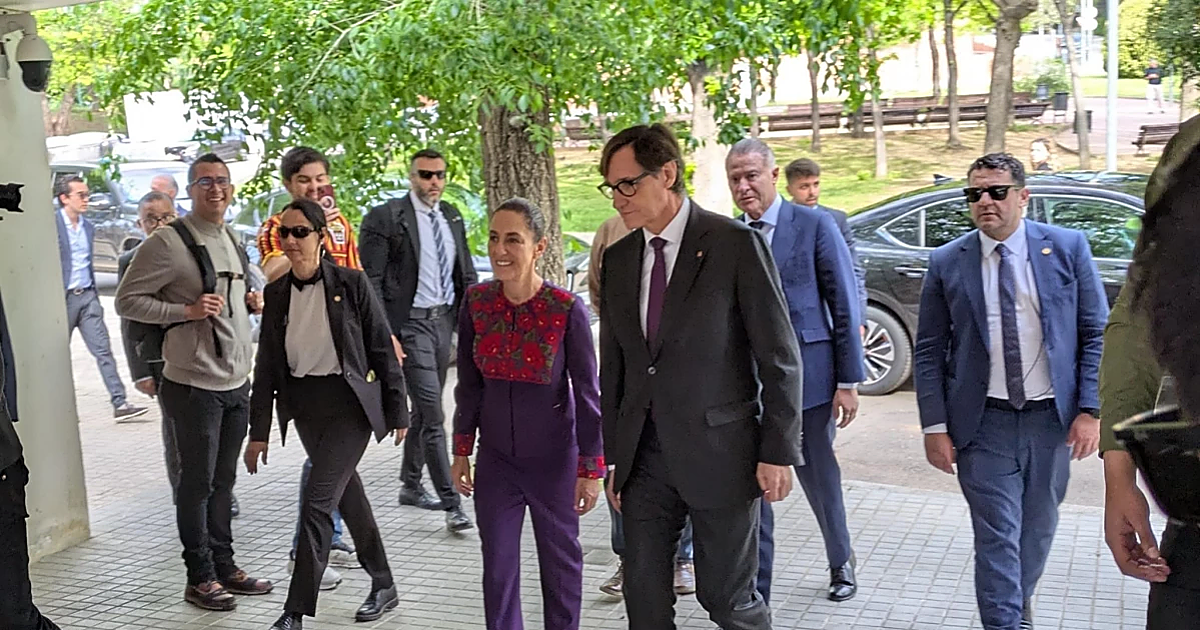
Claudia Sheinbaum, President of Mexico, visited Barcelona’s Supercomputing Center (BSC) on April 10, 2025, accompanied by Salvador Illa, President of the Generalitat of Catalonia. The visit, which included a private meeting and a tour of the facility’s MareNostrum 5 supercomputer, underscored growing scientific and technological cooperation between Mexico, and Catalonia. During the encounter, Illa presented Sheinbaum with a small-scale replica of Antoni Gaudí’s iconic dragon from Park Güell, a gesture symbolizing the cultural and innovative ties between the two regions.
The meeting took place amid broader discussions on advancing joint research initiatives in climate modeling, artificial intelligence, and sustainable computing. Both leaders emphasized the importance of international collaboration in tackling global challenges, particularly those affecting Mediterranean and Latin American regions. The BSC, a joint venture involving the Spanish government, the Generalitat of Catalonia, and the Polytechnic University of Catalonia, is recognized as one of Europe’s leading centers for high-performance computing and scientific research.
Sheinbaum’s visit to the BSC forms part of her official trip to Spain, which also included engagements in Madrid focused on economic cooperation and clean energy transition. According to the Presidency of Mexico, the trip aimed to strengthen bilateral ties in science, technology, and innovation, with a particular focus on green technologies and digital transformation. The visit to Barcelona highlighted Catalonia’s role as a hub for advanced computing and its potential as a partner for Mexican research institutions.
During the tour, Sheinbaum and Illa were briefed on the capabilities of MareNostrum 5, which became operational in late 2023 and is among the most powerful supercomputers in Europe. The system, hosted at the BSC’s campus in Barcelona, supports research in areas such as climate change mitigation, biomedical sciences, and materials engineering. Officials noted that MareNostrum 5 achieves a peak performance of over 314 petaflops, making it a critical tool for complex simulations requiring immense computational power.
The exchange of the Gaudí dragon figurine carried symbolic weight. Antoni Gaudí, the renowned Catalan architect, designed the dragon as part of the serpentine bench in Park Güell, a UNESCO World Heritage Site. The creature has become an emblem of Catalan modernism and creativity. By presenting the replica, Illa underscored the shared appreciation for innovation rooted in cultural heritage—a theme resonant in both Mexican and Catalan identities.
Sources close to the Generalitat confirmed that the meeting was private and focused on aligning scientific agendas, particularly regarding the Mediterranean climate corridor and its vulnerabilities to extreme weather events. Both regions face similar challenges, including droughts, rising sea levels, and urban heat islands, making collaborative research in environmental modeling a priority. The BSC has previously contributed to climate projections used in regional adaptation strategies across southern Europe.
Mexico’s National Council of Science and Technology (CONACYT) has expressed interest in exploring partnerships with European supercomputing centers to enhance domestic research capacity. While no formal agreements were announced during the visit, officials indicated that discussions laid the groundwork for potential future collaborations, including researcher exchanges and joint access to computational resources.
The visit also coincided with ongoing efforts to strengthen EU-Latin America relations in science and innovation. The European Union’s Horizon Europe program includes Mexico as a partner country in select calls, facilitating joint research projects. Catalan institutions, including the BSC, have participated in several such initiatives, particularly in the fields of renewable energy integration and pandemic preparedness.
Salvador Illa, who has led the Generalitat since 2021, has prioritized innovation and international outreach as key pillars of his administration. His government has supported initiatives to position Catalonia as a European leader in digital infrastructure and green technology. The meeting with Sheinbaum reflects this strategy, aiming to build bridges with Latin American nations that share both linguistic ties and developmental goals.
For her part, Sheinbaum—formerly Head of Government of Mexico City and a physicist by training—has consistently emphasized science-based policymaking. Her administration has promoted investments in renewable energy, sustainable urban development, and technological education. The visit to the BSC aligned with her broader vision of leveraging science and international cooperation to drive equitable development.
Although the meeting was not widely covered in real time by international wire services, both the Presidency of Mexico and the Generalitat of Catalonia released official statements and photographs documenting the event. Images showed Sheinbaum and Illa walking through the BSC’s data hall, observing the MareNostrum 5 system, and exchanging gifts. The dragon figurine was displayed on a wooden pedestal during the photo opportunity, accompanied by a brief explanation of its cultural significance.
No protests or public controversies were reported in connection with the visit. Local Catalan media noted the event as a positive example of institutional diplomacy, focusing on shared values rather than political differences. Coverage in outlets such as CCMA and Ara highlighted the cultural exchange and scientific collaboration aspects, avoiding partisan framing.
The BSC, founded in 2005, operates as a consortium dedicated to advancing computational science and its applications. It receives funding from Spanish and European sources, including the European High-Performance Computing Joint Undertaking (EuroHPC JU). MareNostrum 5, its latest flagship system, was installed as part of Europe’s strategy to maintain sovereignty in critical computing infrastructure.
Looking ahead, neither the Mexican Presidency nor the Generalitat has announced a specific follow-up date for high-level scientific talks. However, both entities participate in recurring forums such as the EU-Latin America and Caribbean Summit, where science and innovation are regular agenda items. The next such summit is scheduled for 2026, though exact dates and host nation have not yet been confirmed.
For readers interested in tracking developments in Mexico-Catalonia scientific cooperation, official updates are typically published through the Presidency of Mexico’s website (gob.mx) and the Generalitat’s department of research and universities (gencat.cat). The BSC also maintains a public news portal (bsc.es) detailing research breakthroughs, system upgrades, and international visits.
This visit exemplifies how subnational diplomacy and scientific collaboration can complement national foreign policy agendas. By focusing on shared challenges in climate resilience and technological advancement, leaders like Sheinbaum and Illa are building practical partnerships that transcend traditional diplomatic channels. As global challenges grow more interconnected, such exchanges may become increasingly vital in fostering resilient, knowledge-based regions.
We invite our readers to share their thoughts on the role of international scientific cooperation in addressing regional challenges. Have you seen similar partnerships between subnational governments and research institutions drive meaningful change? Join the conversation in the comments below and share this article with others interested in global innovation and diplomacy.
Claudia Sheinbaum, President of Mexico, visited Barcelona’s Supercomputing Center (BSC) on April 10, 2025, accompanied by Salvador Illa, President of the Generalitat of Catalonia. The visit, which included a private meeting and a tour of the facility’s MareNostrum 5 supercomputer, underscored growing scientific and technological cooperation between Mexico and Catalonia. During the encounter, Illa presented Sheinbaum with a small-scale replica of Antoni Gaudí’s iconic dragon from Park Güell, a gesture symbolizing the cultural and innovative ties between the two regions.
The meeting took place amid broader discussions on advancing joint research initiatives in climate modeling, artificial intelligence, and sustainable computing. Both leaders emphasized the importance of international collaboration in tackling global challenges, particularly those affecting Mediterranean and Latin American regions. The BSC, a joint venture involving the Spanish government, the Generalitat of Catalonia, and the Polytechnic University of Catalonia, is recognized as one of Europe’s leading centers for high-performance computing and scientific research.
Sheinbaum’s visit to the BSC forms part of her official trip to Spain, which also included engagements in Madrid focused on economic cooperation and clean energy transition. According to the Presidency of Mexico, the trip aimed to strengthen bilateral ties in science, technology, and innovation, with a particular focus on green technologies and digital transformation. The visit to Barcelona highlighted Catalonia’s role as a hub for advanced computing and its potential as a partner for Mexican research institutions.
During the tour, Sheinbaum and Illa were briefed on the capabilities of MareNostrum 5, which became operational in late 2023 and is among the most powerful supercomputers in Europe. The system, hosted at the BSC’s campus in Barcelona, supports research in areas such as climate change mitigation, biomedical sciences, and materials engineering. Officials noted that MareNostrum 5 achieves a peak performance of over 314 petaflops, making it a critical tool for complex simulations requiring immense computational power.
The exchange of the Gaudí dragon figurine carried symbolic weight. Antoni Gaudí, the renowned Catalan architect, designed the dragon as part of the serpentine bench in Park Güell, a UNESCO World Heritage Site. The creature has become an emblem of Catalan modernism and creativity. By presenting the replica, Illa underscored the shared appreciation for innovation rooted in cultural heritage—a theme resonant in both Mexican and Catalan identities.
Sources close to the Generalitat confirmed that the meeting was private and focused on aligning scientific agendas, particularly regarding the Mediterranean climate corridor and its vulnerabilities to extreme weather events. Both regions face similar challenges, including droughts, rising sea levels, and urban heat islands, making collaborative research in environmental modeling a priority. The BSC has previously contributed to climate projections used in regional adaptation strategies across southern Europe.
Mexico’s National Council of Science and Technology (CONACYT) has expressed interest in exploring partnerships with European supercomputing centers to enhance domestic research capacity. While no formal agreements were announced during the visit, officials indicated that discussions laid the groundwork for potential future collaborations, including researcher exchanges and joint access to computational resources.
The visit also coincided with ongoing efforts to strengthen EU-Latin America relations in science and innovation. The European Union’s Horizon Europe program includes Mexico as a partner country in select calls, facilitating joint research projects. Catalan institutions, including the BSC, have participated in several such initiatives, particularly in the fields of renewable energy integration and pandemic preparedness.
Salvador Illa, who has led the Generalitat since 2021, has prioritized innovation and international outreach as key pillars of his administration. His government has supported initiatives to position Catalonia as a European leader in digital infrastructure and green technology. The meeting with Sheinbaum reflects this strategy, aiming to build bridges with Latin American nations that share both linguistic ties and developmental goals.
For her part, Sheinbaum—formerly Head of Government of Mexico City and a physicist by training—has consistently emphasized science-based policymaking. Her administration has promoted investments in renewable energy, sustainable urban development, and technological education. The visit to the BSC aligned with her broader vision of leveraging science and international cooperation to drive equitable development.
Although the meeting was not widely covered in real time by international wire services, both the Presidency of Mexico and the Generalitat of Catalonia released official statements and photographs documenting the event. Images showed Sheinbaum and Illa walking through the BSC’s data hall, observing the MareNostrum 5 system, and exchanging gifts. The dragon figurine was displayed on a wooden pedestal during the photo opportunity, accompanied by a brief explanation of its cultural significance.
No protests or public controversies were reported in connection with the visit. Local Catalan media noted the event as a positive example of institutional diplomacy, focusing on shared values rather than political differences. Coverage in outlets such as CCMA and Ara highlighted the cultural exchange and scientific collaboration aspects, avoiding partisan framing.
The BSC, founded in 2005, operates as a consortium dedicated to advancing computational science and its applications. It receives funding from Spanish and European sources, including the European High-Performance Computing Joint Undertaking (EuroHPC JU). MareNostrum 5, its latest flagship system, was installed as part of Europe’s strategy to maintain sovereignty in critical computing infrastructure.
Looking ahead, neither the Mexican Presidency nor the Generalitat has announced a specific follow-up date for high-level scientific talks. However, both entities participate in recurring forums such as the EU-Latin America and Caribbean Summit, where science and innovation are regular agenda items. The next such summit is scheduled for 2026, though exact dates and host nation have not yet been confirmed.
For readers interested in tracking developments in Mexico-Catalonia scientific cooperation, official updates are typically published through the Presidency of Mexico’s website (gob.mx) and the Generalitat’s department of research and universities (gencat.cat). The BSC also maintains a public news portal (bsc.es) detailing research breakthroughs, system upgrades, and international visits.
This visit exemplifies how subnational diplomacy and scientific collaboration can complement national foreign policy agendas. By focusing on shared challenges in climate resilience and technological advancement, leaders like Sheinbaum and Illa are building practical partnerships that transcend traditional diplomatic channels. As global challenges grow more interconnected, such exchanges may become increasingly vital in fostering resilient, knowledge-based regions.
We invite our readers to share their thoughts on the role of international scientific cooperation in addressing regional challenges. Have you seen similar partnerships between subnational governments and research institutions drive meaningful change? Join the conversation in the comments below and share this article with others interested in global innovation and diplomacy.