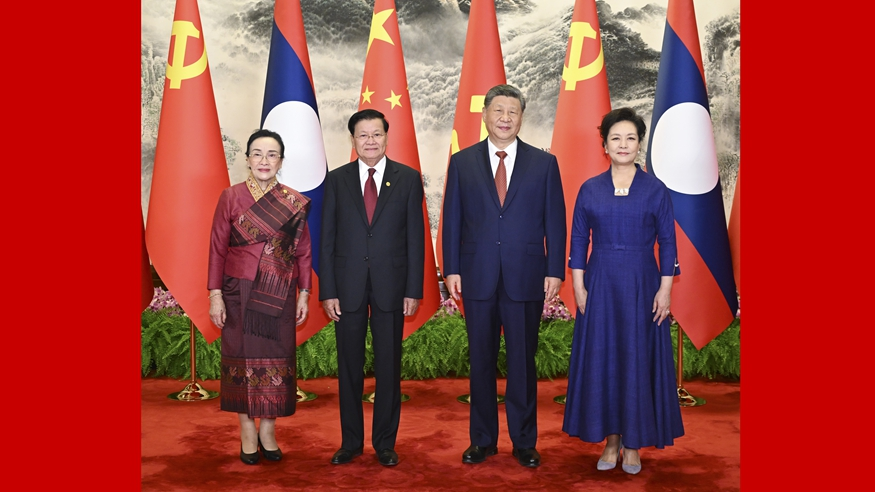
Strategic Alignment in Beijing: China and Laos Strengthen Bilateral Ties Amid Regional Shifts
BEIJING — In a move signaling a deepening of long-standing diplomatic ties, the top leadership of China and Laos convened in Beijing this week for high-level talks aimed at reinforcing their strategic partnership. The discussions, held between the Chinese presidency and the leadership of the Lao People’s Democratic Republic, focused on elevating the “all-weather” friendship between the two nations into a more integrated “community with a shared future.”
The meeting comes at a pivotal moment for Southeast Asian geopolitics, as both nations seek to navigate complex economic transitions and shifting regional security dynamics. For Beijing, the engagement underscores its commitment to securing stable, cooperative relationships within its immediate periphery. For Vientiane, the talks represent a critical opportunity to accelerate infrastructure development and economic modernization through enhanced connectivity with the world’s second-largest economy.
As the two nations deliberate on future cooperation, the focus remains squarely on three pillars: high-quality economic integration, regional stability through the Mekong subregion, and the continued implementation of large-scale infrastructure projects under the Belt and Road Initiative (BRI). The outcome of these talks is expected to set the trajectory for bilateral relations for the remainder of the decade.
Strengthening the Strategic Partnership
The core of the Beijing discussions centered on the conceptual framework of a “China-Laos community with a shared future.” This diplomatic doctrine, which has become a cornerstone of their bilateral relationship, moves beyond traditional diplomacy toward a more deeply intertwined political and economic alignment. Officials from both sides emphasized that the partnership is not merely transactional but is rooted in mutual political support and a shared vision for regional development.

During the sessions, leaders addressed the importance of maintaining political stability and enhancing cooperation in areas such as security, social development, and people-to-people exchanges. This includes strengthening ties between the Communist Party of China (CPC) and the Lao People’s Revolutionary Party (LPRP), a relationship that provides the political bedrock for their formal state-to-state interactions.
The discussions also highlighted a mutual interest in navigating the complexities of a multipolar world. By aligning their strategic interests, both Beijing and Vientiane aim to ensure that their bilateral relationship remains resilient against external economic pressures and shifting global trade patterns. This alignment is seen as a way to bolster Laos’s position within the ASEAN (Association of Southeast Asian Nations) framework while supporting China’s broader regional engagement strategies.
From Land-Locked to Land-Linked: The Economic Dimension
Perhaps the most tangible aspect of the China-Laos relationship is the massive emphasis on infrastructure. A primary topic of the Beijing talks was the continued optimization of the China-Laos Railway, a landmark project that has fundamentally altered the economic geography of the region. Since its official opening, the railway has been the centerpiece of Laos’s ambitious strategy to transform from a land-locked nation into a “land-linked” hub for regional trade.

The railway serves as a vital artery, connecting Kunming in China’s Yunnan province directly to Vientiane, the Laotian capital. This connection has significantly reduced transit times and costs for both agricultural exports from Laos and manufactured goods from China. The talks in Beijing sought to explore ways to maximize the economic spillover effects of this corridor, including the development of special economic zones (SEZs) and improved logistics networks surrounding the rail terminals.
Infrastructure and Energy Cooperation
Beyond the rail corridor, economic cooperation is heavily weighted toward energy and the Belt and Road Initiative (BRI). Laos, often referred to as the “battery of Southeast Asia” due to its vast hydroelectric potential, continues to seek Chinese investment to expand its power generation and transmission capabilities. This energy cooperation is mutually beneficial: Laos gains the capital and technology required to become a regional energy exporter, while China secures a stable supply of renewable energy to support its own growing green energy needs.
The leaders also touched upon the diversification of trade. While traditional commodities remain essential, there is a growing push toward “high-quality” development, which includes digital economy cooperation, e-commerce, and the modernization of agricultural supply chains. By integrating Laotian producers more deeply into Chinese markets through digital platforms, both nations hope to foster more sustainable and high-value economic growth.
Regional Geopolitics and the Mekong Subregion
The bilateral relationship between China and Laos cannot be viewed in isolation from the broader geopolitical landscape of the Mekong subregion. The management of the Mekong River—a vital lifeline for millions in Southeast Asia—remains a sensitive and critical issue. The Beijing talks included discussions on enhancing cooperation within the Lancang-Mekong Cooperation (LMC) framework, which seeks to address water resource management, environmental protection, and flood control.
For China, fostering close ties with Laos is a key component of its strategy to maintain influence within the Mekong subregion and to promote a regional order that prioritizes stability and development over external intervention. For Laos, a strong relationship with China provides a necessary counterweight and a source of developmental capital that is essential for its national progress.
the talks underscored the importance of regional stability in the context of ASEAN’s centrality. As Southeast Asia becomes a primary theater for great-power competition, the China-Laos partnership serves as a model for how middle and smaller powers can engage with major neighbors to secure developmental gains without compromising regional equilibrium. The ability of these two nations to coordinate on maritime and terrestrial security issues also remains a quiet but significant component of their strategic dialogue.
Key Takeaways: China-Laos Strategic Alignment
| Strategic Pillar | Primary Objective | Key Implementation Tool |
|---|---|---|
| Political Alignment | Building a “community with a shared future” | CPC-LPRP party-to-party cooperation |
| Economic Connectivity | Transforming Laos from land-locked to land-linked | China-Laos Railway and BRI corridors |
| Energy Security | Developing regional renewable energy hubs | Hydroelectric projects and grid integration |
| Regional Stability | Managing Mekong subregion resources | Lancang-Mekong Cooperation (LMC) |
The meeting in Beijing reaffirms that the relationship between China and Laos is moving into a more sophisticated phase. It is no longer just about bilateral trade or simple infrastructure projects; it is about the deep integration of economic, political, and environmental systems. As the two nations continue to implement the agreements reached this week, the rest of Southeast Asia will be watching closely to see how this strengthened axis influences the regional balance of power and the pace of economic integration.
Next Checkpoint: Further details regarding specific bilateral trade agreements or new infrastructure funding announcements are expected following the release of the official joint communiqué from the respective foreign ministries.
What do you think about the growing economic integration in the Mekong subregion? Share your thoughts in the comments below and share this article with your network.
Keep reading