
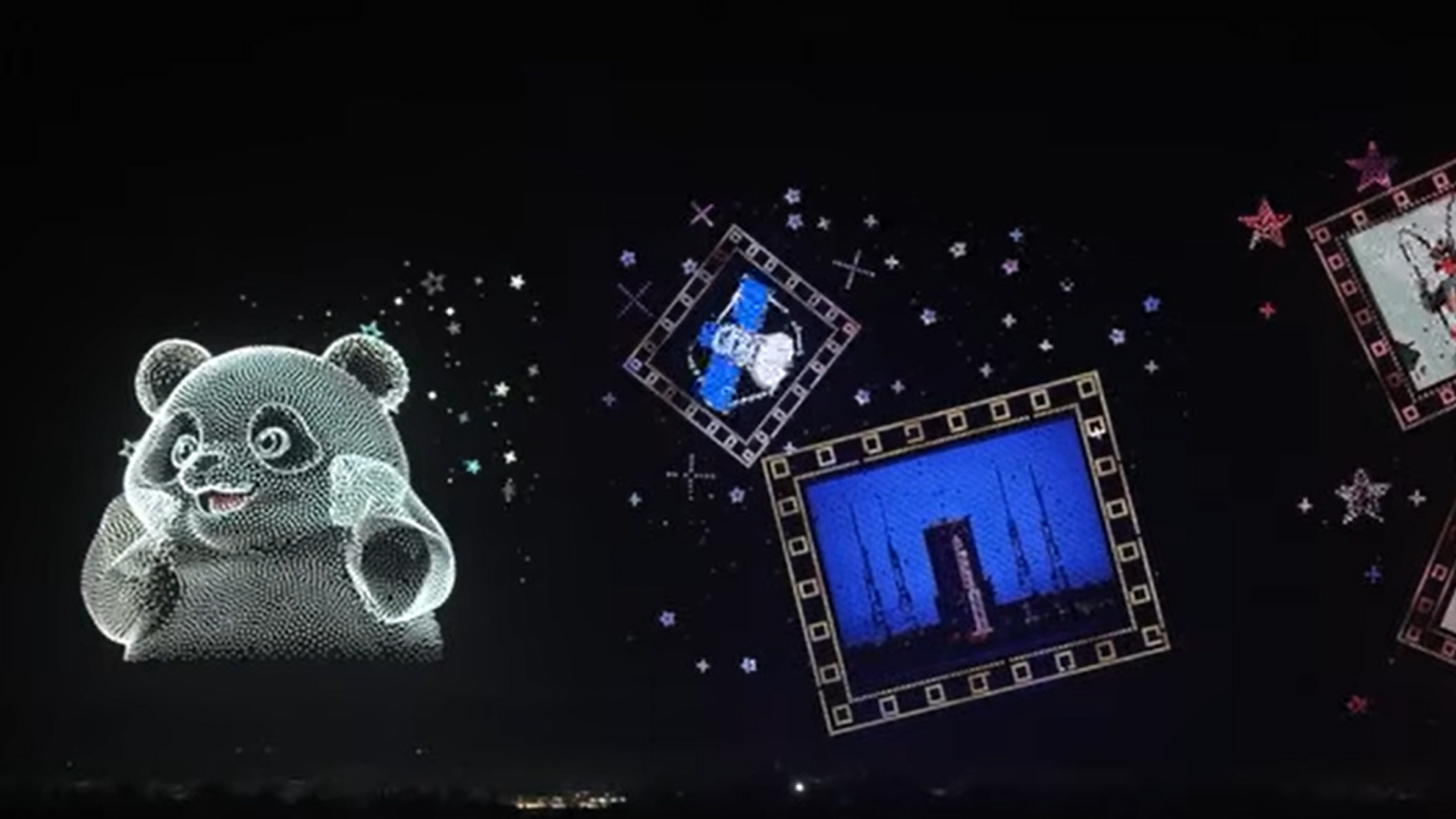
A swarm of 33,615 drones recently illuminated the night sky in Sichuan, China, setting three new Guinness World Records for the largest aerial drone display. The performance, which utilized a massive LED mesh to form intricate cultural imagery, has drawn international attention to the rapid advancement of swarm robotics and coordinated autonomous flight systems. According to official records from Guinness World Records, the event surpassed previous benchmarks for the number of unmanned aerial vehicles (UAVs) operating in a single, synchronized formation.
The display, which took place in late September 2024, was orchestrated to showcase the precision of large-scale drone choreography. Each drone acted as a single pixel within a vast, three-dimensional mesh, allowing the swarm to create complex, fluid shapes that appeared to float against the night sky. The sheer scale of the operation required sophisticated software capable of managing thousands of individual flight paths simultaneously while maintaining safety distances and battery synchronization, as noted in technical reports regarding large-scale drone swarm operations.
How the Drone Swarm Achieved Record-Breaking Scale
The technical achievement relied on a centralized control system that processed telemetry data for every one of the 33,615 drones in real time. Unlike smaller drone shows that often use pre-programmed flight paths, this display necessitated high-bandwidth communication links to prevent signal interference—a common hurdle in dense swarm environments. According to industry analysis published by IEEE Spectrum, managing a swarm of this magnitude requires robust anti-collision algorithms and precise GPS positioning to ensure that the “pixels” of the mesh do not overlap or drift during the performance.

The record-breaking event in Sichuan officially surpassed the previous title holders, which typically featured between 5,000 and 10,000 drones. By more than tripling the previous capacity, the organizers demonstrated a significant shift in the feasibility of massive-scale aerial displays. Guinness World Records confirmed that the performance successfully met the criteria for the most drones used in an aerial display, the largest aerial image formed by drones, and the longest duration for a swarm of this specific density.
The Evolution of Autonomous Swarm Technology
Beyond the visual spectacle, the event highlights the practical evolution of swarm intelligence. While these displays are designed for entertainment, the underlying technology has significant implications for sectors such as search and rescue, environmental monitoring, and logistics. The ability to coordinate tens of thousands of autonomous units is a key area of study in computer science research, where researchers focus on decentralized decision-making and collective behavior.

In a decentralized swarm, individual drones communicate with their neighbors rather than relying solely on a central controller. This approach makes the group more resilient to the failure of a single unit. As demonstrated in recent academic literature on autonomous drone coordination, the transition from centralized to decentralized control is the next frontier for ensuring that large swarms can operate reliably in complex or unpredictable environments.
Safety and Regulatory Considerations
Operating a swarm of over 33,000 drones involves stringent safety protocols and airspace management. In China, all commercial and large-scale drone operations must comply with regulations set by the Civil Aviation Administration of China (CAAC). These regulations mandate flight clearance, pilot certification for ground control stations, and strict adherence to geofencing to prevent interference with civilian or military aircraft.
The Sichuan display was conducted in a cordoned-off area, ensuring that spectators remained at a safe distance from the flight path. For large-scale events, organizers are typically required to provide a comprehensive risk assessment that details how the system handles communication blackouts or sudden sensor failure. The success of this display suggests that current flight management systems are capable of handling high-density traffic, provided the operational environment is carefully controlled and monitored.
What Happens Next for Swarm Robotics?
The next milestone for the industry will likely be the integration of these swarms into practical, non-entertainment applications. While the current record serves as a proof of concept for display technology, the industry is now pivoting toward autonomous infrastructure inspection and rapid-response disaster relief. Industry stakeholders are expected to provide further updates on the integration of these swarm technologies during the upcoming international robotics and automation forums scheduled for early 2025.

As the technology matures, the focus will remain on battery efficiency and the development of lightweight, long-endurance airframes. Readers interested in the future of autonomous systems can follow updates from the International Federation of Robotics for ongoing developments in swarm standards and safety. If you have thoughts on the potential uses for such massive drone formations, feel free to share your perspective in the comments section below.