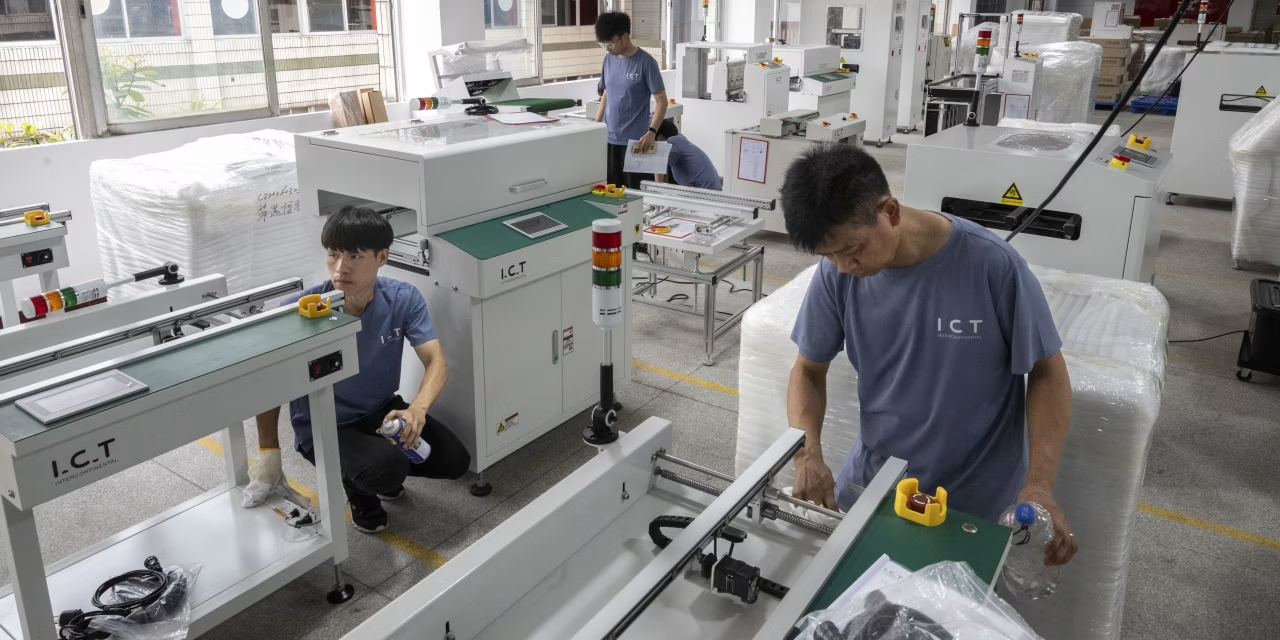
China is evolving beyond finished consumer goods to export smart manufacturing operating systems, industrial robotics, and factory automation platforms overseas. According to recent trade data and industry reports, Chinese manufacturers are building overseas production bases and licensing technology to counter tariffs and sluggish domestic demand.
Exporting the Industrial Internet and Smart Factory Platforms
Chinese companies are transplanting the same manufacturing operating systems used at home into international production hubs, spreading digital standards across global supply chains. At the Rayong Industrial Estate in Thailand’s Eastern Economic Corridor, trailers loaded with electric sedans move continuously through a local BYD facility where electronic display boards update defect rates and process progress every second. A Chinese technician on site stated, We are working on aligning the Thai production line to the same standards as the Shenzhen factory.
This operational shift relies on industrial internet platforms that integrate production facilities, logistics, and quality control via the Internet of Things, artificial intelligence, and big data. Data from China’s Ministry of Industry and Information Technology shows that the number of industrial internet platforms exported overseas by Chinese companies stood at just 80 in 2018, but is projected to surge more than fourfold to around 340 by the end of this year.
From Consumer Goods to Intermediate and Capital Hardware
Industrial transformation spans from high-tech machinery to the physical infrastructure of global manufacturing. Dongguan, a city near Hong Kong that built its reputation on cheap toys, shoes, and apparel, now stands at the center of a shift toward exporting higher-value intermediate and capital goods like chips, precision machinery, and robotic arms, according to reporting by WSJ.
In the past, advanced manufacturing was led by Germany and Japan,
said Frank Jiang, vice president of international business at Topstar, one of China’s largest industrial robotics and machinery manufacturers, in an interview cited by WSJ. But we believe our technology has caught up. For many products, we have surpassed them.
Official customs data analyzed by the McKinsey Global Institute shows that in the first five months of 2026, China’s exports of intermediate and capital goods jumped 25% and 12% respectively compared to the prior year, while consumer goods exports grew by just 4%.
Tariff Evasion and the K-Shaped Domestic Economy
Export expansion comes as Beijing confronts a K-shaped domestic economy burdened by weak consumer confidence and a prolonged real estate slump. Gross domestic product expanded at 4.3 per cent year-on-year in the second quarter, marking one of the slowest rates in years, while retail sales grew just 1 per cent and real estate investment plunged by 18 per cent in the first half, according to data cited by scmp.com.
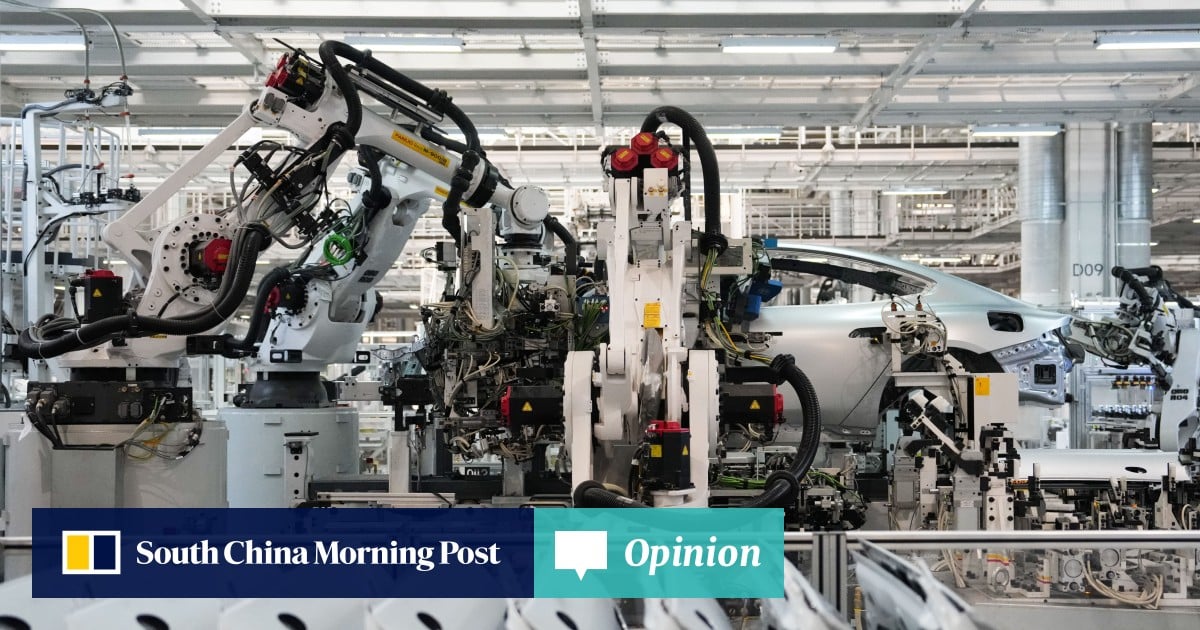
Export reliance has strained trade relations, prompting advanced economies to push back against perceived overcapacity. France and Germany recently agreed to pursue tougher European Union trade safeguards. Yet analysts note that tariffs on finished products do little to stop Chinese firms from building factories abroad. Professor Yu Hao from the International Institute for Management Development in Switzerland diagnosed in an analysis published by the South China Morning Post that China’s next export will be the world’s factory itself.
“Tariffs can block imported goods, but they cannot stop Chinese companies from building factories overseas and producing there,” adding that “China’s future overseas income will come not from finished product exports but from technology royalties and investment dividends.”
Professor Yu Hao, International Institute for Management Development, via South China Morning Post
Corporate Strategies and Regional Manufacturing Rivalry
Major Chinese enterprises are actively executing this dual strategy of globalizing production while keeping core intellectual property tied to the home country through strict outbound investment screening. Midea has deployed its proprietary industrial internet platform to a facility in Thailand’s Chonburi Industrial Estate operating on a 5G network built by Huawei, China Unicom, and AIS. Meanwhile, automakers are leveraging direct investments and licensing deals, such as CATL providing battery technology to Ford’s Michigan plant and Chery acquiring a former Nissan facility in Barcelona, Spain, to manufacture electric vehicles.
These developments present distinct competitive pressures for neighboring manufacturing powers. Lee Jong-myung, head of the Industrial Growth Division at the Korea Chamber of Commerce and Industry, noted that Chinese manufacturing is evolving beyond a low-cost mass production system into an intelligent service that sells platforms and standards, urging regional competitors to look beyond simple product shipments.
Keep reading