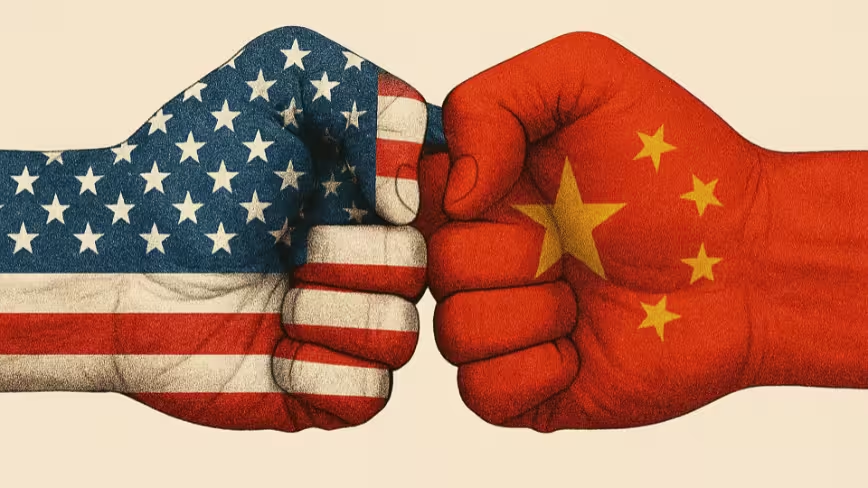
China’s Ministry of Commerce warned on Saturday that US legislation advancing through Congress would “severely disrupt the international economic and trade order and seriously undermine the stability of the global semiconductor industry chain and supply chain.” The legislation in question is the MATCH Act, the Multilateral Alignment of Technology Controls on Hardware, which passed the US House Committee on Foreign Affairs on April 22, 2026.
The MATCH Act aims to close loopholes to prevent the Chinese military from accessing advanced semiconductors, according to a press release by the US House Committee on Foreign Affairs. It is part of a broader markup of export control measures intended to ensure America continues to lead in the AI Arms Race.
China will closely follow the progress of the relevant legislation, carefully assess its impact on China’s interests, and will resolutely take necessary measures to firmly safeguard the legitimate and lawful rights and interests of Chinese enterprises, a spokesperson with China’s Ministry of Commerce (MOFCOM) said on Saturday.
China has consistently opposed any actions that overstretch the concept of national security and abuse export control measures, the MOFCOM spokesperson added. If the bill is eventually enacted, it will severely disrupt the international economic and trade order and seriously undermine the stability of the global semiconductor industry chain and supply chain.
The MATCH Act would extend semiconductor export controls to block China from buying and servicing DUV lithography tools, and Asian chipmakers with China fabs are directly in the crosshairs.
Understanding the MATCH Act and Its Scope
The Multilateral Alignment of Technology Controls on Hardware (MATCH) Act is a legislative proposal designed to strengthen coordination among allied nations on export controls for advanced semiconductor manufacturing equipment. It seeks to prevent adversaries, particularly China, from acquiring critical technologies that could enhance military capabilities.
The bill targets key components of the semiconductor supply chain, including deep ultraviolet (DUV) lithography tools, which are essential for producing chips used in a wide range of applications from consumer electronics to defense systems. By restricting access to such equipment, the US aims to limit China’s ability to advance its domestic semiconductor industry.
According to the US House Committee on Foreign Affairs press release dated April 22, 2026, the MATCH Act is part of a series of export control measures being marked up to address concerns about technology transfer and national security in the context of the global AI arms race.
China’s Response and Global Implications
China’s Ministry of Commerce has expressed strong opposition to the MATCH Act, arguing that it overextends the concept of national security and misuses export control mechanisms. The ministry warns that such actions could destabilize global markets and harm businesses worldwide that rely on interconnected semiconductor supply chains.
Asian chipmakers with fabrication facilities in China are particularly vulnerable to the proposed restrictions. These companies often serve as critical nodes in the global production network, supplying chips to manufacturers across industries and regions. Disruptions to their operations could ripple through the global economy, affecting everything from smartphones to automobiles.
China has pledged to monitor the legislation’s progress closely and assess its impact on national interests. The MOFCOM spokesperson emphasized that Beijing will take firm action to protect the rights of Chinese enterprises engaged in lawful international trade.
Historical Context of US-China Tech Tensions
The MATCH Act represents the latest development in an ongoing strategic competition between the United States and China over technological supremacy. Over the past several years, the US has imposed a series of export controls targeting advanced semiconductors, semiconductor manufacturing equipment, and related technologies.
These measures have been justified by US officials as necessary to prevent the diversion of sensitive technology to military end-users in China. Critics, however, argue that such controls risk fragmenting the global tech ecosystem and incentivizing China to accelerate efforts toward self-reliance in critical industries.
The current legislative effort builds on previous initiatives like the CHIPS and Science Act of 2022, which aimed to strengthen domestic semiconductor production in the US while also addressing supply chain vulnerabilities exposed during the pandemic.
What Happens Next?
The MATCH Act must now proceed through the full House of Representatives and potentially the Senate before it can be signed into law by the President. No vote has been scheduled in either chamber as of April 25, 2026.
China’s Ministry of Commerce has stated it will continue to follow the bill’s progress carefully and evaluate its potential consequences for global trade and industry stability. Officials from both countries are expected to engage in diplomatic discussions through established channels, though no specific meetings have been announced.
For updates on the legislative process, readers can refer to the official website of the US House Committee on Foreign Affairs. Statements from China’s Ministry of Commerce are typically published via its official portal and disseminated through state-affiliated media outlets such as Global Times and ECNS.
As the situation evolves, the global semiconductor industry will be watching closely to see whether the MATCH Act advances to become law—and what that could mean for the future of international technology cooperation and competition.
What are your thoughts on the growing tech tensions between the US and China? Share your perspective in the comments below, and experience free to share this article with others interested in global technology policy.
Keep reading