
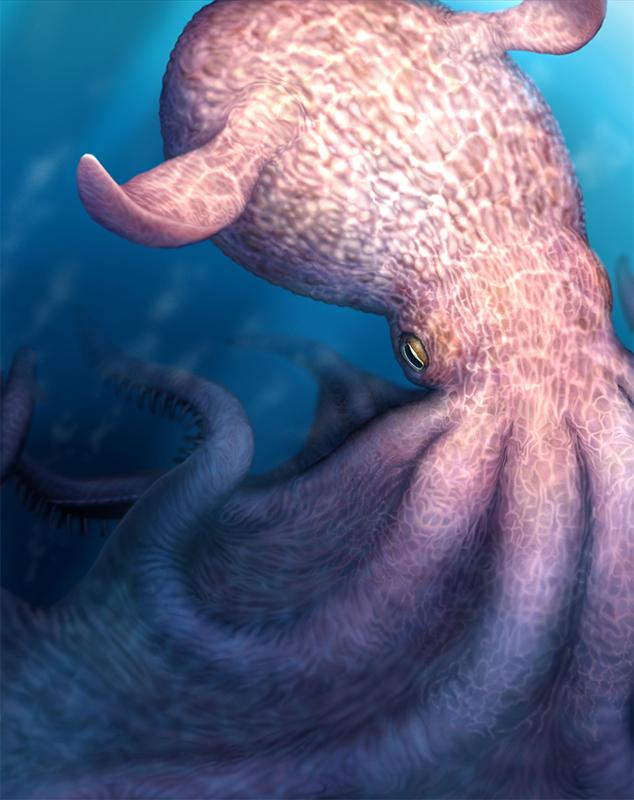
Recent paleontological discoveries have shed new light on the ancient oceans of the Cretaceous Period, revealing that giant octopus-like creatures, colloquially referred to as “krakens,” may have dominated marine ecosystems as apex predators. These findings challenge long-held assumptions about the marine food chain during the age of dinosaurs, suggesting that soft-bodied invertebrates could rival—and possibly surpass—large vertebrates in size, intelligence, and predatory power.
The evidence comes from fossilized jaws unearthed in Japan and Canada’s Vancouver Island, dating back to between 100 million and 72 million years ago. Researchers from Hokkaido University analyzed 15 known cephalopod jaw fossils and identified an additional 12 specimens embedded in rock formations. Using comparative anatomy and scaling techniques based on modern octopus and squid beaks, they estimated that some of these ancient creatures reached lengths of up to 19 meters—comparable to a semi-truck—and possessed sophisticated hunting abilities.
Unlike most octopuses, which rarely fossilize due to their soft bodies, these Cretaceous krakens left behind durable chitinous beaks—hard, jaw-like structures made of the same material found in insect exoskeletons and fungal cell walls. The size and robustness of these beaks indicate powerful biting force, capable of subduing large prey. According to the study published in Science on April 23, 2026, these cephalopods were not merely scavengers but active hunters that occupied the top tier of the Cretaceous marine food web.
During this period, marine reptiles such as mosasaurs were previously thought to rule the oceans unchallenged, although dinosaurs like Tyrannosaurus rex dominated terrestrial habitats. Yet, the new research suggests that giant octopuses may have competed directly with these reptiles for prey and habitat. Yasuhiro Iba, a paleontologist at Hokkaido University and lead author of the study, noted that the discovery implies a more complex ecosystem than previously modeled, where invertebrates played a far more significant role as predators.
The intelligence of these ancient cephalopods is inferred from their modern relatives. Octopuses today exhibit problem-solving skills, tool use, and complex behaviors supported by large brains and sophisticated nervous systems. While direct evidence of cognition in fossils is impossible, the evolutionary consistency of cephalopod neurology supports the hypothesis that their Cretaceous counterparts possessed heightened sensory and learning abilities, enhancing their effectiveness as predators.
This discovery also raises questions about the evolutionary limits of invertebrate size. For the past 370 million years, vertebrates have dominated the upper tiers of marine ecosystems—think sharks, ichthyosaurs, plesiosaurs, and whales. The existence of 19-meter-long octopuses suggests that, under certain ecological conditions, soft-bodied animals could achieve vertebrate-rivaling dimensions. Whether these krakens were the largest invertebrates to ever live remains under investigation, but their size places them among the most extreme examples of invertebrate gigantism in Earth’s history.
Preserving soft-tissue fossils is exceptionally rare, which explains why such discoveries have taken so long to surface. The reliance on beak fossils means scientists must infer entire body size, behavior, and ecology from limited hard parts. To address this, researchers used biomechanical modeling and comparisons with extant cephalopods to estimate total length and feeding mechanics. Despite these uncertainties, the consistency across multiple fossil sites strengthens the case for widespread presence of these giant predators during the Late Cretaceous.
The study’s authors emphasize that their function does not claim octopuses replaced mosasaurs or sharks as the sole apex predators, but rather that they were part of a dynamic and competitive marine ecosystem. As Iba explained in interviews following the publication, “We’re not saying octopuses ruled the seas alone—but they were certainly players at the highest level, and that changes how we view prehistoric ocean life.”
Moving forward, researchers plan to examine additional fossil sites in hopes of finding more complete remains, including potential impressions of soft tissues or trace fossils that could reveal movement patterns or feeding behaviors. Advances in imaging technology, such as synchrotron scanning, may allow non-destructive analysis of internal structures within existing fossils, offering deeper insights without damaging precious specimens.
For the public and scientific community alike, this discovery serves as a reminder of how much remains hidden in the fossil record—and how new perspectives can reshape our understanding of life’s diversity over geological time. As ongoing research continues to uncover the secrets of ancient seas, the image of the kraken shifts from myth to a plausible chapter in Earth’s natural history.
To stay updated on developments in paleontology and evolutionary biology, readers can follow announcements from the American Association for the Advancement of Science (AAAS) and the Scientific American, both of which regularly cover breakthroughs in fossil research.
What do you think about the idea of giant octopuses patrolling Cretaceous oceans? Share your thoughts in the comments below, and help spread awareness of this fascinating discovery by sharing the article on social media.