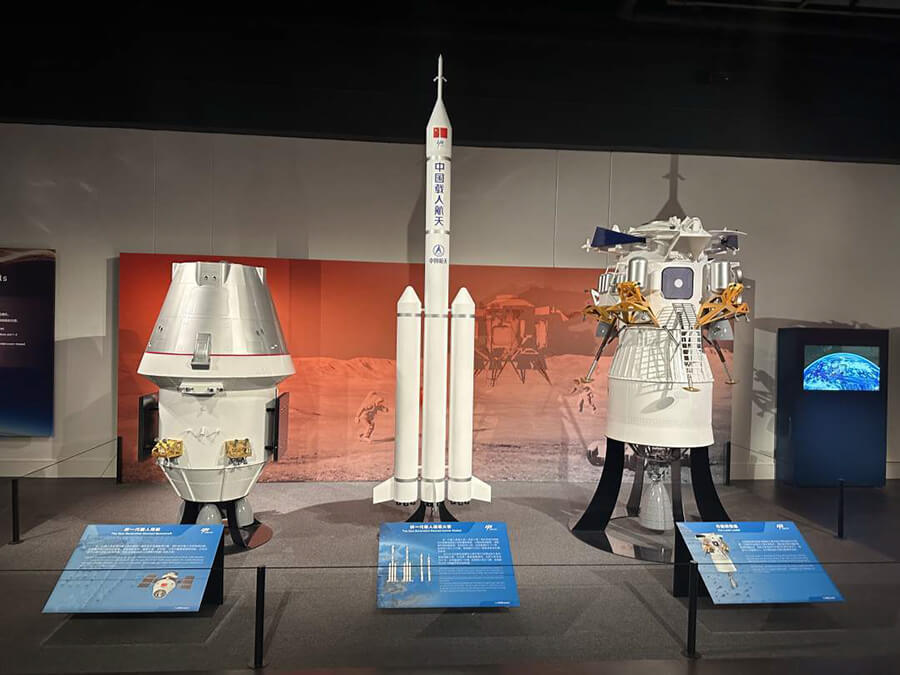
The celestial horizon is once again becoming a theater for geopolitical ambition as the United States and China accelerate their efforts to return humans to the lunar surface. This renewed competition, often characterized as a new space race, is no longer just about the prestige of a first footprint, but about establishing a sustainable presence on the Moon and securing the technological leadership of the next century.
Beijing is aggressively advancing its infrastructure to meet these goals, focusing on a suite of specialized hardware designed to transport astronauts across the void. At the heart of this effort is the development of the Long March 10 heavy-lift rocket, the Mengzhou crew spacecraft, and the Lanyue lunar lander, which together form the backbone of China’s manned lunar exploration program.
For the international community, the stakes extend beyond scientific discovery. The ability to land humans on the Moon and maintain a lunar base represents a pinnacle of engineering and organizational capability, signaling a nation’s status as a global superpower in the high-tech era. As NASA continues its Artemis campaign, China’s rapid progress suggests a timeline that may bring the two superpowers to the lunar surface in close proximity.
China’s Path to the Moon: The Long March 10 and Beyond
China has reached a critical juncture in its lunar ambitions with the development of the Long March 10. This heavy-lift launch vehicle is specifically designed to propel the Mengzhou spacecraft and its crew toward the Moon. Recent milestones indicate that the program is moving from the design phase into active testing and implementation.
A significant breakthrough was recently achieved as China successfully completed a low-altitude test of the Long March 10, a move that marks a major step forward for the country’s manned lunar exploration program Global Times. These tests are essential for verifying the aerodynamic stability and control systems of the rocket before It’s tasked with the immense pressure of a lunar trajectory.
Looking ahead, the timeline for these assets is becoming clearer. China is currently targeting 2026 for the first launch of the Long March 10, as well as the first flight of the new lunar crew spacecraft SpaceNews. The Mengzhou spacecraft will serve as the primary transport for taikonauts, while the Lanyue lander is intended to facilitate the actual descent and ascent from the lunar surface.
A Complex Dynamic: Rivalry or Collaboration?
The relationship between NASA and the China National Space Administration (CNSA) is often framed as a binary rivalry, yet the reality is more nuanced. While both nations are competing for lunar dominance, the nature of this “race” differs from the Cold War era. Today’s competition is characterized by a mix of strategic friction and a shared, albeit distant, interest in the advancement of human knowledge.
Industry analysts suggest that the current dynamic is a “rivalry/not-rivalry,” where the competitive pressure drives innovation while the sheer scale and cost of deep-space exploration leave the door open for potential future cooperation IEEE Spectrum. Yet, political tensions on Earth continue to influence how these agencies interact, often limiting direct collaboration.
Key Hardware of the Chinese Lunar Program
| Asset | Primary Function | Current Status/Target |
|---|---|---|
| Long March 10 | Heavy-lift launch vehicle | First launch targeted for 2026 |
| Mengzhou | Crew spacecraft | First flight targeted for 2026 |
| Lanyue | Lunar lander | Under development for surface operations |
What Which means for the Future of Space Exploration
The push toward the Moon is not merely a symbolic victory. The lunar south pole, in particular, is of high interest due to the presence of water ice, which could be converted into oxygen for breathing and hydrogen for rocket fuel. Controlling these resources would effectively turn the Moon into a “gas station” for further exploration of the solar system, including Mars.
For the global audience, the competition between the US and China accelerates the pace of discovery. When two superpowers compete, the resulting breakthroughs in materials science, propulsion, and life-support systems often trickle down into terrestrial applications, benefiting global industry and medicine.
However, the lack of a unified international framework for lunar governance remains a concern. As both nations move toward establishing semi-permanent bases, the world will be watching to see if the Moon becomes a site of diplomatic cooperation or a new frontier for territorial disputes.
The next major checkpoint for the global space community will be the targeted 2026 window for the first Long March 10 launch and the initial flight of the Mengzhou crew spacecraft. These events will determine if China can maintain its current momentum and potentially narrow the gap in the race to the lunar surface.
Do you believe the competition between the US and China will accelerate scientific progress, or does it risk creating unnecessary tension in space? Share your thoughts in the comments below.
Worth a look