
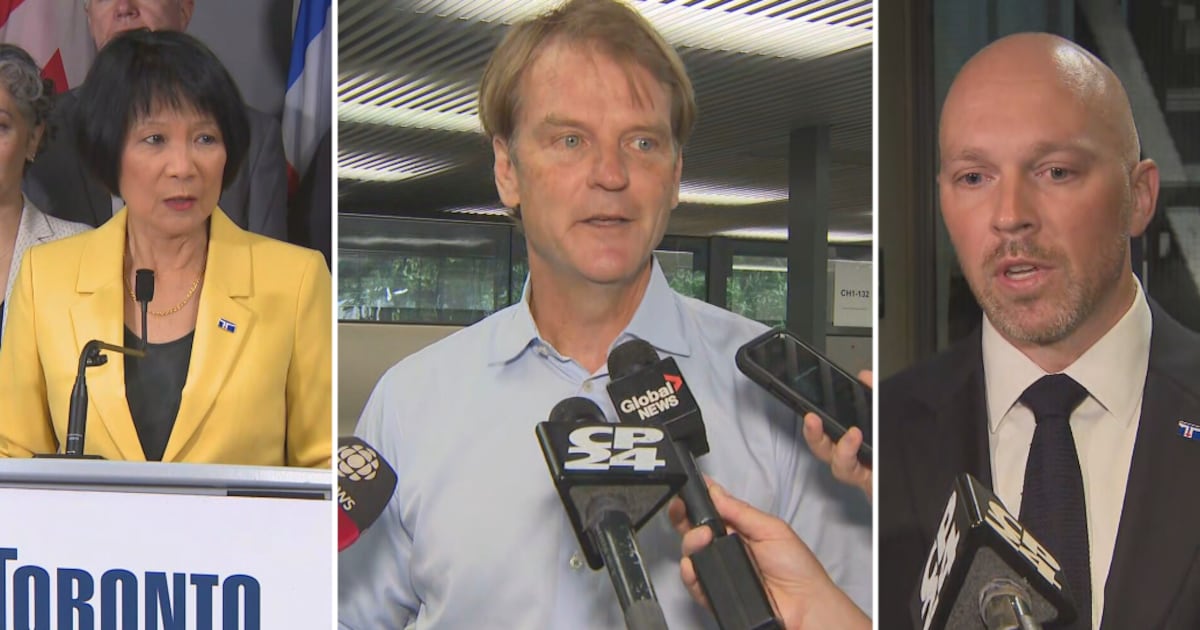
Former federal cabinet minister Chris Alexander registered as a mayoral candidate in Toronto on July 29, 2026, entering a 33-person race against incumbent Mayor Olivia Chow and Councillor Brad Bradford as a new Liaison Strategies poll shows Chow leading Bradford among decided voters.
Former federal Conservative cabinet minister Chris Alexander has officially entered Toronto’s mayoral race, registering his candidacy at City Hall. Pitching himself as an outside perspective to civic politics, the 57-year-old father of three argued that Toronto has been economically idle and requires centrist leadership to regain its footing ahead of the municipal election scheduled for October 26.
Candidate Background and Diplomatic Career
Alexander brings a background in federal politics and international diplomacy to the municipal contest. He served as Canada’s ambassador to Afghanistan from 2003 to 2005, living in the country for six years during the deployment of Canadian troops. He later represented the eastern suburb of Ajax-Pickering as a one-term Conservative Member of Parliament and served as the citizenship and immigration minister under former prime minister Stephen Harper from 2013 until the Conservative defeat in 2015. Following his time in parliament, he ran for the federal Conservative leadership in 2016-17, and subsequently worked as a consultant and as a fellow with the Canadian International Council and the Macdonald Laurier Institute.
“As democracy in Canada has always shown, it doesn’t hurt and it usually helps when people from outside of a given political arena bring their expertise and their experience to bear. I’m one of those people.”
Chris Alexander, Mayoral Candidate, via The Globe and Mail
Speaking to reporters, Alexander stated that his immediate priorities include improving public transit, increasing housing supply, and unlocking economic growth. He also addressed a controversial episode from his federal career: his role in proposing a barbaric cultural practices
tip line during the 2015 federal campaign, a policy that preceded his loss of his seat to the Liberals. Alexander acknowledged regret over the handling of that proposal, stating that we played that issue wrongly,
while maintaining his commitment to defending the rights of women and girls.
Rival Reactions from Mayor Chow and Councillor Bradford
Alexander’s entry into the contest drew starkly different responses from his primary opponents. Incumbent Mayor Olivia Chow declined to engage with his criticisms, telling reporters that she remains focused on municipal business. The election is three months from now,
Chow said. Today, I’m focusing on the last council. We have a lot of very important work ahead of us.

Councillor Brad Bradford offered a much sharper assessment during his scrum at Toronto City Hall. Bradford claimed he had never heard of Alexander prior to the campaign rumors and dismissed the bid as a distraction.
“In the most diverse city in the world, somebody who harbours those views, I think that makes you unfit for this office.”
Brad Bradford, Toronto City Councillor, via The Globe and Mail
Bradford characterized Alexander’s campaign as a vanity project
and an audition for his next job,
while also asserting that he held no concerns regarding potential vote-splitting on the centre-right side of the political spectrum.
Polling Figures and Strategic Impact on the Campaign
Alexander’s registration coincides with the release of a new Liaison Strategies poll surveying 1,000 Toronto residents between July 24 and July 26. Among decided voters, Mayor Chow holds 49 per cent support compared to Bradford’s 41 per cent, with other candidates capturing 10 per cent. When including all respondents, Chow sits at 39 per cent, Bradford at 33 per cent, other candidates at 8 per cent, and 20 per cent remaining undecided. Alexander was not included as an option in this particular survey.
| Voter Category | Olivia Chow | Brad Bradford | Other Candidates | Undecided |
|---|---|---|---|---|
| Decided Voters | 49 per cent | 41 per cent | 10 per cent | — |
| All Respondents (Including Undecided) | 39 per cent | 33 per cent | 8 per cent | 20 per cent |
Political observers note that Alexander’s presence could alter the contest dynamics by creating a second alternative to the incumbent mayor alongside Bradford. Myer Siemiatycki, professor emeritus of politics at Toronto Metropolitan University, observed that having two challengers creates distinct strategic hurdles for Bradford’s campaign. Meanwhile, Kelly Aizicowitz, executive director of the non-profit group A Better City Toronto, cautioned that an extended candidacy by Alexander risks splintering the anti-Chow electorate without a clear path to victory.
Alexander rejected the premise that his candidacy is designed to divide ballots. The votes of Torontonians aren’t a pie to be split up by strategists behind closed doors,
he told reporters, setting the stage for a three-month sprint toward the October 26 vote.
Keep reading