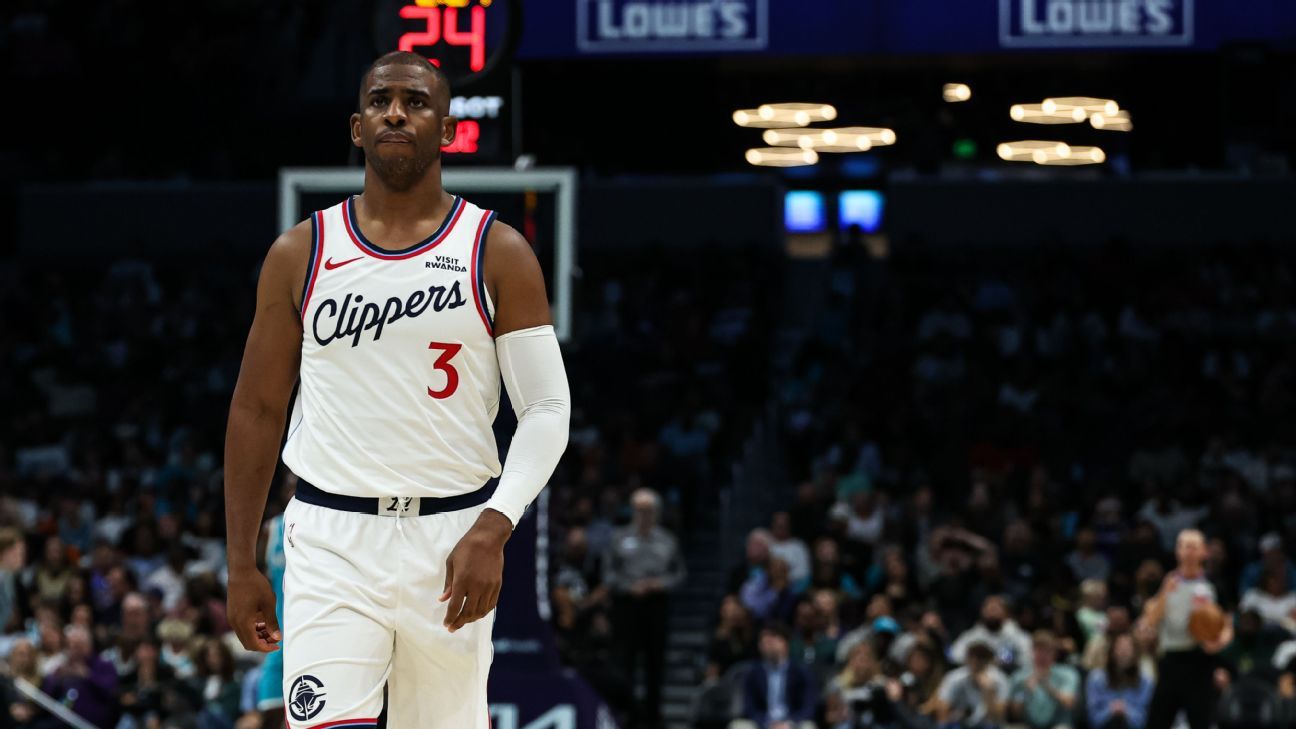
The End of an Era: Reflecting on the Legacy of Chris Paul
Chris Paul’s recent free agency departure signals more than just a change of address for a veteran point guard.It feels like the closing of a chapter - perhaps the chapter – on a specific archetype in the NBA. For those of us who’ve followed the league for decades,Paul represents a dying breed: the pure,unadulterated point guard.
He wasn’t just skilled; he understood the game at a level few ever reach. You saw it in his court vision,his precise passing,and his ability to control tempo.But his journey to becoming “The Point God” was anything but straightforward.
A career defined by Pivotal Moments
Let’s rewind a bit. Paul’s early career was marked by near-misses and dramatic twists. Remember the 2011 trade that would have sent him to the Los Angeles Lakers? It was famously vetoed at the last minute, a decision that reshaped the landscape of the Western Conference.
This ultimately lead to his arrival in Los Angeles with the Clippers, where he teamed up with Blake Griffin and DeAndre Jordan to create the electrifying “Lob City” era.It was a period of high-flying highlights and genuine excitement for a franchise long starved of success.
However, his time with the Clippers wasn’t without its challenges. He navigated the fallout from the Donald Sterling scandal, a dark chapter in NBA history, with grace and professionalism. You could see his leadership qualities shine even amidst the turmoil.
Beyond the court, Paul consistently stepped up as a leader. He was instrumental in establishing the NBA Bubble during the 2020 season, ensuring the league could safely resume play amidst the pandemic. His impactful tenure as president of the NBA Players association further cemented his role as a voice for the players.
The Last of a Dying Breed
But it’s his on-court brilliance that truly defines his legacy.In his prime, Paul wasn’t just a scorer; he was an orchestrator. He dictated the pace, found the open man, and consistently made the right play.
The game has evolved, though. Today, the lines between positions are blurred. Players are asked to do more, to be versatile threats on both ends of the floor. Centers like Nikola Jokic and forwards like Luka Doncic now possess the playmaking skills traditionally reserved for point guards.
Even the reigning MVP, Shai Gilgeous-Alexander, a player who counts Paul as a mentor, embodies this new breed - a dynamic scorer and a capable ball-handler.
Paul, however, remains a throwback. He’s a true point guard in the mold of John Stockton,Isiah Thomas,or Jason Kidd. he’ll finish his career near the top of the all-time assist list, trailing only Stockton. And among players 6-feet or shorter, he reigns supreme in career assists, steals, and rebounds.
What Does This Mean for the Future?
What you’re witnessing isn’t just the end of a career; it’s a shift in the vrey fabric of the game.The customary point guard, the floor general who prioritizes passing and decision-making above all else, is becoming increasingly rare.
While the skills of a traditional point guard haven’t disappeared, they’re now distributed across all five positions.Every player is expected to handle the ball, make passes, and contribute to the offense.
Chris Paul’s legacy isn’t just about the accolades or the statistics. It’s about preserving a style of play, a commitment to fundamentals, and a deep understanding of the game. He reminds us of a time when the point guard was the heart and soul of the team, the conductor of the orchestra. And for that, he’ll always be remembered as “the Point God.”
Worth a look