
For healthcare administrators and IT specialists, the countdown to a critical regulatory milestone has entered a high-pressure phase. With the compliance deadline for the Centers for Medicare & Medicaid Services (CMS) interoperability mandates looming, the industry is facing a practical hurdle: knowing exactly who to test with to ensure systems actually communicate.
The challenge centers on the “Advancing Interoperability and Improving Prior Authorization Final Rule,” known as CMS-0057-F. While the technical specifications for the required Application Programming Interfaces (APIs) are established, the real-world application requires rigorous testing between payers, providers, and vendors. Without successful interoperability testing, the promise of seamless data exchange remains theoretical.
To address this gap, the Workgroup for Electronic Data Interchange (WEDI) has launched a new interoperability testing directory. This free resource is designed to connect organizations that are ready to test their APIs with partners who need them, streamlining the path toward the January 1, 2027 compliance deadline.
As a physician and health journalist, I have seen how administrative friction—specifically the “fax-and-wait” cycle of prior authorizations—stalls patient care. The move toward standardized APIs is not merely a technical upgrade. This proves a fundamental shift in how healthcare delivery is coordinated in the United States.
Bridging the Gap in Healthcare Data Exchange
Interoperability is the ability of different information systems, devices, and software applications to access, exchange, and cooperatively use data in a coordinated manner. In the context of CMS-0057-F, Which means moving away from fragmented silos toward a unified digital ecosystem where data follows the patient.
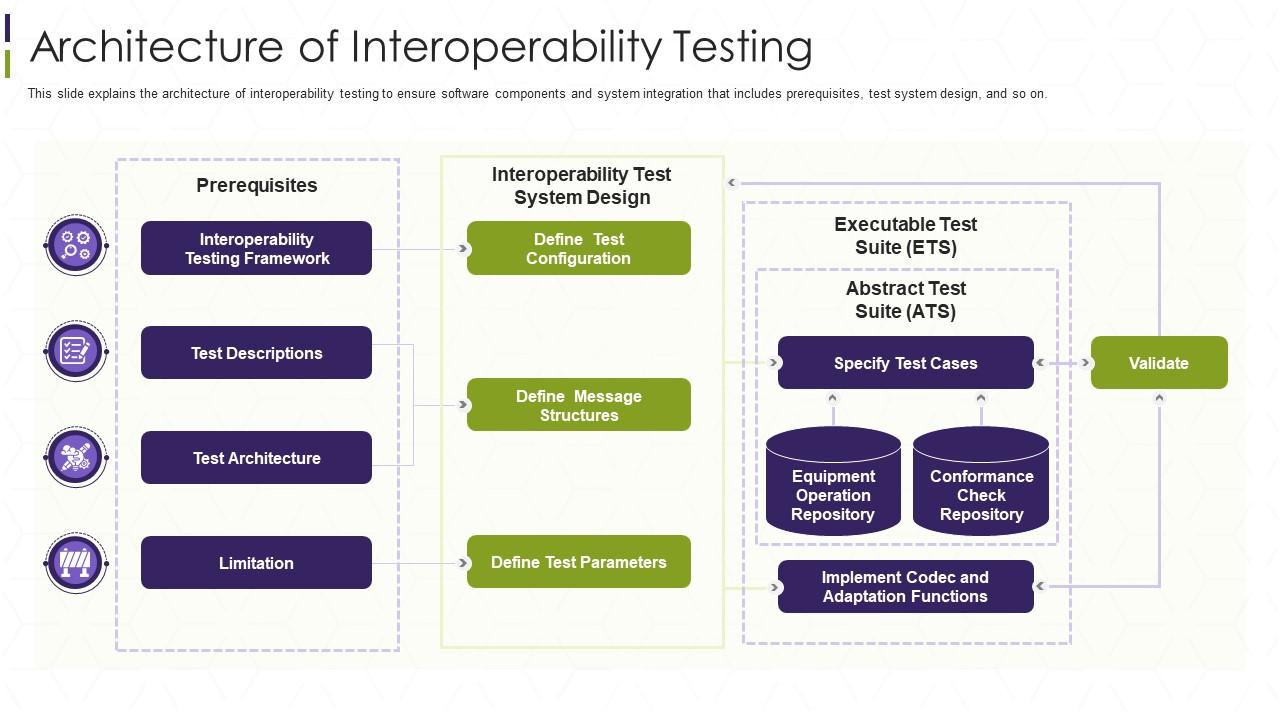
The WEDI interoperability testing directory serves as a matchmaking platform. Because the mandate requires multiple entities—such as a health insurance payer and a hospital system—to exchange data perfectly, neither can verify their readiness in a vacuum. They need a partner to “ping” their API and ensure the response is accurate and timely.
Robert Tennant, the Executive Director of WEDI, emphasized the urgency of this collaborative effort. “It is critical that organizations test with their partners to ensure readiness to meet the CMS-0057-F API requirements by January 1, 2027,” Tennant stated.
By providing a centralized location where payers, providers, and vendors can list their availability and technical capabilities, WEDI is attempting to remove the networking barrier that often slows down large-scale health IT implementations.
Breaking Down the CMS-0057-F API Mandates
To understand why a testing directory is necessary, one must understand the complexity of the CMS-0057-F requirements. The rule does not mandate a single tool, but rather four distinct API methodologies designed to reduce administrative burden and increase transparency.

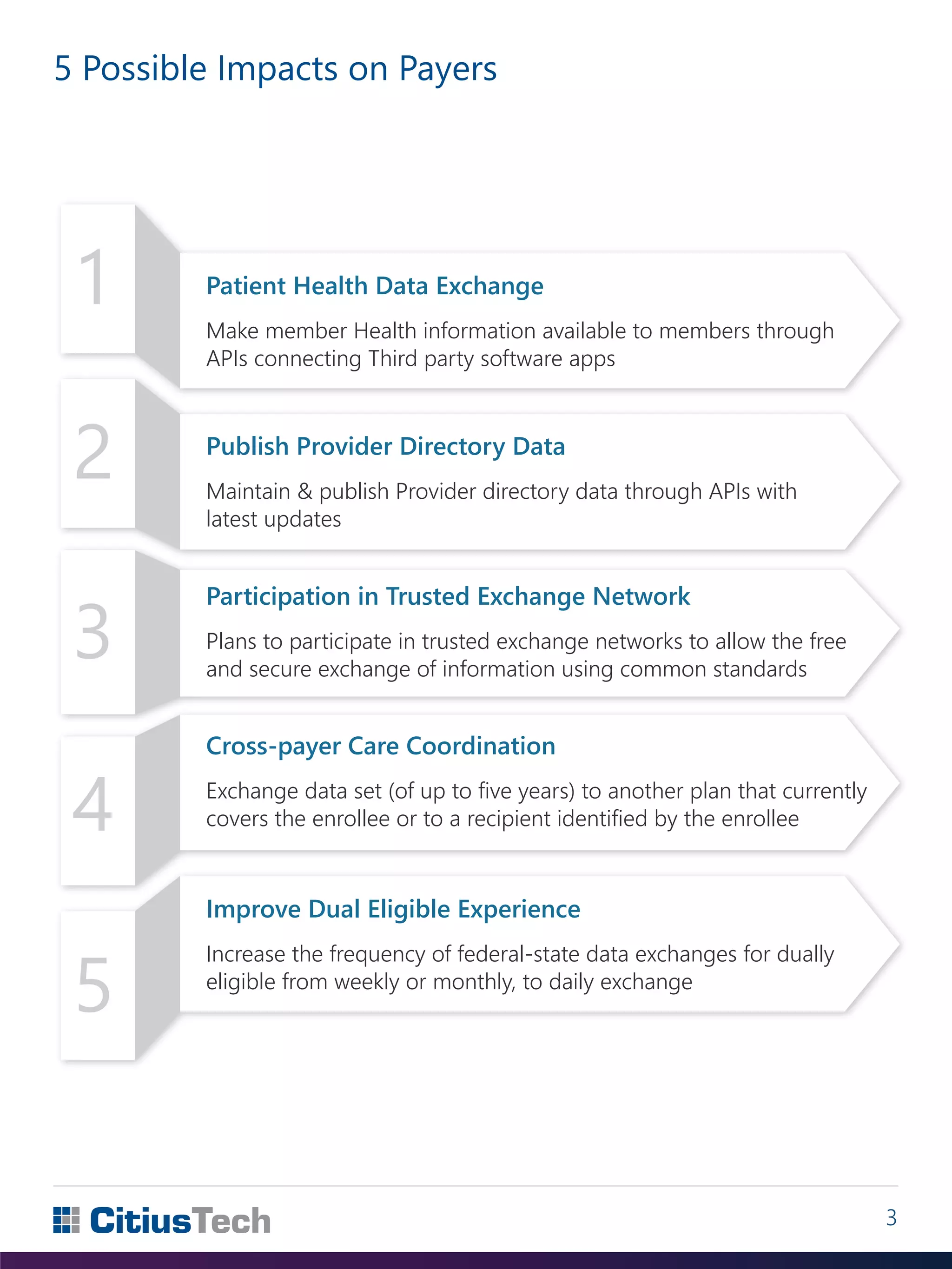
- Patient Access APIs: These empower patients to access their own health information from payers more easily, allowing them to move their data to the app or provider of their choice.
- Provider Access APIs: These allow healthcare providers to retrieve necessary data from payers, reducing the need for manual requests and phone calls to determine coverage or clinical history.
- Payer-to-Payer APIs: Designed for when a patient switches insurance plans, these APIs allow the new payer to request clinical data from the previous payer, ensuring continuity of care and reducing redundant testing.
- Prior Authorization APIs: Perhaps the most anticipated, these APIs aim to automate the prior authorization process. Instead of manual submissions, providers can check requirements and submit requests digitally, receiving faster responses.
Each of these four pathways requires a different set of data mappings and security protocols. A provider might have their Patient Access API working perfectly but find their Prior Authorization API fails when communicating with a specific payer’s system. What we have is why the WEDI directory is focused on “versions available for testing,” ensuring that partners are using compatible technical standards.
How the WEDI Testing Directory Functions
The directory is designed to be a low-friction resource. There is no cost to list an organization or to access the information within the directory, removing financial barriers to compliance.
Organizations interested in finding a testing partner can navigate the directory and review the profiles of other entities. Conversely, organizations ready to assist in testing can join the directory by completing a straightforward questionnaire. This questionnaire captures essential technical and logistical details, including:
- Organization name and primary contact details.
- The specific APIs (from the four mandated categories) available for testing.
- The technical versions of those APIs.
- Available dates and windows for testing.
- A link to the organization’s website for further technical documentation.
Once a match is found, the organizations can coordinate their own testing schedules and protocols. This decentralized approach allows the industry to scale its readiness rapidly without relying on a single, centralized testing hub that could become a bottleneck.
The Human Impact: Why Interoperability Matters
While the conversation around CMS-0057-F often focuses on “APIs” and “compliance deadlines,” the ultimate goal is the reduction of the “payer, provider, and patient burden.”
For the physician, this means fewer hours spent on the phone with insurance companies and less time spent chasing down clinical records. For the patient, it means faster approvals for critical medications or surgeries and a more cohesive experience when changing insurance providers.
The transition to these data exchange methodologies is expected to deliver a meaningful reduction in overall administrative waste. When data flows automatically and accurately, the risk of medical errors decreases, and the speed of care increases.
Key Takeaways for Health IT Leaders
- Deadline: Full compliance with CMS-0057-F API requirements is mandated by January 1, 2027.
- The Resource: WEDI has launched a free directory to help payers, providers, and vendors find interoperability testing partners.
- Core Requirements: The rule mandates four specific APIs: Patient Access, Provider Access, Payer-to-Payer, and Prior Authorization.
- Action Step: Organizations should list their available API versions and testing windows in the WEDI directory to ensure they are not left without a partner as the deadline approaches.
Looking Ahead: The Path to 2027
The launch of the WEDI directory on April 30, 2026, marks a transition from the “development” phase of CMS-0057-F to the “validation” phase. The coming months will be critical for organizations to identify gaps in their API performance and remediate them before the mandate takes full effect.
Industry stakeholders should continue to monitor official updates from the Centers for Medicare & Medicaid Services regarding any potential extensions or updated technical guidance. The focus now shifts to the execution of these partnerships and the successful exchange of live data.
The healthcare industry has a history of struggling with the “last mile” of implementation. By fostering a collaborative environment through the WEDI directory, the sector has a better chance of meeting the January 1, 2027, deadline and finally realizing the benefits of a truly interoperable health system.
We want to hear from you: Is your organization currently testing for CMS-0057-F compliance? What have been the biggest hurdles in finding interoperability partners? Share your thoughts in the comments below.