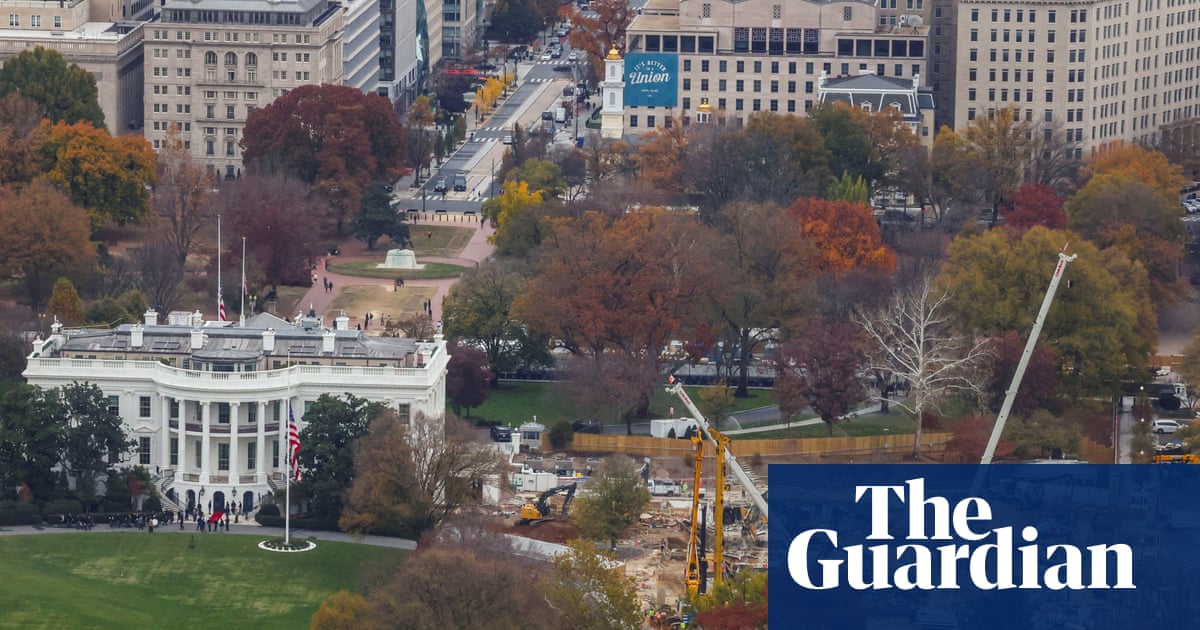
An appeals court in Washington, D.C., has ruled that the Trump administration may proceed with construction of a recent ballroom beneath the White House, despite ongoing legal challenges over the project’s justification and scope. The decision, issued by a three-judge panel of the U.S. Court of Appeals for the District of Columbia Circuit, allows work to continue while litigation over whether the expansion constitutes a legitimate use of federal funds proceeds in lower courts.
The ruling does not resolve the underlying dispute about whether the project — described by critics as a “massive underground complex” — is necessary for national security or primarily serves private or ceremonial purposes. Instead, the court determined that halting construction at this stage would cause unnecessary disruption and potential damage to the White House grounds, given the advanced state of excavation and structural work already underway.
The project, which began during the Trump administration, involves expanding the existing basement levels beneath the North Portico of the White House to create a larger event space capable of hosting state dinners, diplomatic receptions, and other high-profile gatherings. Officials have argued that the current ballroom, dating to the Truman renovation of the late 1940s, is too small to accommodate modern security protocols, technological infrastructure, and the scale of international events hosted by the presidency.
However, watchdog groups and Democratic lawmakers have challenged the project’s funding and necessity, asserting that it bypasses congressional appropriations processes and risks transforming a symbolic national residence into a fortified, insular complex. They contend that the administration’s reliance on national security as a justification lacks transparency and overlooks less costly alternatives for upgrading event capacity.
Court Balances Project Progress Against Legal Uncertainty
The appeals court’s decision centered on the balance of hardships and the likelihood of success on the merits of the legal claims. In its opinion, the court acknowledged that plaintiffs raised serious questions about whether the project complies with the National Environmental Policy Act (NEPA) and whether funds were properly allocated without congressional approval. Nevertheless, the judges concluded that the government had demonstrated sufficient cause to allow construction to continue pending a full review.
“While the plaintiffs’ concerns regarding procedural compliance and fiscal accountability are not without merit,” the court stated, “the equities favor maintaining the status quo at this juncture, particularly given the irreversible nature of ongoing excavation and foundation work.” The ruling emphasized that halting the project now could risk structural instability or require costly remediation if work were stopped and later resumed.
The decision does not preclude future rulings that could halt or modify the project. The case remains active in the U.S. District Court for the District of Columbia, where Judge Tanya Chutkan is overseeing the broader challenge. Earlier in the litigation, Judge Chutkan ruled that the administration could not categorically claim the entire project was essential for national security, noting that such a blanket assertion undermines judicial oversight of executive branch decisions.
That earlier finding, issued in March 2024, required the government to provide more specific evidence linking particular aspects of the expansion to identifiable security needs — such as blast resistance, emergency egress, or secure communications infrastructure — rather than invoking national security as a general justification.
Project Scope and Funding Remain Under Scrutiny
Independent estimates suggest the ballroom expansion could cost upwards of $100 million, though the White House has not released a detailed budget breakdown. Funding appears to have been drawn from a combination of existing maintenance accounts, presidential residence funds, and possibly reprogrammed agency budgets — a practice that has drawn criticism from congressional oversight committees.
The White House Historical Association, which preserves and interprets the building’s legacy, has not taken an official position on the project but has noted that any alterations to the Residence must adhere to strict preservation guidelines established under the 1961 Historic Preservation Act. The Executive Residence is listed as a National Historic Landmark, meaning significant interior modifications typically require review by the Advisory Council on Historic Preservation.
Security experts consulted by multiple outlets have acknowledged that modernizing the White House’s underground facilities could enhance resilience against threats such as chemical, biological, radiological, or nuclear (CBRN) incidents. However, they also note that many of the cited security upgrades — such as air filtration systems or reinforced doors — could be implemented within the existing footprint without necessitating a major expansion.
The project’s scale has fueled speculation about additional concealed functions, including expanded situational awareness centers, secure presidential relocation pathways, or continuity-of-government facilities. While no credible evidence has emerged to confirm such uses, the lack of public detail has contributed to ongoing skepticism among transparency advocates.
Historical Context of White House Modifications
Alterations to the White House interior are not unprecedented. Every president since John Adams has made some changes to the private residence or public spaces, though most have been cosmetic or functional upgrades rather than structural expansions. The Truman renovation (1948–1952) remains the most extensive overhaul in the building’s history, undertaken after engineers deemed the structure in imminent danger of collapse.
That project involved gutting the interior while preserving the outer sandstone walls, then reconstructing the building with a steel frame. It added sub-basement levels that now house mechanical systems, storage, and limited office space. The current ballroom expansion builds upon that foundation, aiming to create a column-free space suitable for large gatherings.
Previous administrations have considered similar ideas. During the Obama presidency, officials explored expanding the East Wing to accommodate larger events but ultimately abandoned the plan due to cost and preservation concerns. The Bush administration upgraded security systems in the basement following the September 11 attacks but did not pursue major spatial expansion.
What distinguishes the current effort is its scale, the timing during a period of heightened political polarization, and the explicit invocation of national security to justify what critics view as a discretionary enhancement. The absence of a formal environmental impact statement or public comment period — typically required for federal construction projects — has further intensified scrutiny.
What Comes Next in the Legal Process
The appeals court’s ruling is not final. The case will return to Judge Chutkan’s courtroom for further proceedings, where both sides will present evidence regarding compliance with NEPA, the Antideficiency Act, and congressional spending authority. A key point of contention is whether the project was properly classified as maintenance or repair — categories that allow more flexibility in funding — or as new construction, which would require explicit appropriations.
Discovery in the case is expected to continue through mid-2025, with potential motions for summary judgment filed later in the year. If the district court rules against the administration, it could issue an injunction halting work or requiring modifications to the design. Any such decision would likely be appealed immediately, potentially returning the case to the D.C. Circuit.
The White House Counsel’s Office has not commented publicly on the ruling, citing ongoing litigation. The Department of Defense, which has provided technical support for aspects of the project related to force protection, has referred questions to the White House.
For members of the public seeking official updates, the Federal Register and the Congressional Record remain the primary sources for tracking any formal notifications, funding reallocations, or committee hearings related to the project. The House Committee on Oversight and Accountability and the Senate Committee on Homeland Security and Governmental Affairs have both held hearings on White House security and infrastructure in the past two years, though neither has focused exclusively on the ballroom expansion.
As the legal battle continues, the physical work proceeds beneath the North Lawn, hidden from view but increasingly central to a debate about the balance between presidential authority, institutional transparency, and the preservation of one of the nation’s most symbolic buildings.
What do you think about the ongoing debate over the White House ballroom expansion? Share your perspective in the comments below, and consider sharing this article with others interested in presidential history, government accountability, or the evolving role of the Executive Residence.
Keep reading
- Fatal Tram Attack in Schaarbeek: Police Find Key Witness as Community Honors Hero Driss Atounane
- Art Exhibitions in Arcachon: Promenade des Arts & MicroMettalica (August 2026)
- At typically tranquil Camp David, Trump publicly lashes out at political enemies (archyworldys.com)
- Trump’s Pressure on the Fed: The Battle Over Interest Rate Cuts (archynewsy.com)