Asteroid Defense Mission Shifts Orbit of More Than Its Target
In a landmark achievement for planetary defense, NASA’s Double Asteroid Redirection Test (DART) mission has not only altered the orbit of the asteroid Dimorphos, as initially confirmed, but has also measurably shifted the orbit of the entire Didymos binary system around the Sun. This marks the first time humanity has demonstrably influenced the trajectory of a celestial body’s path around our star. The findings, published on Friday in the journal Science Advances, represent a significant step forward in understanding how to potentially deflect hazardous asteroids threatening Earth. NASA announced the results on March 6, 2026.
The DART mission, which intentionally crashed a spacecraft into Dimorphos in September 2022, was designed to test the kinetic impactor method of asteroid deflection. While the immediate result – a 33-minute reduction in Dimorphos’ orbital period around Didymos – was encouraging, scientists knew that determining the full extent of the impact required long-term observation. The Didymos system, consisting of the larger asteroid Didymos (approximately 780 meters in diameter) and the smaller moonlet Dimorphos (160 meters in diameter), presented a unique opportunity for such a test. The system is classified as a potentially hazardous asteroid and near-Earth object of the Apollo group, according to Wikipedia.
Measuring the subtle changes in the orbit of a binary asteroid system millions of miles away is a complex undertaking. Researchers, led by Rahil Makadia at the University of Illinois Urbana-Champaign, relied on a combination of data sources, including nearly 6,000 ground-based astrometric measurements collected over 29 years, optical navigation data from the DART probe itself, and ground-based radar measurements. A crucial technique employed was stellar occultation, where astronomers precisely time the brief dimming of a star as an asteroid passes in front of it, allowing for highly accurate positional measurements. Between October 2022 and March 2025, 22 such stellar occultations of the Didymos system were captured.
The ‘Ejecta Engine’ and Momentum Transfer
The impact of the DART spacecraft, traveling at over 22,000 kilometers per hour, decreased the along-track velocity of the entire Didymos system by roughly 11.7 micrometers per second. While seemingly minuscule, researchers emphasize that even small impulses, applied early enough, can accumulate over years and result in a meaningful shift in trajectory. “When you do it early enough, even a small impulse can accumulate over years and cause a meaningful shift,” Makadia explained, as reported by Ars Technica.
However, the impact itself wasn’t the sole driver of the orbital change. Scientists discovered that the ejected material – pulverized rock and dust blasted into space upon impact – played a significant role. This phenomenon, dubbed the “ejecta engine,” acts like an additional rocket plume, enhancing the momentum transfer. The momentum enhancement factor, denoted by the Greek letter beta, quantifies this effect. A beta of one would indicate a perfect transfer of momentum with no ejected debris, but in the case of DART, the beta parameter was found to be around two, indicating a substantial boost from the ejecta.
Because Dimorphos orbits Didymos, some of the ejected material remained gravitationally bound to the binary system, altering their mutual orbit. Crucially, a significant portion of the ejecta achieved escape velocity, carrying momentum away from the entire Didymos-Dimorphos pair and contributing to the shift in its orbit around the Sun. This is what ultimately caused the measurable change in the system’s heliocentric trajectory.
Implications for Planetary Defense
The success of the DART mission and the confirmation of the orbital shift of the entire Didymos system have profound implications for planetary defense strategies. Previously, the focus was primarily on altering the orbit of the impacting asteroid itself. This new data demonstrates that the momentum imparted by the impact, combined with the ejecta, can have a broader effect, influencing the entire system’s trajectory. This understanding is crucial for refining models and predicting the effectiveness of future asteroid deflection missions.
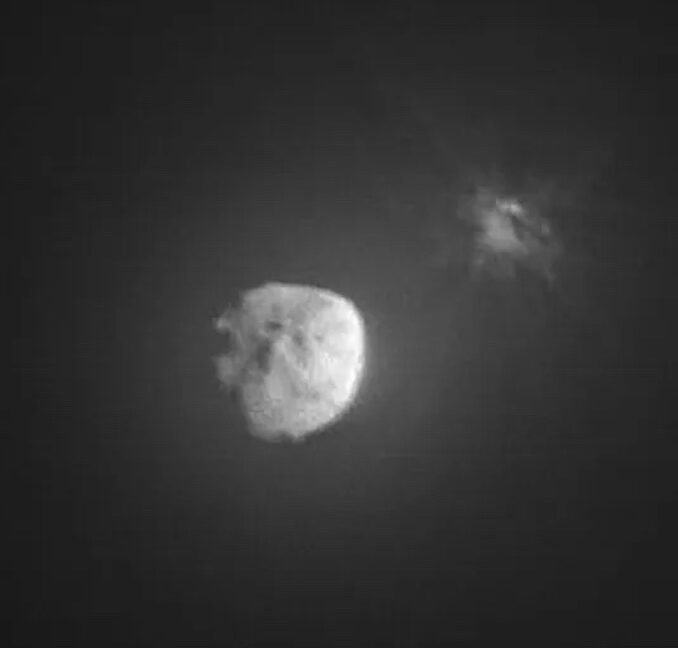
The Italian Space Agency’s LICIACube, which traveled alongside DART, captured images of the collision and the resulting debris field, providing valuable data for analyzing the ejecta engine effect. An image taken moments after impact shows rocky debris fanning out from Dimorphos, illustrating the scale of the event.
The 770-day orbital period of the Didymos binary system around the Sun changed by a fraction of a second following the DART impact, a change that represents the first time a human-made object has measurably altered the path of a celestial body around the Sun. While the change is small, it validates the kinetic impactor method as a viable option for planetary defense. The research team continues to analyze data from the Didymos system, seeking to further refine their understanding of the impact’s effects and improve the accuracy of future deflection strategies.
Future Missions and Continued Monitoring
NASA and other space agencies are actively planning future missions to further investigate asteroid deflection techniques and characterize potentially hazardous asteroids. Continued monitoring of the Didymos system will be essential to track the long-term effects of the DART impact and refine predictive models. The data gathered from DART and subsequent observations will inform the development of more effective planetary defense strategies, safeguarding Earth from the threat of asteroid impacts.
The success of DART underscores the importance of international collaboration in addressing global challenges like planetary defense. The mission involved contributions from numerous countries and organizations, demonstrating the power of collective effort in advancing scientific knowledge and protecting our planet. The findings from this mission will undoubtedly shape the future of asteroid deflection research and contribute to a safer future for humanity.
The next scheduled update on the Didymos system’s orbital parameters is expected in December 2026, following further analysis of data collected by ground-based telescopes and potentially future space-based observatories. Stay tuned to World Today Journal for continued coverage of this evolving story. We encourage you to share your thoughts and questions in the comments below.
Keep reading
- Anthropic Reveals Claude Models Accessed Internet and Cyberattacked Three Organizations in Evaluation Blunder
- Czech Government Proposes New Energy Fee: Will Households Pay More and Is Babiš to Blame?
- Europe Wildfires: Latest Updates and Impact Across France, Greece, and Spain (archynewsy.com)
- SpaceX Rocket Predicted to Hit Moon on August 5: Impact and Analysis (archyde.com)