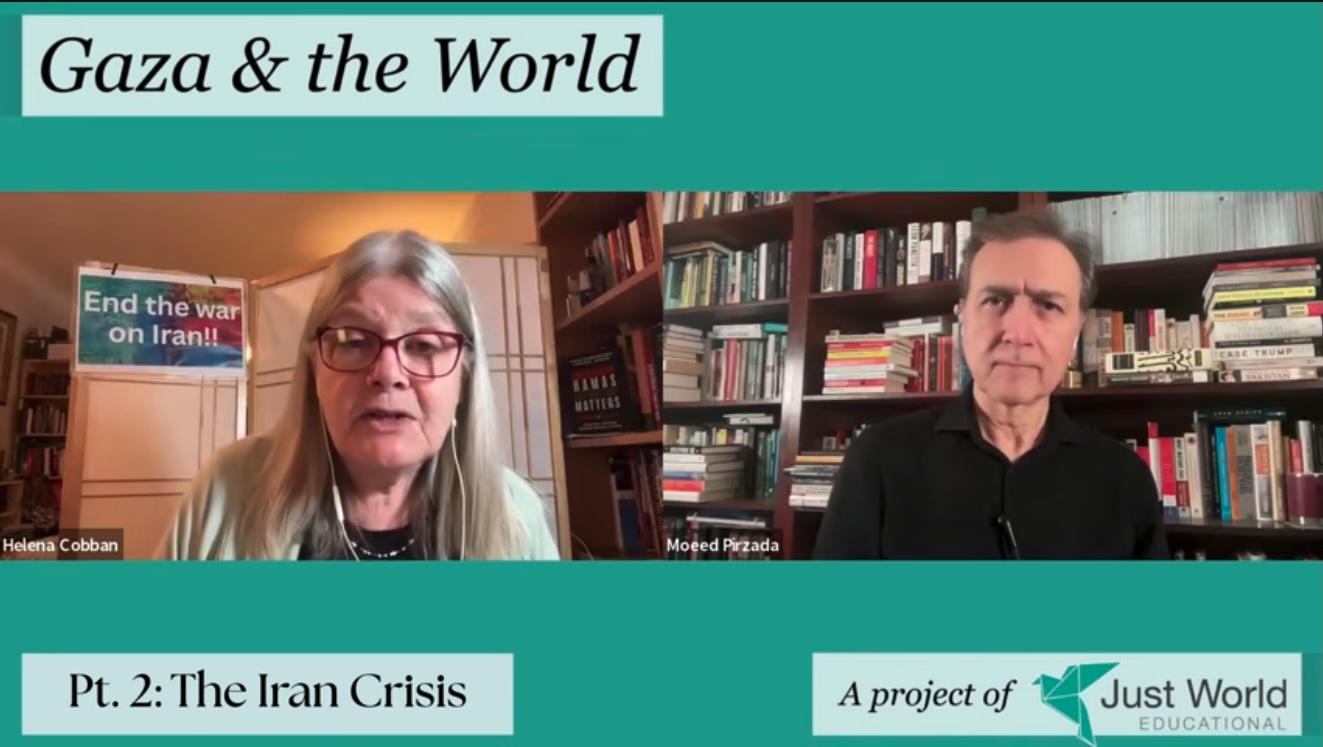
On the evening of April 23, 2026, Dr. Moeed Pirzada issued a stark warning during a discussion with Helena Cobban of Just World Educational, stating that an attack by Israel and the United States could occur at any moment within the next 24 hours. The warning came amid heightened tensions following the collapse of a U.S.-brokered ceasefire framework involving Iran, with Pirzada emphasizing the precarious state of diplomatic efforts in the region.
Pirzada, who is based in Washington D.C. And serves as founder and editor of Global Village Space, has closely monitored the fragile dynamics surrounding U.S.-Iran relations, particularly in the wake of conflicting signals from the Trump administration. During the conversation, which marked the 15th episode of Just World Educational’s Iran Crisis series launched in February 2025, Pirzada detailed how mixed messaging from Washington had undermined prospects for de-escalation.
He noted that while President Trump publicly claimed no urgency in reaching a deal with Iran, his administration maintained a naval blockade in the Persian Gulf—a move interpreted by Tehran as an act of hostility rather than a pause in hostilities. This contradiction, Pirzada argued, created deep confusion about the actual status of any ceasefire, with Iran refusing to recognize the blockade as indicative of peace.
Further complicating matters, Trump had publicly rejected a proposal that would have acknowledged Iranian sovereignty over the Strait of Hormuz, a key maritime chokepoint for global oil shipments. Pirzada explained that Iran’s subsequent actions—seizing two oil tankers registered in Greece and Switzerland and imposing coordination requirements on vessels—were not an outright blockade but an assertion of administrative control aimed at leveraging its position in the waterway.
Regarding military movements, Pirzada pointed to the extended deployment of the USS George H.W. Bush into the Persian Gulf and the return of the USS Gerald Ford to the Red Sea as signs of increased U.S. Readiness. He also cited statements from Israeli Defense Minister Israel Katz indicating Israel’s preparedness to resume military operations at short notice.
One specific scenario Pirzada highlighted involved the potential for targeted strikes against Iran’s Islamic Revolutionary Guard Corps (IRGC) leadership, which he suggested could serve as a tactical move to provide political cover for renewed negotiations under the Trump administration.
On Pakistan’s role, Pirzada contended that Islamabad functioned less as a neutral mediator and more as a facilitator offering diplomatic cover for U.S. Policy reversals. He emphasized that Pakistan’s financial reliance on U.S.-aligned institutions constrains its autonomy in mediating the conflict. This limitation is compounded by the deployment of approximately 13,000 Pakistani troops and an air force squadron to King Abdulaziz Air Base in Saudi Arabia, placing Pakistan in a contradictory position as it seeks to mediate while aligned with Saudi Arabia—a key U.S. Ally and potential adversary in any escalation involving Iran.
Pirzada also observed that China, despite Pakistan’s efforts to involve Beijing in the diplomatic process, has chosen to remain on the sidelines, issuing only minimal public statements and declining formal participation. He interpreted this restraint as part of a broader Chinese strategy to avoid direct entanglement in a crisis that could strengthen U.S. Influence, while simultaneously advancing long-term goals of creating alternatives to the dollar-dominated global financial system.
He further discussed the impact of U.S. Dollar dominance and secondary sanctions, which have left Iran unable to access tens of billions of dollars in frozen funds owed by countries including Iraq, India, and China. While acknowledging growing international interest in reducing reliance on the dollar, Pirzada noted that displacing the current system remains exceptionally difficult due to its deep entrenchment in global trade and finance.
The discussion, available in full on YouTube and via podcast platforms such as Apple Podcasts and Spotify, underscores the fragility of the current moment in U.S.-Iran relations and the complex web of alliances and interests shaping the potential for renewed conflict. As of the publication date, no further official statements have been issued by the U.S. Department of Defense or Israel’s Ministry of Defense regarding imminent military action.
Readers seeking updates on developments in the Persian Gulf region are encouraged to consult official sources such as U.S. Central Command releases, statements from the International Atomic Energy Agency, and verified reporting from international news agencies for the latest verified information.
Share your thoughts on this developing situation in the comments below, and help spread awareness by sharing this article with others interested in global affairs and peacebuilding efforts.