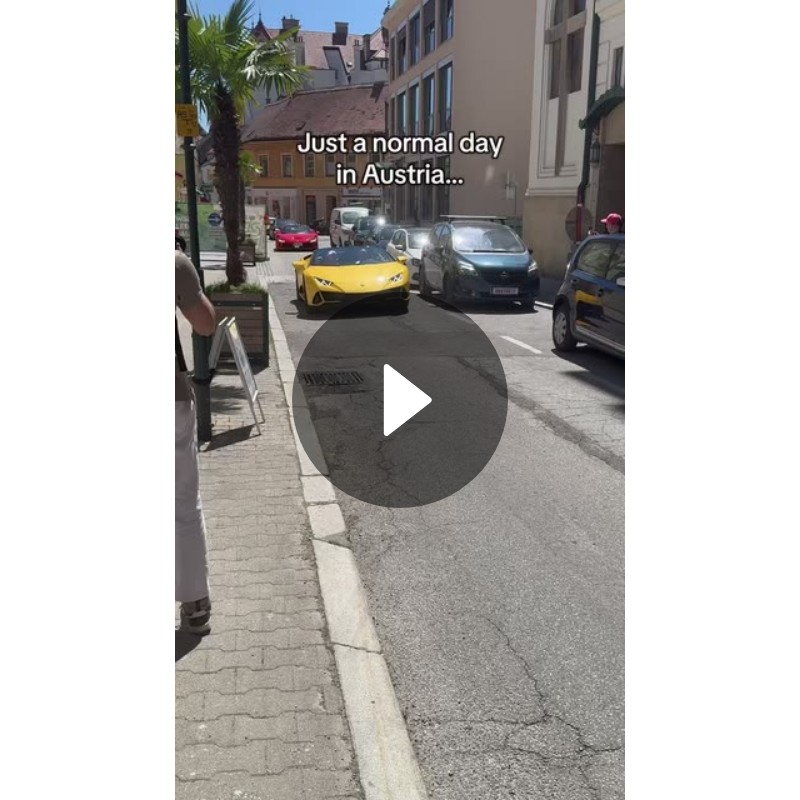
The sight of a vibrant yellow Lamborghini Huracán Spyder carving through the pristine landscapes of Austria is more than just a display of wealth; This proves a collision of cutting-edge Italian engineering and some of the most challenging, scenic topography in Europe. For automotive enthusiasts and digital creators alike, the presence of such high-performance machinery in the heart of the Alps has become a focal point for a growing global community of “supercar spotters.”
Recent social media captures, including a glimpse into a typical day in Austria shared by creator Manuel (@manuel2468135) via Snapchat, highlight the visceral appeal of these vehicles. The Huracán Spyder, with its open-top design, allows the roar of its naturally aspirated engine to echo through mountain valleys, transforming a simple drive into a sensory event. This trend reflects a broader shift in how luxury automotive culture is consumed—no longer confined to exclusive showrooms or private tracks, but broadcast in real-time to millions via short-form video platforms.
From a technical perspective, the Huracán Spyder represents a pinnacle of internal combustion evolution. As the automotive industry pivots toward electrification, the Huracán’s V10 engine is increasingly viewed as a legacy masterpiece. For those operating these vehicles in Austria, the experience is defined by the contrast between the car’s aggressive, futuristic geometry and the timeless, organic beauty of the Austrian countryside.
The Engineering Behind the Allure: The Huracán Spyder
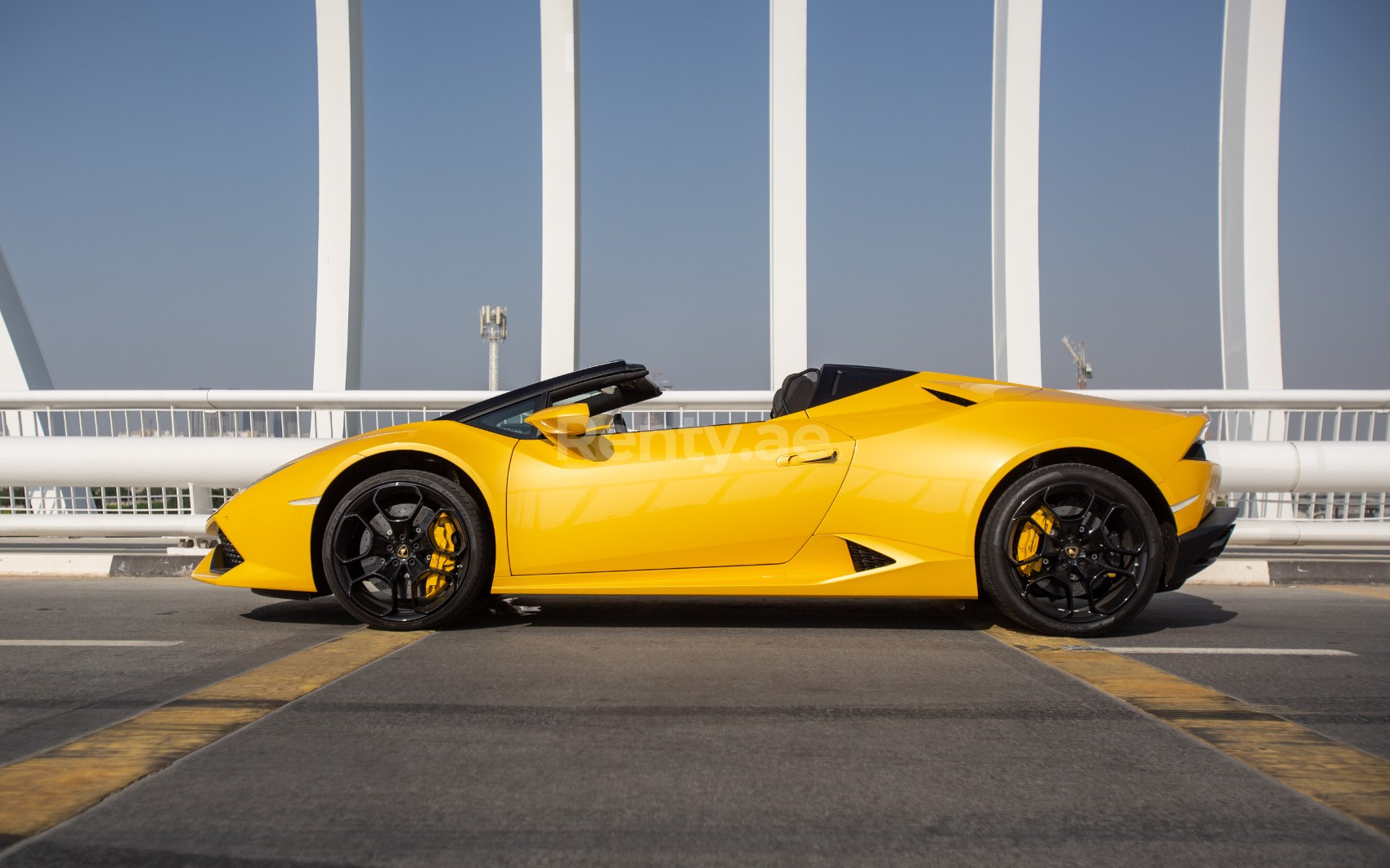
To understand why a yellow Lamborghini Huracán Spyder captures so much attention, one must glance at the specifications that define its performance. The vehicle is powered by a naturally aspirated 5.2-liter V10 engine
, a choice that distinguishes it from many modern competitors who have moved toward turbocharging or hybrid powertrains to meet emissions standards. According to Lamborghini’s official technical specifications, this engine delivers an explosive power output, typically ranging around 640 PS (approximately 631 hp) in the Evo variants, allowing the car to accelerate from 0 to 100 km/h in roughly 2.9 to 3.0 seconds.
The “Spyder” designation refers to the retractable soft-top, which provides the driver with an immersive experience of the environment. In the context of the Austrian Alps, this feature is critical. The Huracán employs a sophisticated all-wheel-drive system and active aerodynamics that ensure stability while navigating the sharp hairpins and steep inclines characteristic of the region’s high-altitude passes.
From a software and electronics standpoint—an area of particular interest given the integration of drive-by-wire systems—the Huracán utilizes a complex Electronic Control Unit (ECU) to manage torque distribution. This ensures that the massive power of the V10 is delivered efficiently to the road, preventing wheel spin on the varied surfaces of European mountain roads.
Austria’s Supercar Ecosystem and the “Spotting” Culture
Austria has evolved into a prime destination for supercar enthusiasts, not only because of its wealth but because of its geography. The country is home to some of the most celebrated driving roads in the world, most notably the Grossglockner High Alpine Road. This route, which reaches an altitude of 2,504 meters, serves as a natural gallery for exotic cars, attracting owners from across Germany, Switzerland, and Italy.
This geographical advantage has fueled the rise of “supercar spotting.” Creators like Manuel use platforms like Snapchat to document these sightings, turning the public appearance of a rare vehicle into a viral event. The appeal lies in the rarity; while luxury cars are common in cities like Vienna or Salzburg, seeing a Huracán Spyder in a rural Alpine village creates a stark visual juxtaposition that performs exceptionally well on social media.
However, owning and operating such a vehicle in Austria involves significant financial and regulatory hurdles. The Austrian government employs a stringent taxation system for vehicles based on their CO2 emissions. The Normverbrauchsabgabe (NoVA)
, or Standard Consumption Tax, is a one-time tax paid upon the first registration of a vehicle in Austria. For a high-emission V10 engine like that of the Lamborghini, the NoVA can be substantial, often amounting to tens of thousands of euros depending on the specific CO2 output of the model.
The Economic Impact of Luxury Automotive Tourism
The presence of supercars in Austria is not merely a hobby for the wealthy; it contributes to a niche but potent form of automotive tourism. High-net-worth individuals often travel to the region for “driving tours,” staying in luxury resorts and frequenting high-end establishments in towns like Kitzbühel and St. Anton.
This ecosystem supports a variety of specialized services, including:
- Bespoke Maintenance: Specialized workshops capable of handling the precision engineering of Italian exotics.
- Luxury Logistics: Flatbed transport services for moving vehicles across borders without adding mileage.
- Digital Content Creation: A growing industry of photographers and videographers who specialize in automotive “lifestyle” content.
The visual impact of a yellow Lamborghini against a backdrop of snow-capped peaks is a powerful marketing tool, not just for the brand, but for the region itself. It portrays Austria as a destination that blends traditional heritage with modern luxury and high-energy excitement.
The Future of the Internal Combustion Engine in the Alps
As the European Union pushes toward a ban on modern internal combustion engine (ICE) vehicles by 2035, the era of the V10 supercar is drawing to a close. This creates a paradoxical increase in the value and desirability of cars like the Huracán Spyder. They are becoming “modern classics”—vehicles that represent the zenith of mechanical engineering before the transition to electric power.
The shift toward Electric Vehicles (EVs) presents a challenge for the supercar culture in the mountains. While EVs offer instantaneous torque and superior acceleration, they lack the auditory experience—the “scream” of the engine—that is central to the appeal of the Huracán. For the community of spotters and enthusiasts, the sound is as essential as the sight.
Despite this, the luxury market in Austria is beginning to adapt. We are seeing an increase in hybrid hypercars that attempt to bridge the gap, offering the efficiency of electric power with the emotional resonance of a combustion engine. Yet, for the purists, the naturally aspirated V10 remains the gold standard.
Comparative Overview: V10 vs. Modern EV Supercars
| Feature | Lamborghini Huracán (V10) | Modern Electric Supercar |
|---|---|---|
| Acceleration | Linear, explosive build-up | Instantaneous torque |
| Auditory Profile | High-pitched V10 roar | Silent or synthetic sound |
| Weight Distribution | Mid-engine balance | Low center of gravity (battery floor) |
| Environmental Impact | High CO2 emissions (High NoVA) | Zero tailpipe emissions |
| Emotional Appeal | Mechanical connection | Technological precision |
Key Takeaways for Automotive Enthusiasts
- Technical Mastery: The Huracán Spyder’s V10 engine is a benchmark of internal combustion, offering a visceral experience that EVs cannot currently replicate.
- Geographic Synergy: Austria’s Alpine roads, such as the Grossglockner, provide the ideal environment for showcasing supercar performance.
- Regulatory Pressure: High taxes like the NoVA in Austria make the ownership of high-emission luxury cars a significant financial commitment.
- Digital Evolution: Social media platforms like Snapchat have democratized the “supercar spotting” experience, bringing exclusive automotive culture to a global audience.
The appearance of a yellow Lamborghini in the Austrian countryside is more than a fleeting social media moment. It is a symbol of a specific era of automotive history—one defined by noise, power, and a daring disregard for subtlety. As we move toward a quieter, electrified future, these sightings serve as a reminder of the raw, mechanical passion that continues to drive the world’s most exclusive cars.
The next major milestone for the luxury automotive sector in Europe will be the further integration of synthetic fuels (e-fuels), which may allow the internal combustion engine to survive in a carbon-neutral framework. Official updates on EU e-fuel regulations are expected to clarify whether these legendary engines will continue to roam the Alpine passes in the decades to come.
Do you perceive the roar of a V10 engine is essential to the supercar experience, or are you ready for the silent speed of the electric era? Share your thoughts in the comments below.
Keep reading