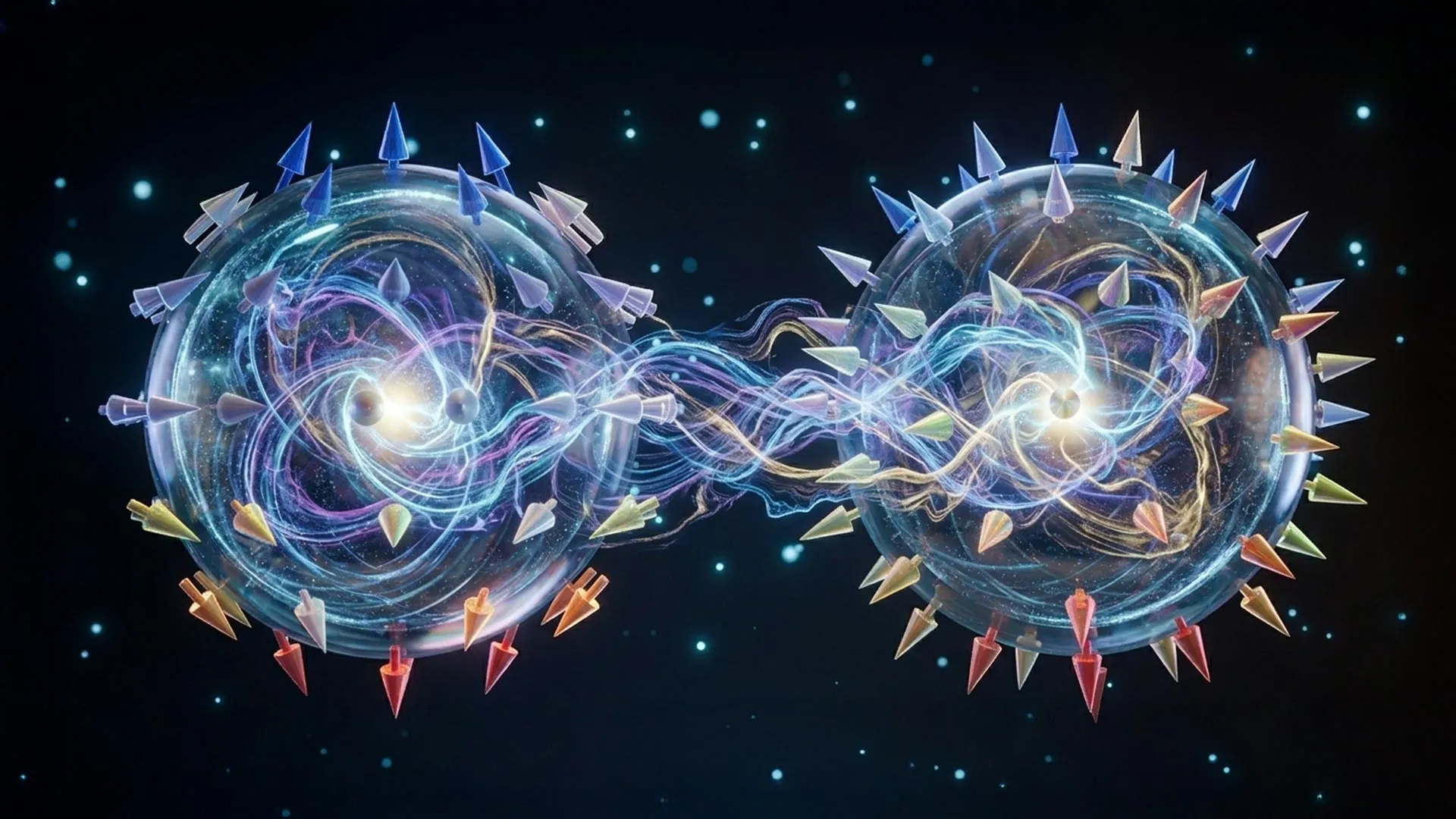
Imagine a hidden architecture woven into the very fabric of light—not a physical place you could visit, but a mathematical landscape of staggering complexity. For decades, scientists have used entangled photons to push the boundaries of quantum computing, but a recent breakthrough has revealed that these particles are carrying far more information than previously imagined.
Researchers have uncovered a hidden 48-dimensional world in quantum light, discovering that entangled states can host incredibly complex topological structures. This discovery, led by scientists at the University of the Witwatersrand in South Africa in collaboration with Huzhou University, suggests that light possesses a vast, untapped “alphabet” that could revolutionize how we store, protect and transmit quantum information.
The study reveals that these high-dimensional patterns emerge from a single property of light known as orbital angular momentum (OAM). By tapping into this property, the team identified a topological spectrum spanning over 17,000 distinct invariants, providing a level of stability and capacity for data encoding that was previously thought unattainable using standard optical paradigms.
Decoding the Twist: What is Orbital Angular Momentum?
To understand how a “48-dimensional world” can exist within a beam of light, one must first understand orbital angular momentum (OAM). While most people are familiar with the polarization of light (the direction in which the light wave oscillates), OAM refers to the spatial distribution of the light field. Orbital angular momentum of light is essentially the component of angular momentum that depends on the field’s shape rather than its polarization.
In a standard light beam, wavefronts are flat. However, light carrying internal OAM features “helical modes,” where the wavefront is shaped like a corkscrew or a helix, creating an optical vortex at the center of the beam. This twisting motion allows the light to carry a specific amount of angular momentum, which can be manipulated to encode information.
While OAM has been used in laser optics for some time, the new research takes this concept into the realm of quantum entanglement. By entangling the OAM of photons, the researchers found they could create topological maps that exist in much higher dimensions than the traditional two-dimensional systems used in most quantum experiments.
From Skyrmions to 48 Dimensions
The research, detailed in Nature, demonstrates that the topology of entangled OAM states is far more rich than previously assumed. In two-dimensional systems, the team demonstrated multiple “skyrmion” topologies. These are stable, knot-like configurations of a field that are mathematically equivalent to ’t Hooft-Polyakov magnetic monopoles, effectively connecting these optical states to the physics of the Higgs field.
As the researchers scaled their experiments to higher dimensions, the complexity grew exponentially. Using non-Abelian gauge fields of SU(d) Yang-Mills theory, the team predicted and experimentally confirmed a tapestry of topological maps for dimensionality up to seven. This process revealed an underlying topology of 48 dimensions and a topological spectrum containing more than 17,000 invariants.
This “hidden world” is not a physical dimension in the science-fiction sense, but rather a high-dimensional state space. In quantum mechanics, the more dimensions a state can occupy, the more information it can carry and the more robust it becomes against external interference.
A New Alphabet for Quantum Information
The practical implications of this discovery center on the “alphabet” of quantum communication. Currently, most quantum systems rely on qubits—binary units of information (0 and 1). However, the discovery of 17,000 topological signatures allows for a much larger set of symbols to be used for encoding.
According to reports from ScienceDaily, the researchers utilized a routine quantum optics technique called spontaneous parametric downconversion (SPDC) to generate these entangled photons. SPDC naturally creates entanglement in the spatial properties of light, and the team discovered that the high-dimensional topologies were already present within this process, waiting to be revealed.
This high-dimensional approach offers two primary advantages:
- Increased Capacity: By using OAM and its associated topological invariants, researchers can encode significantly more data into a single pair of entangled photons than is possible with simple polarization.
- Robustness to Noise: Topology is inherently stable; a “knot” in a field does not easily unravel. This means the quantum information encoded in these topological structures is naturally protected from perturbations and noise, which are the primary obstacles to building scalable quantum computers.
Key Takeaways of the Discovery
| Feature | Details |
|---|---|
| Core Mechanism | Orbital Angular Momentum (OAM) of entangled photons |
| Dimensionality | Up to 48 dimensions revealed in the topological structure |
| Complexity | Over 17,000 distinct topological invariants identified |
| Key Technique | Spontaneous Parametric Downconversion (SPDC) |
| Primary Benefit | Enhanced stability and a larger “alphabet” for quantum encoding |
Breaking the Optical Paradigm
For years, the prevailing paradigm in quantum optics was to rely on polarization-based spin-textured fields to create topological states. This often required complex “quantum state engineering”—essentially forcing the light into a specific shape through precise and difficult manipulation.
The work by the University of the Witwatersrand and Huzhou University breaks away from this approach. By using OAM as the sole degree of freedom to construct the topology, they have shown that these complex structures can emerge naturally. This simplifies the process of creating high-dimensional entangled states and suggests that other “hidden” topologies may exist in other properties of light or matter.
The theoretical framework developed for this study is not limited to light; the researchers note that it can be extrapolated to any dimension and any degree of freedom, potentially opening new doors in the study of quantum materials and synthetic dimensions.
As we move toward a future of quantum internet and ultra-secure communication, the ability to utilize a 48-dimensional topological space could be the key to making these technologies viable outside of a controlled laboratory setting. By leveraging the inherent geometry of light, scientists are turning the “noise” of the quantum world into a structured, stable, and incredibly powerful tool for information technology.
While the research is currently in the experimental and theoretical phase, the confirmation of 17,000 invariants provides a concrete roadmap for future quantum encoding protocols. The scientific community now looks toward implementing these high-dimensional states in real-world quantum key distribution (QKD) systems to test their resilience against environmental decoherence.
Stay tuned for further updates as the team continues to explore the boundaries of high-dimensional quantum topology. We encourage readers to share their thoughts on how quantum light might reshape the future of the internet in the comments below.
Related reading