For the past two years, the narrative surrounding enterprise artificial intelligence has been dominated by a “model war.” The industry has focused almost exclusively on the intellectual horsepower of the underlying Large Language Models (LLMs)—pitting OpenAI’s GPT series against Anthropic’s Claude and Google’s Gemini. The primary metric for success was simple: which model could follow instructions more accurately or reason through a complex prompt more effectively?
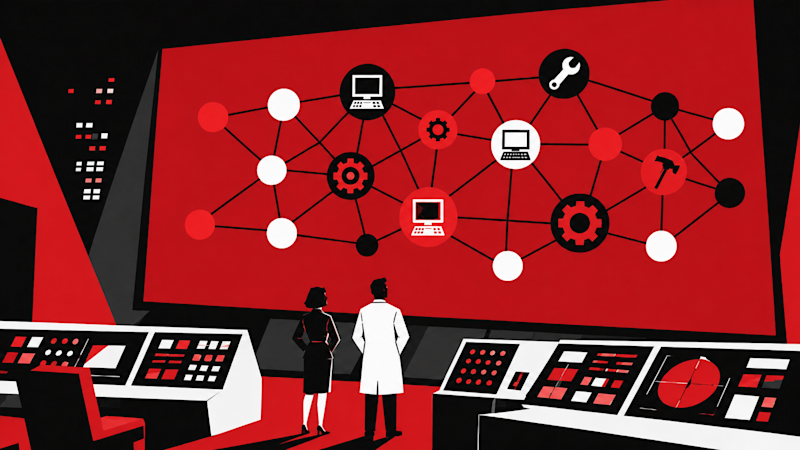
However, a strategic pivot is occurring. The battle is shifting from the “brain” of the AI to its “nervous system.” The next critical frontier in the enterprise AI race is not about which model provides the best answer, but who controls the enterprise AI agent orchestration layer—the control plane where AI agents plan their actions, call external tools, access proprietary data, and execute multi-step workflows.
This orchestration layer is the operational machinery of the AI era. This proves the difference between a chatbot that can tell you how to file an expense report and an agent that can actually log into the accounting software, upload the receipts, and notify the manager for approval. As companies move from experimental prototypes to production-ready deployments, the focus is moving toward the infrastructure that ensures these agents operate securely, predictably, and within strict corporate boundaries.
Recent industry tracking data indicates that this category is already crystallizing. Microsoft currently holds a significant early lead, with its Microsoft Copilot Studio and Azure AI Studio seeing primary-platform adoption rates of approximately 38.6% as of February. OpenAI follows in second place, with its Assistants and Responses API reaching a 25.7% adoption rate in the same period. While Anthropic’s footprint in orchestration is currently much smaller—appearing in recent trackers at roughly 5.7%—the move is strategically significant. It signals that Claude is moving beyond being a plug-and-play model and is beginning to compete as a native orchestration environment.
The Runtime Trap: Why Infrastructure is Stickier Than Inference
To understand why this fight matters, one must understand the fundamental difference between a model and a runtime. In the current “multi-model” era, swapping one LLM for another is relatively straightforward. A developer can route a coding task to Claude 3.5 Sonnet, a creative writing task to GPT-4o, and a high-volume, low-complexity task to a smaller open-source model. Because the model is essentially a stateless function—input goes in, output comes out—the cost of switching is low.
An agent runtime, however, is entirely different. When an enterprise adopts a specific orchestration platform, they aren’t just choosing a model; they are choosing where their operational logic lives. This includes the agent’s memory, tool permissions, API credentials, audit logs, and sandboxed execution environments. Once a company’s entire business workflow—including how an agent interacts with a CRM or a production database—is baked into a specific provider’s infrastructure, switching providers becomes less like changing a lightbulb and more like replacing the entire electrical wiring of a building.
This creates a powerful “lock-in” effect. If an organization relies on a provider’s managed runtime to handle the state of a long-running workflow, moving that workflow to a competitor requires migrating not just the prompt, but the entire operational state and security configuration. This is the real prize in the enterprise market: the transition from providing a service (inference) to providing the essential infrastructure (the control plane).
Anthropic’s Strategy: The Model Context Protocol and Managed Agents
Anthropic is acutely aware of this dynamic. The company is positioning itself to be more than just a provider of the Claude model. Through its Model Context Protocol (MCP), Anthropic has introduced an open standard designed to connect AI systems to data and tools more seamlessly. By championing an open protocol, Anthropic is attempting to reduce the friction of integration, making it easier for enterprises to plug Claude into their existing data silos without building custom connectors for every single tool.
However, openness at the protocol layer does not eliminate the gravity of the runtime layer. Alongside MCP, Anthropic is developing “Managed Agents,” a managed harness that provides secure sandboxing and API-run sessions. The goal is to host the environment where Claude agents remember context, execute code, and persist across complex, long-term projects.
The pitch to the enterprise is one of convenience and safety. Most Chief Information Officers (CIOs) do not want to stitch together a fragmented agent stack from a dozen different open-source libraries. They want a “turnkey” solution that provides built-in permission boundaries and audit trails. If Anthropic can convince enterprises that its managed environment is the safest place for high-stakes workloads—particularly those requiring the high levels of steerability and long context windows for which Claude is known—it can carve out a durable niche even in the face of Microsoft’s massive distribution advantage.
The Rise of ‘Agent Ops’ and the Security Mandate
As AI agents move from reading data to writing data, the “blast radius” of a failure increases exponentially. A chatbot that hallucinates a fact is a nuisance; an agent that accidentally deletes a production database or sends an unauthorized email to a thousand clients is a corporate catastrophe. This risk is driving a transition from LLMOps (Large Language Model Operations) to “Agent Ops.”

In a standard LLM call, a guardrail can catch a toxic output or a hallucination. But in an agentic workflow, the governance must extend beyond the individual response to the entire scope of the agent’s action. This includes monitoring for “infinite loops”—where an agent repeatedly calls a tool in a costly, unbreakable cycle—and ensuring that the agent’s identity is strictly tied to a human user’s permissions.
Industry experts argue that orchestration without a robust identity layer is a recipe for chaos. Without a unified identity plane, an organization cannot truly know what an agent accessed, why it took a specific action, or how to instantly revoke its access if it begins to operate outside of policy. Security and permissions have become the primary selection criteria for orchestration platforms, often outweighing a model’s raw intelligence or flexibility.
For enterprises, the critical questions for 2025 and 2026 are no longer “Which model is smartest?” but rather:
- Who gave this agent permission to access this specific database?
- Is there a tamper-proof log of every action the agent took?
- Can we “undo” the changes made by an agent if a workflow fails?
- Is the agent operating in a secure sandbox that prevents it from accessing the underlying host system?
The Hybrid Future: Avoiding the Single-Vendor Trap
Despite the convenience of managed platforms, there is a growing resistance to total vendor lock-in. Many enterprises are wary of handing the keys to their entire AI operational infrastructure to a single provider. This has led to the emergence of the “hybrid control plane,” where companies combine provider-native orchestration (like Azure AI Studio) with independent, third-party frameworks.
Data suggests that a hybrid approach is becoming the consensus architecture for large-scale enterprises, with roughly 35% to 36% of technical decision-makers favoring a mix of tools. This strategy allows companies to leverage “best-in-breed” models for specific tasks—perhaps using Claude for complex coding and GPT-4o for general reasoning—while maintaining a centralized, independent layer for governance and auditability.
This trend poses a challenge for independent orchestration frameworks. Some early developer-first tools have seen a decline in primary adoption as enterprises migrate toward platforms that offer “enterprise packaging”—meaning SOC2 compliance, professional support, and deep integration with existing identity providers like Microsoft Entra ID. The market is consolidating around providers who can offer both the intelligence of the model and the rigor of enterprise-grade infrastructure.
What This Means for the Global AI Landscape
The shift toward the agent control plane transforms the AI market from a software race into a cloud infrastructure race. The winning vendors will not necessarily be those with the most parameters in their models, but those who provide the most reliable “operating system” for AI agents. This includes deep integration of identity management, observability, and domain-specific context.
For Anthropic, the path forward is not necessarily to out-distribute Microsoft, but to become the preferred runtime for high-sensitivity, high-complexity workloads. By focusing on safety, governance, and open protocols like MCP, Anthropic is betting that the market will value a specialized, secure environment over a general-purpose one.
As we move toward 2026, the defining characteristic of enterprise AI will be “agency”—the ability of systems to act autonomously on behalf of a user. The companies that control the layer where those actions are authorized, monitored, and executed will hold the real power in the AI economy. The model is the engine, but the control plane is the steering wheel and the brakes; in the enterprise world, the brakes are often more important than the speed.
Next Milestone: Industry analysts are closely watching the rollout of expanded “Managed Agent” features from the major providers throughout the coming quarters, which will likely define the standard for AI agent governance in the enterprise. We will continue to monitor updates on the adoption of the Model Context Protocol as more third-party developers integrate with the standard.
Do you believe the convenience of a managed AI runtime outweighs the risk of vendor lock-in? Share your thoughts in the comments below or join the conversation on our social channels.