For millions of stroke survivors, the most profound challenges are often not the ones visible to a casual observer. While walking impairment is frequently the focus of rehabilitation, the loss of fine motor control and strength in the upper limbs—the hands and arms—can be even more devastating to daily independence. The inability to feed oneself, grasp a cup, or perform basic grooming tasks can lead to a profound loss of autonomy and a significant decline in mental health.
However, a new frontier in neurorehabilitation is offering a glimmer of hope. Recent findings from a pivotal feasibility trial suggest that spinal cord stimulation for stroke recovery may soon move from the realm of experimental science to a transformative clinical reality. By targeting the cervical spinal cord with epidural electrical stimulation (EES), researchers have demonstrated that it is possible to safely enhance motor function in patients living with chronic post-stroke hemiparesis.
The trial, which focused on the complex task of restoring upper limb movement, has provided critical data on how neuromodulation can interface with the damaged neural pathways left behind after a cerebrovascular accident. For those who have long believed that the “window of recovery” closes months or years after a stroke, these results suggest that the nervous system may remain far more plastic and responsive than previously thought.
Bridging the Gap: How Epidural Stimulation Works
To understand this breakthrough, one must first understand the nature of the “broken connection” caused by a stroke. When a stroke occurs, the brain’s ability to send signals through the corticospinal tract—the primary highway for voluntary movement—is disrupted. Even if the spinal cord itself remains intact, the signals from the motor cortex often fail to reach the muscles in the arm and hand with enough strength or precision to trigger meaningful movement.
Epidural spinal cord stimulation does not attempt to “fix” the brain. Instead, it acts as a biological amplifier. By placing an electrode array in the epidural space—the area just outside the protective membrane of the spinal cord—clinicians can deliver precise electrical pulses to the cervical segments of the spinal cord. These pulses do not cause muscles to contract directly. rather, they increase the excitability of the spinal circuits. This makes the remaining, weakened signals from the brain much more effective at reaching their targets.
This process relies heavily on the principle of neuroplasticity. As the stimulation is paired with intensive physical therapy, the nervous system begins to “relearn” how to navigate these amplified pathways. According to the Mayo Clinic, neuroplasticity is the brain’s ability to reorganize itself by forming new neural connections, a process that is essential for recovering from neurological injury.
Trial Results: Safety, Strength, and Spasticity
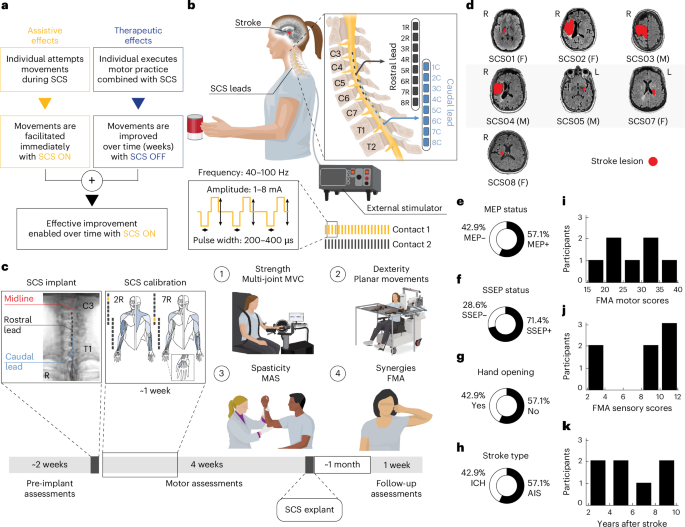
The feasibility trial in question focused on a small but significant cohort of seven individuals suffering from chronic arm hemiparesis. The primary goal was not yet to prove widespread efficacy, but to determine if this highly invasive procedure was safe and if it could produce measurable improvements in motor control.
The results were encouraging across three key clinical metrics:
- Motor Strength: Participants showed measurable increases in the force they could exert using their affected limbs, a crucial step toward regaining functional use.
- Functional Reach and Grasp: Beyond simple strength, the trial noted improvements in the ability to perform coordinated movements, such as reaching for objects and manipulating them.
- Spasticity Management: One of the most significant hurdles in post-stroke care is spasticity—the involuntary, painful muscle stiffness that can lock a limb in place. The trial indicated that epidural stimulation could help modulate these abnormal muscle tones, potentially making physical therapy more effective and less painful.
Crucially, the trial reported that the procedure was safe. For a technology involving implanted hardware in the cervical spine—a highly sensitive area of the human anatomy—safety is the most critical prerequisite for moving toward larger, multi-center clinical trials.
The Complexity of the Upper Limb vs. Lower Limb
In the history of neurostimulation, much of the “headline-grabbing” success has occurred in the realm of gait restoration (walking). Stimulating the lumbar spinal cord to help paralyzed individuals stand and walk has been a major area of research. However, restoring movement to the arms and hands is an exponentially more difficult challenge.
The reason lies in the sheer complexity of the neural architecture. Walking involves gross motor movements—large, rhythmic patterns of muscle activation. In contrast, the upper limb requires highly sophisticated, fine motor control. The hands, in particular, require a dense concentration of neural inputs to manage tasks like buttoning a shirt or typing. The cervical spinal cord, which governs these movements, is more anatomically complex and requires much more precise stimulation patterns to avoid “noise” that could interfere with delicate movements.
The success of this feasibility trial suggests that we are finally developing the precision required to tackle these fine motor circuits. This represents a shift from “broad-brush” stimulation to “surgical-grade” electrical targeting.
Key Takeaways: Spinal Cord Stimulation for Stroke
| Feature | Details |
|---|---|
| Primary Target | Cervical spinal cord (neck area) |
| Patient Profile | Chronic post-stroke hemiparesis (upper limb weakness) |
| Core Mechanism | Epidural Electrical Stimulation (EES) to amplify neural signals |
| Key Benefits | Improved strength, better functional reach, and reduced spasticity |
| Current Status | Feasibility stage; safety confirmed in small cohort |
Challenges on the Horizon: Implementation and Access
While the scientific results are a triumph, the path from a seven-person feasibility trial to standard clinical care is long and fraught with hurdles. The first is the need for much larger, randomized controlled trials (RCTs). To gain regulatory approval from bodies like the U.S. Food and Drug Administration (FDA) or the European Medicines Agency (EMA), researchers must prove that these improvements are not just possible, but statistically significant and superior to existing rehabilitation methods.
The second challenge is the “intensity” of the required therapy. Neuromodulation is not a “set it and forget it” solution. For the stimulation to drive neuroplasticity, it must be paired with rigorous, repetitive, and task-specific physical training. This raises questions regarding healthcare policy and accessibility: Who will pay for the implant, the surgical expertise, and the hundreds of hours of specialized physical therapy required to make the technology work?
Finally, there is the matter of surgical precision and long-term stability. An implanted electrode array must remain perfectly positioned within the cervical spine for years to be effective, despite the constant movement of the neck. Developing hardware that is both robust and highly flexible is a major focus for medical device engineers.
What This Means for the Future of Neurorehabilitation
We are witnessing a paradigm shift in how we view neurological “permanence.” For much of the 20th century, a stroke was viewed as a static injury—once the damage was done, the loss of function was considered largely irreversible. Today, we understand that the nervous system is a dynamic, living network that can be retrained.
The integration of neurotechnology with traditional physical therapy represents the future of medicine. We are moving toward a “hybrid” model of recovery, where biological healing is augmented by digital and electrical precision. If the success of cervical stimulation can be scaled, it could redefine the standard of care for stroke survivors worldwide, moving the goalpost from mere survival to true functional restoration.
As researchers prepare for the next phase of clinical testing, the medical community will be watching closely to see if these early successes can be replicated in larger, more diverse populations. The journey from a laboratory breakthrough to a patient’s bedside is complex, but for those living with the limitations of hemiparesis, the destination is worth every step.
Next Steps: The scientific community is currently awaiting the publication of larger-scale multi-center protocols to follow this feasibility study. We will continue to monitor official clinical trial registries for updates on recruitment and results.
What are your thoughts on the use of implanted technology to aid neurological recovery? Do you believe the benefits outweigh the risks of surgical intervention? Share your comments below and please share this article with your network to spread the word on these medical advancements.
Keep reading