For anyone who has spent significant time interacting with the Ethereum blockchain, the struggle is familiar: the anxiety of copying and pasting a 42-character hexadecimal string, praying that a single misplaced character doesn’t send funds into a digital void. This friction has long been one of the primary barriers to mainstream adoption of decentralized finance and web3 technologies. However, the integration of the Ethereum Name Service (ENS) into essential infrastructure like Etherscan is fundamentally changing how users perceive and interact with their on-chain identities.
As a software engineer turned journalist, I have watched the evolution of blockchain interfaces move from raw data dumps to intuitive user experiences. The ability to map a complex address—like 0x761e75bE…7F4d6bB98—to a human-readable name such as “liryc.eth” is not just a convenience; it is a critical security layer. By providing a readable alias, the Ethereum ecosystem reduces the likelihood of manual entry errors and adds a layer of social verification to the sterile environment of the ledger.
Etherscan, the leading block explorer and analytics platform for Ethereum, has deepened its utility by integrating these ENS capabilities directly into its interface. This allows users to navigate the blockchain not as a series of anonymous hashes, but as a network of identifiable entities, bridging the gap between technical necessity and human usability.
Simplifying the Blockchain Experience via Etherscan
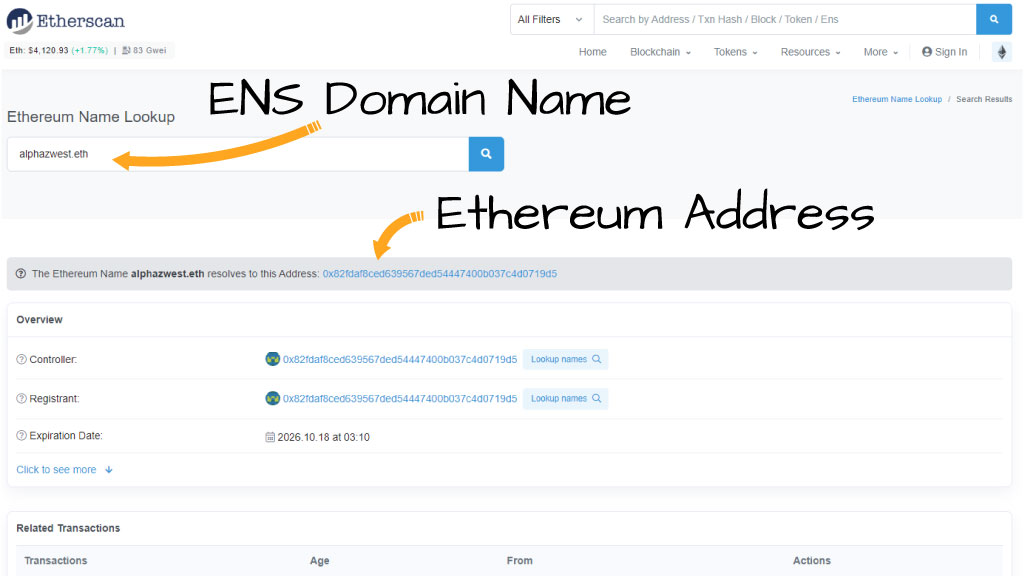
The primary value proposition of the Ethereum Name Service is its capacity to allow users to interact with addresses using human-readable names instead of long and complicated address hashes. This functionality is seamlessly mirrored on Etherscan, where the “Domain Name Lookup” tool enables any user to instantly resolve a name to its corresponding Ethereum address.
For the average user, So that instead of auditing a transaction by squinting at a string of alphanumeric characters, they can see a verified domain. This transparency is vital for trust. When a user can see a recognizable name associated with a contract or a wallet, the psychological barrier to entry drops, and the ability to audit transactions becomes accessible to those without a computer science degree.
From a technical perspective, this integration relies on the ENS smart contracts deployed on the Ethereum network. Etherscan queries these contracts to retrieve the current resolver and registry data, ensuring that the name displayed is the one currently mapped to the address on-chain. This real-time synchronization is what makes Etherscan an authoritative source for verifying the ownership and expiration dates of these digital identities.
Analyzing the ENS Token Ecosystem
Beyond its utility as a naming service, ENS operates with its own governance token, which provides insight into the project’s scale and community support. As of April 13, 2026, the ENS token is trading at a market price of $5.86 (approximately 0.002514 ETH), according to data from Etherscan’s token analytics.
The financial footprint of the protocol is substantial, with an on-chain market capitalization of $586,000,000.00. The distribution of the token likewise suggests a wide base of stakeholders, with 67,121 unique holders currently maintaining positions in the asset. This level of distribution is often a key indicator of a project’s decentralization and the breadth of its governance community.
The token’s role is central to the long-term sustainability of the service. By transitioning from a centralized management model to a decentralized autonomous organization (DAO), ENS ensures that the rules governing the naming system—such as registration fees and auction mechanics—are decided by the community rather than a single entity.
Tracking On-Chain Name Governance and Auctions
One of the most sophisticated features of the ENS integration on Etherscan is the ability to track the lifecycle of a domain. The ENS-specific analytics page on Etherscan provides a transparent window into the competitive nature of domain acquisition. This includes tracking auctions, bids placed, and the finalization of ownership.
The platform records a massive volume of activity, with a total of 795,180 auctions initiated. By monitoring “Set Resolver” events and “New Owner” events, users can track exactly when a domain changes hands or when its resolution logic is updated. This is particularly important for “premium” names—short or highly desirable domains—which often command significant prices in the secondary market.
For instance, Etherscan allows users to filter for the “Most Expensive Names” and “Top Bidded Names,” turning the blockchain explorer into a market research tool for digital real estate. This transparency ensures that the “wild west” of early domain grabbing is replaced by a verifiable, audit-able history of ownership.
Key ENS Metrics at a Glance
| Metric | Value | Verification Source |
|---|---|---|
| Market Price | $5.86 | Etherscan Token Data |
| On-chain Market Cap | $586,000,000.00 | Etherscan Token Data |
| Total Holders | 67,121 | Etherscan Token Data |
| Total Auctions Initiated | 795,180 | Etherscan ENS Analytics |
Why This Integration Matters for the Future of Web3
The integration of ENS into Etherscan represents a shift toward “human-centric” blockchain design. In the early days of Ethereum, the tools available were designed for developers. Today, the focus has shifted toward the end-user. When a block explorer can resolve a domain name instantly, it transforms the ledger from a database of transactions into a directory of identities.

This has profound implications for security. Phishing attacks in the crypto space often rely on “address spoofing,” where a malicious actor provides an address that looks similar to a known entity’s address. By encouraging the use of ENS names and providing an straightforward way to verify those names via Etherscan, the industry is creating a standard for “verified” identities that is much harder to forge than a random string of characters.
the ability to see expiration dates for domains—such as the record for “liryc.eth” expiring on April 14, 2027—allows users and organizations to manage their digital presence with the same precision they use for traditional web domains. This professionalization of on-chain identity is a prerequisite for the integration of blockchain technology into corporate and government workflows.
As the Ethereum ecosystem continues to grow, the synergy between naming protocols and exploration tools will only deepen. We are moving toward a future where the underlying complexity of the blockchain is hidden behind a layer of intuitive, readable, and verifiable identities, making the decentralized web truly accessible to everyone.
The next major milestone for the ENS ecosystem will be the continued evolution of its governance model and the potential integration of further identity metadata. Users can continue to monitor these updates and track their own domain statuses through the official Etherscan portal.
Do you use ENS names for your wallets, or do you prefer the security of raw addresses? Share your thoughts and experiences in the comments below.