
Argentina is currently the site of one of the most aggressive economic experiments in modern history. Since taking office, President Javier Milei has implemented a series of drastic measures—often described as “shock therapy”—designed to dismantle the state’s role in the economy, eliminate the fiscal deficit, and curb hyperinflation that has plagued the nation for decades.
While the administration points to a narrowing fiscal deficit and a slowing of monthly inflation as signs of success, the ground-level reality tells a more complex story. For many Argentine citizens and industrial sectors, the path to stability is paved with severe recession, rising poverty, and a domestic manufacturing base that is struggling to survive in a newly deregulated market.
At the heart of this tension is the clash between macroeconomic stabilization and industrial survival. As Milei removes import restrictions and allows the market to dictate trade flows, local industries—particularly the auto parts sector—are finding themselves unable to compete with a flood of cheaper foreign goods, primarily from China. This shift highlights the central gamble of the current administration: that the long-term benefits of a free market will eventually outweigh the immediate pain of industrial decline.
The Auto Parts Crisis and the Surge of Chinese Imports
The Argentine automotive industry, long a cornerstone of the country’s manufacturing sector, is facing a critical juncture. Under previous administrations, the sector was protected by stringent import controls and tariffs designed to encourage local production and protect domestic jobs. However, the current administration’s drive toward total deregulation has effectively dismantled these barriers.
The result has been a significant influx of imported components, particularly from China, which offer lower price points than locally manufactured alternatives. While this may lower costs for some consumers and assemblers, it has placed immense pressure on domestic suppliers. Many little and medium-sized enterprises (SMEs) in the auto parts chain report a sharp decline in orders as companies pivot toward cheaper imports to maintain their own margins amid a collapsing domestic market.
This trend is not merely a matter of pricing but of structural viability. The “shock therapy” approach involves a sudden exposure to global competition without a transitional period for local firms to modernize or diversify. The industry is seeing a contraction in production volumes, leading to layoffs and the closure of specialized workshops that have operated for generations.
Macroeconomic Stabilization vs. Social Cost
The primary objective of the Milei administration has been the eradication of the fiscal deficit, which the president argues is the root cause of Argentina’s inflation. To achieve this, the government has implemented deep cuts to public spending, including the suspension of public works projects, the reduction of energy and transport subsidies, and a significant devaluation of the Argentine peso.
On paper, some of these measures have yielded results. The government has reported achieving a monthly fiscal surplus, a rarity for Argentina in recent decades. Monthly inflation rates, which peaked at staggering levels in late 2023, have shown a downward trend throughout 2024. According to data from the National Institute of Statistics and Censuses (INDEC), the government’s focus on monetary restraint has been central to this deceleration.
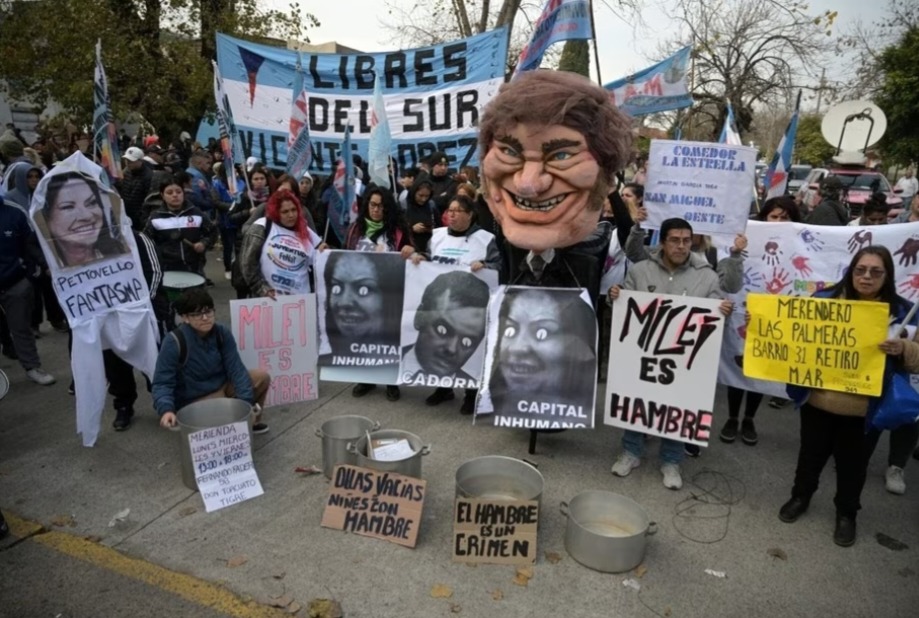
However, these macroeconomic gains have come at a steep social price. The devaluation of the peso, while intended to make exports more competitive and align the currency with market reality, has decimated the purchasing power of the average Argentine. With prices for basic goods and services continuing to climb—even as the rate of increase slows—many households have fallen below the poverty line.
Recent estimates indicate that poverty levels in Argentina have surged, with a significant portion of the population now struggling to afford basic food baskets. The removal of subsidies on electricity and gas has further strained household budgets, creating a paradox where the state’s balance sheet improves while the citizen’s wallet empties.
The Political Tightrope of ‘The Chainsaw’
President Milei’s political brand is built on the image of “the chainsaw,” symbolizing the aggressive cutting of state expenditure. This rhetoric resonates with a segment of the population exhausted by years of economic mismanagement and perceived corruption. For his supporters, the current hardship is a necessary “bitter medicine” required to cure a terminally ill economy.
Yet, maintaining public support during a deep recession is a precarious task. The administration is navigating a difficult balance: it must satisfy the requirements of the International Monetary Fund (IMF) to ensure continued financial support and debt restructuring, while preventing social unrest from reaching a breaking point. The IMF has generally praised the government’s commitment to fiscal discipline but has cautioned that the social impact of these measures must be managed to ensure the sustainability of the program.
The political challenge is compounded by a fragmented Congress. While Milei holds a strong mandate from the presidency, his party lacks a majority in the legislature, forcing the administration to rely on a mix of strategic alliances and executive decrees to push through its legislative agenda. This tension often slows the implementation of structural reforms, even as the “shock” measures are applied via executive action.
What This Means for Argentina’s Future
The outcome of Argentina’s current trajectory depends on whether the “bottom” of the recession can be reached before social stability is irrevocably compromised. The government’s bet is that by killing inflation and balancing the budget, they will create an environment that attracts massive foreign direct investment, which will eventually replace the lost domestic industrial activity with more efficient, globally competitive sectors.
For the auto parts industry and other manufacturing sectors, the window for adaptation is closing. Without targeted support or a strategic transition, Argentina risks a permanent loss of industrial capacity, shifting from a producer of complex goods to a primary exporter of raw materials and a consumer of foreign manufactured products.
The global community continues to watch Argentina as a test case for libertarian economic policy on a national scale. If Milei succeeds, it could provide a blueprint for other nations struggling with debt and inflation. If it fails, it may serve as a cautionary tale about the risks of rapid deregulation in a fragile social environment.
Key Economic Indicators at a Glance
- Fiscal Policy: Shift toward a primary surplus through aggressive spending cuts and subsidy removals.
- Monetary Policy: Focus on reducing the money supply to combat inflation, accompanied by a significant peso devaluation.
- Trade Policy: Transition from protectionism and import controls to a free-trade model, increasing exposure to Chinese imports.
- Social Impact: Increased poverty rates and decreased real wages, offsetting the benefits of slowing monthly inflation.
The next critical checkpoint for the administration will be the upcoming quarterly review of its agreements with the IMF, where the sustainability of its fiscal targets and the impact on poverty levels will be under intense scrutiny. These reviews often determine the release of further loan tranches essential for maintaining foreign exchange reserves.
We want to hear from you. Do you believe “shock therapy” is the only way to fix a failing economy, or is the social cost too high? Share your thoughts in the comments below and share this analysis with your network.
Keep reading