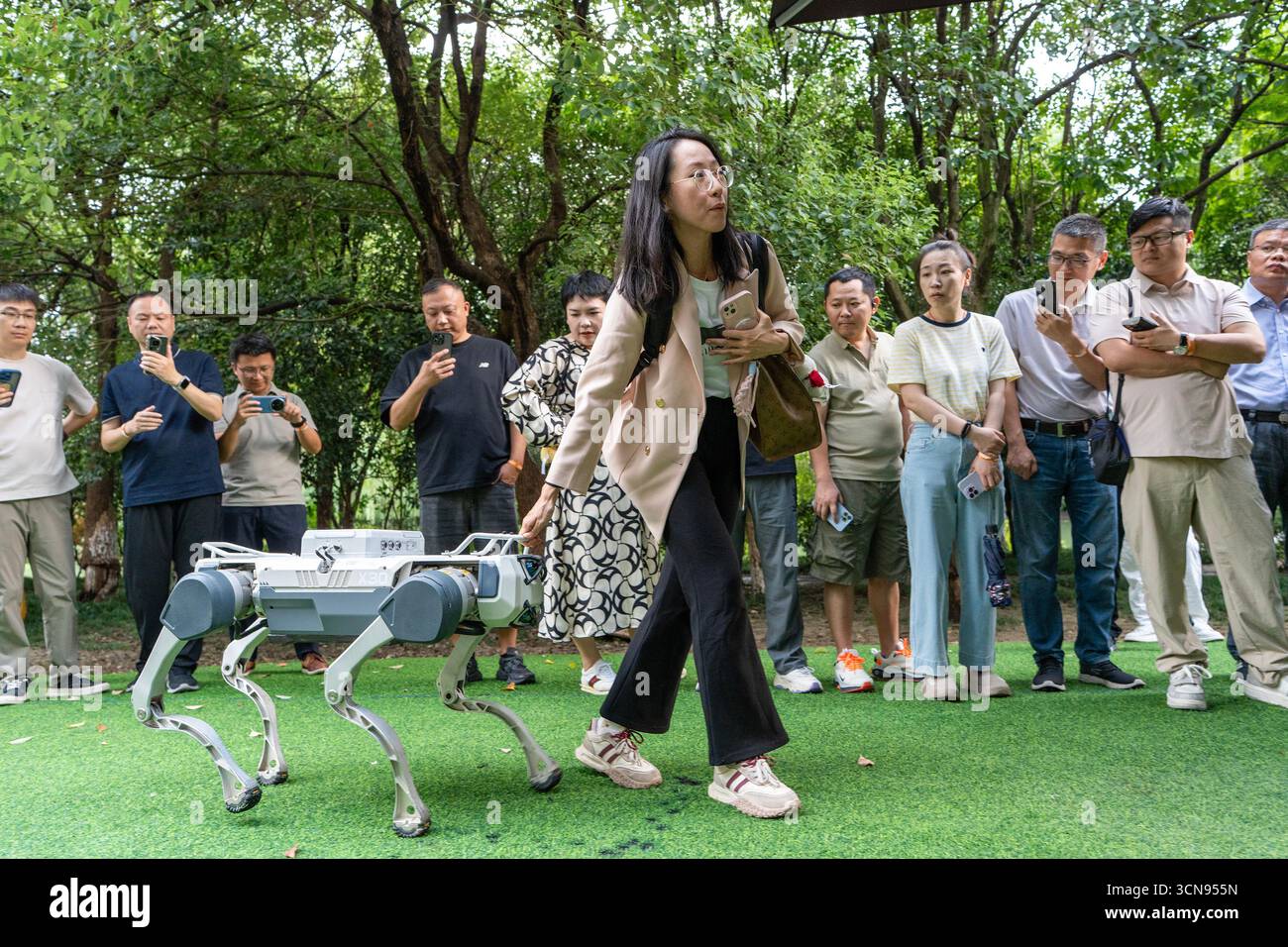
In the heart of Hangzhou, a modern breed of technological pioneers is redefining the boundaries of embodied intelligence. The city has develop into a global epicenter for the four-legged robotics industry, giving rise to a powerhouse group known as the Hangzhou “Four Little Dogs”. This collective of four core enterprises—Unitree Robotics, Deep Robotics, Juwei Technology and Five-Eight Intelligence—is not just competing in a niche market; they are effectively dominating the landscape of quadruped robots.
The scale of this regional dominance is staggering. According to the Quadruped Robot Scenario Application Development Blue Book (2025), global shipments of quadruped robots reached 82,000 units in 2025, with China commanding a massive 80% market share at 65,000 units Sohu. Within this ecosystem, the “Four Little Dogs” are the primary drivers, accounting for over 80% of the market share for the quadruped robot industry in Hangzhou, positioning the city as a critical hub for the global development of the sector Baidu Baike.
For these companies, survival and growth in a crowded field depend on a philosophy of differentiation. Rather than engaging in homogenous competition, the “Four Little Dogs” have strategically carved out distinct niches, ranging from high-volume consumer products to specialized industrial tools designed for the most hazardous environments on Earth. This “complementary coexistence” allows them to scale rapidly whereas pushing the technical limits of what a robot dog can achieve.
Strategic Specialization: How the “Four Little Dogs” Divide the Market
The success of Hangzhou’s quadruped cluster lies in its precise segmentation. Each of the four companies targets a different operational “lane,” ensuring that they do not cannibalize each other’s growth while collectively expanding the total addressable market.
Unitree Robotics: The Scale Leader
Unitree Robotics focuses on the general-purpose domain. Their strategy centers on high cost-performance and large-scale delivery capabilities. By covering consumer-grade, scientific research, and educational markets, Unitree has maintained a leading position in global sales volume over several years Sohu. The company is currently moving toward a new phase of corporate maturity, having already completed listing guidance, with financial data disclosures expected soon Sina Finance.
Deep Robotics (Yunshenchu): The Global Solution Provider
Deep Robotics focuses on technical breakthroughs and the development of industry-specific solutions. They have successfully pivoted toward international expansion, achieving the first overseas industrial application for a domestic Chinese quadruped robot. A notable example of their reach is their successful entry into the Singaporean power grid market Sohu. The company has officially initiated its IPO process and plans to submit its acceptance application in the first half of 2026 Sina Finance.
Five-Eight Intelligence: The “National Team”
Five-Eight Intelligence carries a strong military and research pedigree, often described as part of the “embodied intelligence national team.” Its founding team is primarily composed of experts from the Automation Research Institute of the China Ordnance Industry Group and the Hangzhou Zhiyuan Research Institute Sohu. This background provides the company with deep expertise in defense-grade technology. In October 2025, Five-Eight Intelligence completed a strategic Series A financing round of approximately 500 million yuan Sina Finance.
Juwei Technology: The Specialist for Extreme Environments
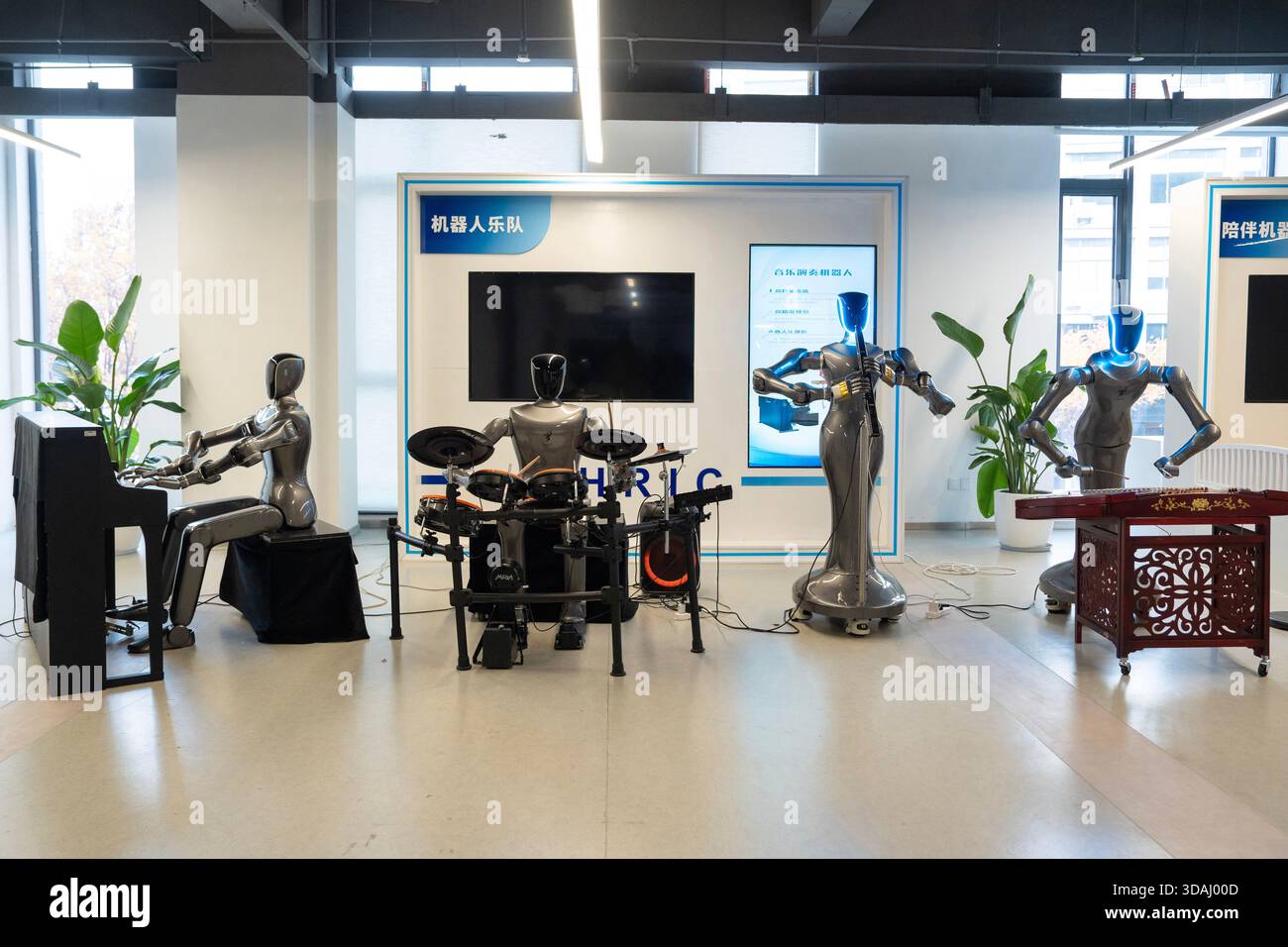
Juwei Technology has carved out a niche in the special industrial sector, creating robots designed for “forbidden zones” where humans and standard robots cannot survive. Their MOVENEW P1 model is a testament to this specialization, featuring a limit load of 400kg and an ultra-long battery life of 12 hours Sohu. Juwei has developed “four-proof” capabilities—resistance to magnetism, explosion, water, and freezing. Notably, the P1 is the first robot dog in the industry to complete control and communication tests in a strong magnetic environment of 1,000 Gauss Sohu. To fuel this growth, Juwei recently announced the completion of a Series A funding round totaling nearly 100 million yuan Sohu.
The Hangzhou Ecosystem: Why This Hub Works
The rise of the “Four Little Dogs” is not an accident but the result of a concentrated industrial ecosystem. Hangzhou serves as the core hub for the Yangtze River Delta’s quadruped robot cluster, leveraging three primary advantages: early technical accumulation, a comprehensive supply chain, and targeted policy support Sohu.
By fostering an environment where companies can specialize rather than compete on the same generic product, Hangzhou has created a synergistic effect. When one company pushes the boundaries of load-bearing (Juwei) and another pushes the boundaries of global deployment (Deep Robotics), the entire regional industry benefits from the shared knowledge and infrastructure of the city.
| Company | Primary Market Focus | Key Competitive Advantage | Recent Financial/Corporate Milestone |
|---|---|---|---|
| Unitree Robotics | Consumer, Education, Research | High cost-performance; scale delivery | Completed listing guidance |
| Deep Robotics | Industry Solutions; Global Markets | Overseas application (e.g., Singapore) | IPO application planned for H1 2026 |
| Five-Eight Intelligence | Military/State-level Research | Deep defense-tech pedigree | 500 million yuan Series A (Oct 2025) |
| Juwei Technology | Special Industrial/Extreme Zones | “Four-proof” (Magnetic, Explosion, Water, Frost) | Nearly 100 million yuan Series A |
What This Means for the Future of Embodied Intelligence
The transition of quadruped robots from technical exploration to large-scale application is entering a “golden decade.” The ability of the Hangzhou cluster to dominate 80% of the domestic market indicates a shift in the global robotics hierarchy. China is no longer just adopting robotic technology but is actively leading the world in the commercialization and deployment of four-legged systems Sohu.
The move toward “embodied intelligence”—where AI is integrated into a physical body capable of interacting with the real world—is most evident in the specialized applications seen in Hangzhou. Whether it is inspecting high-voltage power grids in Singapore or operating in high-magnetic industrial zones, these robots are moving beyond the laboratory and into the “forbidden zones” of human labor.
As the “Four Little Dogs” continue to scale, the next phase of development will likely focus on the integration of more advanced AI brains to complement their agile physical bodies. The financial trajectory of these companies—with multiple IPOs and massive Series A rounds—suggests that capital markets are betting heavily on this specific regional cluster to lead the next wave of industrial automation.
The next major milestone for the cluster will be the formal IPO application of Deep Robotics, scheduled for the first half of 2026 Sina Finance, which will serve as a bellwether for the valuation of embodied intelligence firms in the region.
Do you reckon specialized “industrial” robots will replace general-purpose models in the long run? Share your thoughts in the comments below.
Worth a look