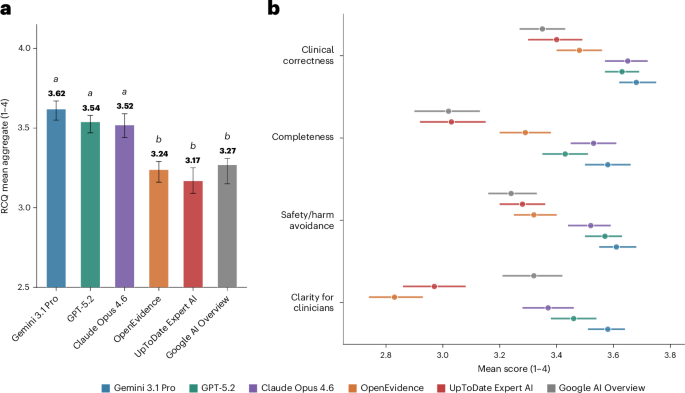
General-purpose large language models (LLMs) currently outperform specialized clinical artificial intelligence tools when answering real-world medical questions posed by physicians. A comparative evaluation revealed that frontier models—developed for broad utility—consistently provided more accurate responses than dedicated clinical AI software, which often performed no better than standard search engine AI overviews. This performance gap highlights a critical need for independent, rigorous testing of diagnostic and decision-support tools before they are integrated into clinical workflows.
As a physician and health journalist, I have observed a rapid influx of digital health tools into hospitals and private practices. While these innovations promise to streamline clinical decision-making, the findings suggest that the proprietary “clinical” nature of a tool does not automatically equate to superior medical reasoning. For clinicians and healthcare administrators, this underscores the importance of evaluating tools based on validated performance metrics rather than marketing claims regarding their specialization.
Benchmarking Performance Gaps in Clinical AI
The evaluation, which assessed AI performance across two public benchmarks and a curated set of physician-submitted queries, found that general-purpose frontier models demonstrated a higher degree of accuracy in clinical reasoning. According to reports from the Nature Medicine research community, specialized clinical tools—often marketed as being “trained” on medical datasets—failed to maintain a performance advantage over generalized, high-parameter models. Instead, these specialized tools reached a performance ceiling comparable to the AI-generated summaries provided by mainstream search engines.

This discrepancy raises questions about the “black box” nature of current clinical AI development. When tools are trained on specific, curated medical literature, they may suffer from overfitting or a lack of the broad, nuanced reasoning capabilities found in larger, general-purpose models. The study suggests that the breadth of training data available to frontier models may provide a more robust foundation for answering complex, multi-variable clinical questions than the narrower datasets used for some specialized medical AI platforms.
The Search Engine Comparison
One of the most striking findings in the comparative analysis is the parity between specialized clinical AI and standard search engine AI overviews. In many instances, clinicians seeking quick, evidence-based answers found that general search-integrated AI provided responses with similar levels of accuracy to clinical-grade tools. This is a significant point of concern for healthcare systems investing heavily in proprietary diagnostic support software.
The World Health Organization has previously emphasized that the deployment of AI in health must be guided by the principles of transparency and safety. The current lack of independent, peer-reviewed testing for specialized clinical tools creates a transparency vacuum. If a general-purpose model is effectively matching or exceeding the performance of a tool specifically designed for healthcare, the justification for the higher costs and integration efforts associated with specialized software becomes increasingly difficult to maintain.
Why Independent Testing Matters
Clinical practice relies on the principle of “first, do no harm.” When AI tools are introduced into the diagnostic pipeline, they must be subjected to the same level of scrutiny as new pharmaceuticals or medical devices. The current landscape, where tools enter practice with limited independent verification, poses risks to patient safety and clinical efficiency. As noted by the U.S. Food and Drug Administration (FDA) regarding software as a medical device (SaMD), regulatory frameworks are evolving, but the speed of AI development continues to outpace the speed of formal clinical validation.
For the practicing physician, this means that the burden of verification often falls on the end-user. Relying on an AI tool that has not been independently validated against standard medical benchmarks can lead to “automation bias,” where a clinician may trust a machine’s output despite subtle errors in reasoning. The evidence suggests that until standardized, transparent testing becomes the industry norm, physicians should treat all AI-generated clinical advice with the same professional skepticism applied to non-peer-reviewed literature.
Future Directions for Medical AI
What happens next in the integration of AI into healthcare depends on the establishment of rigorous, independent evaluation protocols. Researchers are calling for a move away from internal, developer-led testing toward third-party, reproducible benchmarks that reflect the complexity of real-world clinical encounters. This transition is essential for building trust among healthcare providers and ensuring that medical AI tools genuinely enhance patient care rather than adding unnecessary layers of complexity or risk.
Future updates to clinical practice guidelines will likely need to incorporate specific criteria for the use of generative AI in decision support. Until such standards are formalized, institutions should prioritize tools that provide clear, traceable evidence for their recommendations and that have been tested against diverse, clinically relevant datasets. The goal remains the same: to provide clinicians with reliable, time-saving tools that improve outcomes while maintaining the highest standards of safety and accuracy.
As the landscape of medical artificial intelligence continues to shift, we will monitor for new regulatory filings and published performance audits from independent research bodies. Readers are encouraged to share their own experiences with AI-driven diagnostic tools in the comments section below, as peer discussion is a vital component of navigating this rapidly evolving field.
Worth a look