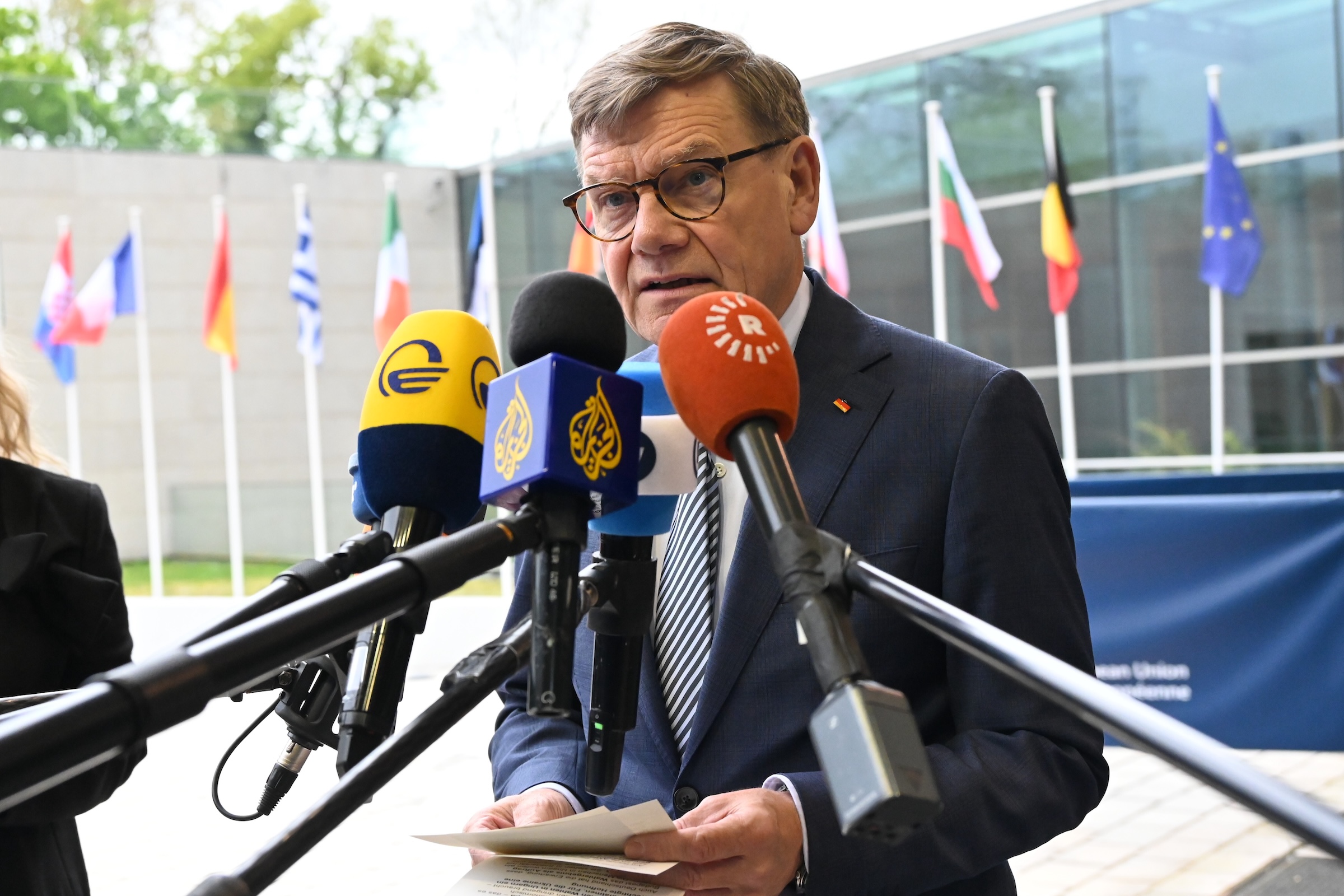
European Union foreign ministers met in Luxembourg on Tuesday to discuss the bloc’s relationship with Israel, specifically addressing calls to suspend the EU-Israel Association Agreement amid growing concerns over human rights violations in Gaza and the occupied West Bank.
The meeting followed a request by Spain, Slovenia, and Ireland to reconsider the trade agreement, which has granted Israel preferential access to European markets since 2000. These three member states argued that Israel’s actions in Palestinian territories constitute violations of international law and human rights obligations under the agreement.
Still, Germany and Italy blocked the motion to suspend the agreement, preventing it from advancing despite support from the requesting nations and a formal appeal by a panel of UN experts who had urged immediate suspension the day before.
The UN experts’ panel, which spoke to EU foreign ministers on Monday, stated that Israel’s conduct in Gaza and the West Bank amounts to atrocity crimes, including genocide, and therefore violates Article 2 of the EU-Israel Association Agreement, which requires respect for human rights and democratic principles.
According to the UN experts, the scale and gravity of documented violations mean that suspension is not a matter of political discretion but a legal obligation for the EU under international law. They emphasized that previous failures by the EU to act decisively have compounded the need for immediate action.
Spain’s Foreign Minister Jose Manuel Albares reiterated his country’s position during the meeting, stating that all EU members must uphold the rulings of the International Court of Justice and the United Nations on human rights and international law, warning that failure to do so would be a defeat for the European Union’s credibility.
Despite the push from Spain, Slovenia, and Ireland, Germany and Italy maintained their opposition, citing concerns about the potential consequences of suspending the agreement and emphasizing the need for caution amid ongoing diplomatic efforts.
The EU-Israel Association Agreement remains a cornerstone of bilateral trade, providing Israel with tariff-free access to European markets for key agricultural and industrial goods. The EU is Israel’s largest trading partner, and the agreement has been in force since 2000, predating many of the recent escalations in violence that have drawn international scrutiny.
In recent years, human rights organizations and UN bodies have increasingly criticized Israel’s policies in the occupied Palestinian territories, including settlement expansion, movement restrictions, and military operations that have resulted in significant civilian casualties, particularly during escalations in Gaza.
The debate over the agreement reflects broader divisions within the EU regarding how to balance economic ties with Israel against growing pressure to uphold human rights commitments. Even as some member states advocate for a reassessment of the relationship, others warn that abrupt changes could undermine regional stability or be perceived as one-sided.
As of Tuesday’s meeting, no consensus emerged to suspend or revoke the agreement, leaving the current framework in place despite ongoing international appeals. The issue is expected to remain on the EU’s agenda, particularly as humanitarian conditions in Gaza continue to draw global attention and scrutiny.
Looking ahead, the next formal opportunity for EU member states to revisit the matter will likely arise during future foreign affairs councils or specialized trade committees, though no specific date has been set for a renewed vote or discussion on the agreement’s status.
For ongoing updates on EU foreign policy decisions, readers can consult official records from the Council of the European Union and statements from member state foreign ministries, which are regularly published and made available to the public.
If you found this informative, consider sharing it with others interested in international affairs and human rights developments. We welcome thoughtful comments below to foster constructive dialogue on this important topic.
Worth a look