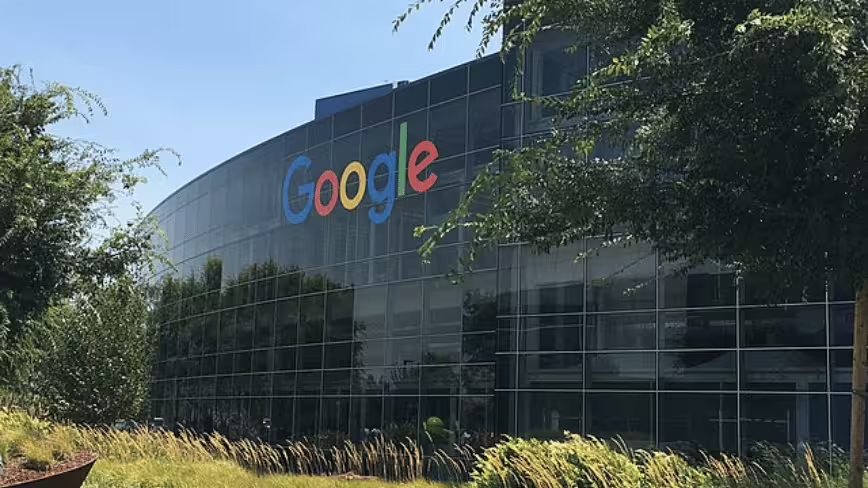
Google has unveiled a $750 million initiative to strengthen its partnerships with major consulting firms, aiming to accelerate the development and deployment of agentic AI applications on its cloud platform. The announcement came during Google Cloud Next 2026, where the company positioned the fund as the largest single partner investment commitment from any hyperscaler to date.
The fund is designed not as a traditional venture capital vehicle but as a combination of cloud credits, co-investment capital, training subsidies, and go-to-market support. Its primary goal is to incentivize global systems integrators to build and deploy AI agents using Google Cloud rather than competing platforms like Microsoft Azure or Amazon Web Services. This strategy reflects a broader shift in the enterprise AI race, where dominance is increasingly determined not by infrastructure alone but by influence over the consultancies that advise enterprises on technology adoption.
According to Kevin Ichhpurani, president of Google Cloud’s global partner ecosystem, agentic AI is expected to create a roughly $1 trillion global market. Google aims to capture a disproportionate share by making its partners the primary delivery channel for these technologies. The economics underpinning the initiative are significant: for every dollar a customer spends on Google Cloud, partners can capture up to $7.05 in services revenue, turning consultancies into powerful multipliers of cloud consumption.
Google reports more than 2,900 services partners in its ecosystem, with a 400% increase in new partner entries over the past year and a 250% increase in partner-influenced revenue. These figures underscore the growing importance of the partner network in Google’s cloud strategy, particularly as it seeks to close the gap with market leaders in enterprise cloud adoption.
Several major consulting firms have already committed to the initiative. Accenture has built over 450 AI agents on Google Cloud, while Deloitte has pledged what it described as its “largest investment yet” in the collaboration. KPMG has committed $100 million, PwC has pledged $400 million, and NTT DATA has dedicated 5,000 engineers to support agentic AI development on the platform. These commitments were highlighted during the Cloud Next 2026 event, where these firms likewise appeared as sponsors.
The sponsorship roster for Google Cloud Next 2026 included Accenture at booth 1201, Deloitte at booth 1019, KPMG at booth 2001, and PwC at booth 1921, with NTT DATA also listed among the sponsors. Other prominent technology and consulting firms such as Capgemini, Cognizant, HCLTech, Tata Consultancy Services, and McKinsey & Company were also present, reflecting the broad industry engagement with Google’s AI and cloud ambitions.
Google Cloud’s partner awards for 2026 further illustrate the depth of these collaborations. Accenture was recognized as the Global Artificial Intelligence: Sales & Services partner of the year, while Deloitte won in the Global Gemini Enterprise and Global Industry Solutions categories. KPMG received the Global Industry Solutions: Breakthrough award, and Capgemini was honored as the Global Artificial Intelligence: Innovation & Solutions recipient. These accolades underscore the joint progress being made in deploying AI-driven solutions across data analytics, databases, and industry-specific applications.
The agentic AI focus marks a strategic evolution from earlier cloud competitions centered on infrastructure and basic AI models. Agentic systems—AI programs capable of autonomous reasoning, planning, and action—are seen as the next frontier in enterprise automation, with applications ranging from supply chain optimization to customer service and financial modeling. By funding partners to build these agents on its platform, Google aims to create a self-reinforcing cycle where increased partner activity drives greater cloud usage, which in turn funds further innovation.
Industry analysts note that the success of this approach will depend on Google’s ability to maintain trust and transparency with its partners, particularly as competing hyperscalers launch similar incentives. Microsoft and Amazon have both invested heavily in their own partner programs, and OpenAI and Anthropic are increasingly engaging consultancies to deploy their models in enterprise settings. The $750 million fund represents Google’s most aggressive move yet to assert influence in this evolving landscape.
As of the Cloud Next 2026 event, no public timeline has been released for the full deployment of the fund’s resources, nor have specific milestones been outlined for partner deliverables. Google has stated that the fund will be administered through its global partner ecosystem team, with allocations based on proposed agentic AI projects that demonstrate clear business value and technical feasibility on Google Cloud.
The initiative comes at a time when enterprise adoption of AI remains uneven, with many organizations still in the experimentation phase. Consulting firms play a critical role in bridging this gap, offering not only technical implementation but also change management, governance, and ROI analysis. By aligning financial incentives with these firms, Google seeks to ensure that its cloud platform becomes the preferred foundation for scalable, production-grade agentic AI systems.
For ongoing updates on Google Cloud’s partner initiatives and agentic AI developments, interested parties can refer to the official Google Cloud blog and the Google Cloud Next 2026 event archive, where session recordings and partner announcements are made available following the conference.
What do you think about Google’s strategy to invest heavily in its consulting partners to drive agentic AI adoption? Share your thoughts in the comments below, and feel free to share this article with colleagues who are following the evolving enterprise AI landscape.