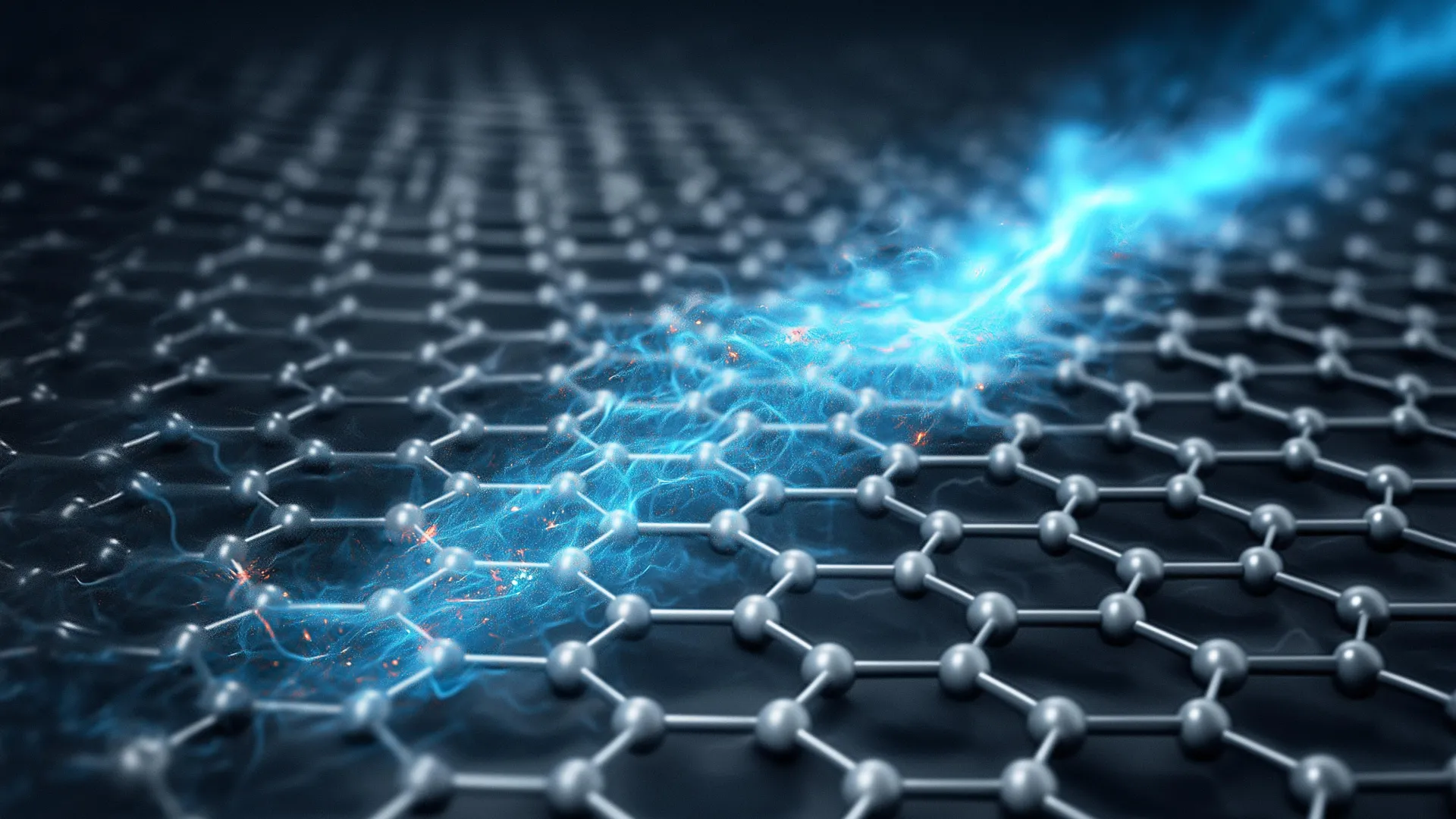
Graphene has once again surprised physicists, this time by exhibiting electron behavior that appears to defy a long-standing principle of classical physics. In experiments conducted at ultra-low temperatures, researchers observed electrons moving through specially engineered graphene structures with virtually no resistance, flowing like a frictionless liquid. This phenomenon, known as the fractional quantum anomalous Hall effect, suggests that under certain conditions, electrons in graphene can collectively behave in ways that challenge conventional understanding of electrical conduction.
The discovery builds on years of research into graphene’s unique electronic properties. Unlike in ordinary metals where electrons scatter and lose energy as they move, these engineered graphene systems allow electrons to travel along the edges without dissipation. What makes this particularly significant is that the effect occurs without the need for an external magnetic field—a requirement in traditional quantum Hall observations. Instead, the material’s intrinsic topology and carefully designed layering create conditions where electron interactions give rise to exotic states of matter.
According to findings published in Nature by a team led by Assistant Professor Zhengguang Lu at Florida State University, the breakthrough involved sandwiching five layers of graphene between boron nitride sheets. At temperatures near absolute zero, this configuration enabled the observation of both integer and fractional quantum anomalous Hall states. In the fractional regime, electrical conductance took on values that are fractions of a fundamental constant—indicating the emergence of quasiparticles with charges that are fractions of an electron’s charge.
“This is one of the special parts about physics—a tiny difference in a material’s structure can create a system that behaves completely differently,” Lu said in a statement released by Florida State University. The research, conducted in collaboration with scientists who first observed similar phenomena in graphite systems at MIT in late 2023, highlights how subtle changes in atomic arrangement can unlock unprecedented electronic behavior.
The implications extend beyond fundamental science. Because the edge currents are dissipationless and topologically protected—meaning they persist despite minor imperfections or deformations in the material—such states could one day be harnessed for robust quantum computing components. Unlike conventional qubits that are easily disrupted by environmental noise, topologically protected states offer a pathway to more stable quantum information processing.
Further supporting the potential of graphene-based systems for quantum applications, separate research has shown exceptionally long spin relaxation times in bilayer graphene quantum dots. A 2022 study published in Nature Communications reported spin relaxation times exceeding 200 microseconds at low temperatures—more than two orders of magnitude higher than previously seen in other carbon-based quantum dots. This longevity is critical for maintaining the coherence of spin-based qubits, suggesting graphene could serve as a promising platform for solid-state quantum devices.
Meanwhile, other laboratories are exploring how frustration in atomic lattices can lead to novel quantum states. Research from the University of California, Santa Barbara published in March 2026 in Nature Materials described a “double-frustrated” material where competing magnetic and electronic interactions produce unconventional magnetic ordering. While not directly about graphene, this work underscores a broader trend in condensed matter physics: exploiting internal conflicts within materials to stabilize exotic quantum phases that may be useful for future technologies.
Experts caution that practical applications remain distant. The current experiments require specialized equipment and temperatures far below those achievable in everyday environments. However, each discovery adds to the growing body of knowledge about how quantum mechanics manifests in two-dimensional materials, guiding the search for more accessible platforms that retain these desirable properties.
As research continues, scientists are focused on refining fabrication techniques to improve consistency and exploring whether similar effects can be stabilized at higher temperatures. The interplay between topology, electron correlation, and material design remains a rich frontier, with graphene continuing to serve as a versatile testbed for probing the limits of physical law.
For now, the observation of frictionless electron flow in graphene stands as a powerful reminder that even well-studied materials can reveal profound surprises when examined under the right conditions. It reinforces the idea that the quantum world still holds secrets waiting to be uncovered—one atom layer at a time.
To stay updated on the latest developments in quantum materials and condensed matter physics, readers can follow peer-reviewed journals such as Nature, Science, and Physical Review Letters, which regularly publish breakthrough studies in this rapidly evolving field.
Worth a look