
A American passenger evacuated from the hantavirus-stricken cruise ship MV Hondius has tested positive for the virus but remains asymptomatic, according to U.S. Health officials, as international authorities scramble to contain the outbreak that has already claimed lives and triggered unprecedented quarantine protocols. The development underscores the escalating public health crisis aboard the vessel, which has become a focal point for global concern over zoonotic disease transmission and the challenges of managing infectious outbreaks at sea.
The MV Hondius outbreak, now in its second week, has prompted a rare and complex repatriation operation involving military transport, strict isolation measures, and coordination between the World Health Organization (WHO), national health ministries, and cruise industry regulators. While the asymptomatic American case adds to the tension, health officials emphasize that the risk of person-to-person transmission—particularly of the Andes strain—remains limited but cannot be ruled out entirely. The situation has drawn parallels to early COVID-19 containment efforts, reviving memories of how quickly cruise ships became flashpoints for viral spread.
As of Monday, May 11, 2026, up to 150 passengers and crew members have been evacuated from the ship, which docked in Tenerife, Spain, after three deaths were confirmed among those aboard. The repatriation process, conducted under military supervision, included passengers wearing protective gear and undergoing decontamination procedures before boarding charter flights. France has already placed its five repatriated citizens—one of whom is now symptomatic—under strict 42-day isolation, while other nations are implementing similar protocols. The WHO has recommended the quarantine period as a precautionary measure, though it has not issued a mandatory global directive.
BREAKING: American evacuee from hantavirus-hit cruise ship MV Hondius tests positive but remains asymptomatic, U.S. Officials confirm. Global health agencies monitoring for further cases as repatriation efforts continue. #Hantavirus #PublicHealth
Hantavirus Transmission: How the Virus Spreads and Why This Outbreak Is Unusual
Hantaviruses are a family of viruses primarily transmitted through contact with rodents—particularly their urine, droppings, or saliva. The most common strain in the Americas, Sin Nombre virus, is carried by deer mice and causes hantavirus pulmonary syndrome (HPS), a severe respiratory illness with a fatality rate of up to 38% if untreated. The Andes virus, however, is the only known strain capable of limited person-to-person transmission, typically through close contact with an infected individual’s secretions.
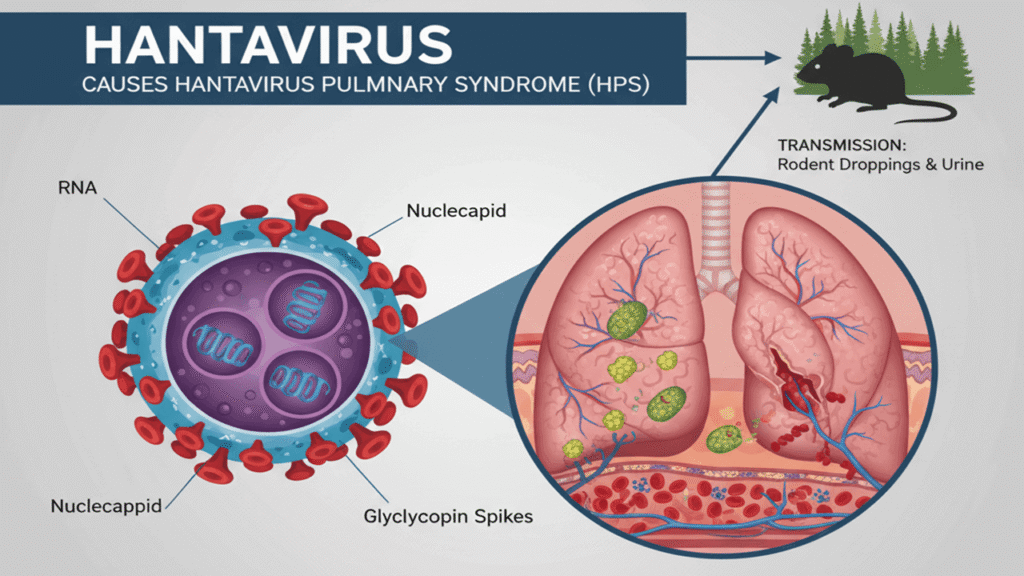
In the case of the MV Hondius, health officials suspect the outbreak originated from rodent infestation aboard the ship, a scenario not uncommon in maritime environments where pest control measures may be compromised. The Centers for Disease Control and Prevention (CDC) warns that early symptoms of HPS—fatigue, fever, muscle aches, and headaches—can mimic those of other illnesses, delaying diagnosis. By the time respiratory symptoms emerge, the disease can progress rapidly, making containment critical.
Key Fact: The Andes virus has been documented in South America, where outbreaks have occurred in Argentina, Chile, and Brazil. Its appearance on a cruise ship in the Atlantic raises questions about how the virus may have been introduced and whether it represents a new strain or a rare international transmission event.
Global Response: Quarantine Protocols and Public Health Measures
France has taken the most aggressive stance thus far, placing all five of its repatriated citizens—including one symptomatic case—under strict isolation for 42 days, the maximum incubation period for hantavirus. Spanish authorities have also implemented similar measures for evacuees arriving on their soil, while the U.S. Centers for Disease Control and Prevention (CDC) is monitoring the asymptomatic American passenger closely. The WHO’s recommendation for a 42-day quarantine reflects its assessment that the risk of secondary transmission, while low, cannot be entirely dismissed.
Countries without confirmed cases are weighing whether to impose travel restrictions or additional screening for passengers arriving from affected regions. The European Centre for Disease Prevention and Control (ECDC) has issued a risk assessment noting that while the overall risk to the EU remains low, localized clusters could emerge if infected individuals travel before symptoms appear. “The asymptomatic nature of this case highlights the challenges of early detection,” said a spokesperson for the ECDC, emphasizing the need for vigilance among healthcare providers.
Stakeholders in the Crisis: Who Is Affected and What Happens Next?
The crisis has placed multiple groups under scrutiny:
- Passengers and Crew: Those repatriated face psychological and logistical challenges, including isolation, financial strain, and the uncertainty of whether they will develop symptoms. Mental health support has been highlighted as a critical need.
- Health Authorities: National and international agencies are coordinating to prevent further spread, with the WHO serving as the primary information hub. Discrepancies in quarantine policies—some countries opting for home isolation, others for centralized facilities—have sparked debates over effectiveness.
- Cruise Industry: The outbreak threatens to revive travel bans and insurance challenges faced during the COVID-19 pandemic. Major cruise lines are reviewing their pest control and sanitation protocols, though industry representatives have not yet issued public statements.
- Scientific Community: Epidemiologists are analyzing whether this outbreak represents a new strain or a rare international transmission event. The CDC and WHO are collaborating on genetic sequencing to determine the virus’s origins.
Practical Guidance: What Travelers and the Public Should Know
While the risk to the general public remains low, health authorities are advising travelers and healthcare providers to remain vigilant. Key precautions include:
- Avoiding contact with rodents, especially in rural or poorly maintained areas.
- Seeking immediate medical attention if experiencing symptoms such as fever, muscle aches, or respiratory distress after potential exposure.
- Monitoring official updates from the CDC and WHO, which are providing real-time guidance.
- For those who have traveled on the MV Hondius, reporting symptoms to local health authorities and following isolation protocols.
Expert Perspective: “A Wake-Up Call for Global Health Surveillance”
Dr. Antoine Flahault, an epidemiologist affiliated with the University of Geneva, has drawn parallels between the hantavirus outbreak and past zoonotic threats, including COVID-19. In a recent interview, he emphasized the need for improved global surveillance systems to detect and respond to emerging infectious diseases. “The MV Hondius case is a stark reminder that no region is immune to zoonotic spillover events,” Flahault stated. “The international community must invest in early warning systems and rapid response mechanisms to prevent such outbreaks from becoming pandemics.”

Note: Dr. Flahault’s comments were published in Le Parisien but have not been independently verified by the WHO or CDC for this specific context.
Key Takeaways: What You Need to Know
- Asymptomatic Transmission: The confirmed positive case among American evacuees highlights the challenges of detecting hantavirus early, as symptoms may not appear for weeks.
- Quarantine Protocols: France and Spain are enforcing 42-day isolation periods, while the WHO recommends similar measures globally to prevent secondary spread.
- Person-to-Person Risk: The Andes strain is the only hantavirus known to transmit between humans, though this is rare and typically requires close contact.
- Global Coordination: The outbreak has prompted rare collaboration between cruise lines, military transport agencies, and public health bodies to manage repatriation.
- Travel Advisory: Authorities urge travelers to monitor symptoms and report potential exposure, though the overall risk to the public remains low.
- Scientific Investigation: Genetic sequencing is underway to determine the virus’s origins and whether it represents a new strain.
The next critical checkpoint will be the release of genetic sequencing results from the WHO and CDC, expected within the next 7–10 days. These findings will clarify whether the virus aboard the MV Hondius is a known strain or a novel variant, which could influence global health advisories. In the meantime, the WHO has scheduled an emergency briefing on May 15, 2026, to reassess containment strategies and address public concerns.
This developing story raises important questions about pandemic preparedness, zoonotic disease surveillance, and the role of cruise ships in global health security. We invite readers to share their experiences, concerns, or questions in the comments below. For official updates, follow the World Health Organization and your local health ministry.
Maria Petrova is an international journalist based in Sofia, Bulgaria, with 14 years of experience covering global health crises and geopolitical developments. She holds an MA in International Relations from Sofia University and has reported from conflict zones and epidemic hotspots worldwide.