Navigating the American healthcare system often feels less like a path to wellness and more like an endurance test in bureaucracy. For millions of patients, the struggle is not merely the illness they are treating, but the “friction” encountered at every touchpoint—from the initial search for a doctor to the arrival of a confusing, high-cost bill weeks after the appointment.
A new national consumer survey released by RevSpring, a provider of healthcare engagement and payment solutions, highlights a systemic crisis of clarity. The report, titled The Cost of Confusion: How Friction Shapes the Healthcare Experience, reveals a staggering disconnect between the care patients receive and their ability to understand and afford that care. This “cost of confusion in healthcare” is not just a matter of administrative annoyance; It’s a primary driver of patient dissatisfaction and, more critically, a barrier to essential medical treatment.
As a physician and journalist, I find the title of this report evokes a particular kind of cultural resonance. It brings to mind the 1970 Motown hit “Ball of Confusion” by The Temptations. Written by Norman Whitfield and Barrett Strong, the song captured a period of intense social upheaval, racism, and political corruption, mirroring a public grievance rooted in a deep distrust of information. Decades later, that same sense of disorientation has migrated into the patient experience. The “ball of confusion” today is often found in the fine print of an insurance denial or the opaque pricing of an outpatient procedure.
The data from the RevSpring study suggests that this friction is nearly universal. An overwhelming 94% of consumers agree that healthcare needs to be made easier so that patients know what to expect, which would in turn foster greater confidence and a feeling of being “seen” by the system.
The Anatomy of Healthcare Friction
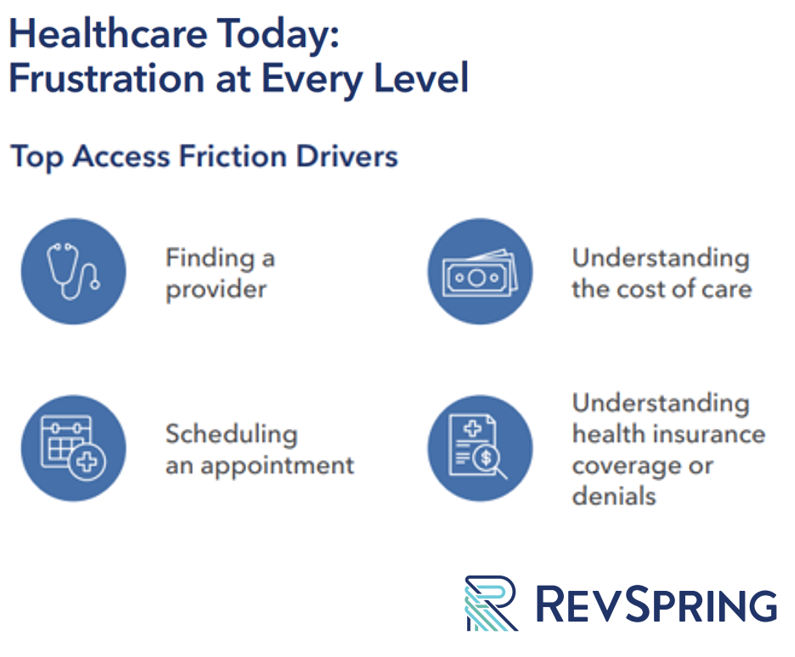
Friction in healthcare refers to the obstacles—digital, financial, or communicative—that hinder a patient’s journey. According to the RevSpring research, this friction begins long before a patient enters the exam room. Finding a provider is one of the first hurdles, with 38% of consumers reporting that finding an in-network provider is difficult.
Once care is accessed, the frustration shifts from logistics to finance. The survey found that uncertainty regarding costs and insurance coverage dominates the experience. Specifically, 39% of respondents cited difficulty understanding the cost of care, and another 39% struggled to understand insurance coverage or denials.
This lack of transparency creates a volatile environment for the patient. The report indicates that 79% of consumers have been surprised by the price of a medical bill. When patients cannot predict their financial liability, the healthcare experience transforms from a healing process into a source of acute stress.
The Dangerous Price of Uncertainty
While billing errors and confusing statements are often viewed as administrative failures, they have profound clinical implications. When the financial path is obscured, patients often make decisions based on fear rather than medical necessity. The most alarming finding in the RevSpring report is that 50% of consumers have cut back on medical care due to cost.
This behavioral shift—delaying screenings, skipping follow-up appointments, or rationing medication—creates a dangerous cycle. Untreated conditions often escalate into emergencies, which are both more expensive for the system and more hazardous for the patient. Scott MacKenzie, CEO of RevSpring, noted that “confusion around provider selection and uncertainty around cost and coverage results in patient dissatisfaction, and causes some people to delay care or disengage.”
The crisis is further compounded by a lack of flexible payment infrastructure. Only 29% of consumers say they had all the options they needed to manage healthcare payments, suggesting that the financial tools provided by many institutions are insufficient for the reality of modern medical costs.
Rebuilding Trust Through Communication
If the “ball of confusion” is driven by a distrust of information, the solution lies in radical transparency. The RevSpring study suggests that the opportunity for providers lies in reducing uncertainty early in the patient-financial process. When cost and coverage details are clearly communicated on a statement, patient satisfaction increases significantly.
Consumers have expressed a clear desire for specific improvements:
- Straightforward explanations of insurance benefits.
- Upfront, accurate out-of-pocket cost estimates.
- Accessible and flexible payment plan options.
In the world of medical journalism and internal medicine, we often discuss “patient-centered care” in terms of clinical outcomes. However, true patient-centered care must include the financial experience. Communication is not merely an administrative task; it is a clinical tool. When a provider can clearly explain the cost of a procedure, they remove a psychological barrier to treatment, thereby improving the likelihood of compliance and positive health outcomes.
The link between communication and trust is the primary lever for patient retention and loyalty. In an era where healthcare is increasingly commodified, the providers who prioritize clarity over complexity will be the ones who maintain the strongest bonds with their patients.
Key Takeaways from the RevSpring Report
- Universal Frustration: 94% of consumers believe the healthcare experience needs to be simplified.
- Financial Barriers: Half of all surveyed consumers have reduced their medical care because of cost.
- The Transparency Gap: Nearly 80% of patients are surprised by their final medical bills.
- Access Hurdles: Finding an in-network provider remains a significant challenge for 38% of consumers.
- The Solution: Upfront cost estimates and clear insurance explanations are the most requested improvements from patients.
The Temptations sang about a world where “nobody knows” where things were headed, reflecting a society in chaos. In the context of U.S. Healthcare, the chaos is often engineered by complexity. Moving away from this “ball of confusion” requires a concerted effort from insurers, hospitals, and providers to treat financial transparency as a fundamental component of patient care.

The next critical step for the industry will be the widespread adoption of standardized, upfront pricing models and the integration of more intuitive payment solutions to ensure that no patient feels forced to choose between their financial stability and their health.
Do you find the U.S. Healthcare billing process confusing? Have you ever delayed care due to cost uncertainty? Share your experiences in the comments below or share this article to join the conversation on healthcare transparency.
Worth a look