
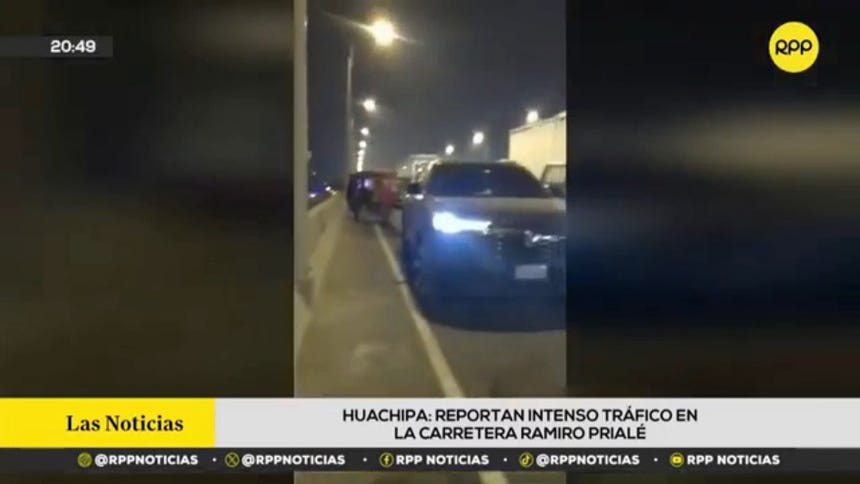
Severe Traffic Gridlock Paralyzes Ramiro Prialé Highway in East Lima
A massive wave of traffic congestion on the Ramiro Prialé highway in East Lima left hundreds of commuters and travelers stranded for more than five hours on Friday, May 7, 2026. The immobilization began around 4:00 p.m., turning a critical transit artery into a standstill that persisted well into the evening, severely disrupting movement toward the eastern sectors of the city.
The Ramiro Prialé highway traffic congestion was not merely a result of peak-hour volume but was triggered by a combination of a road accident and systemic delays in official response. The situation was further exacerbated by the closure of alternative detour routes due to ongoing infrastructure works, leaving motorists with no viable options to maneuver or exit the highway.
Among the most distressing accounts of the gridlock was that of a family attempting to transport a deceased relative to a cemetery. The immobilization of the highway transformed a solemn funeral procession into a desperate struggle, highlighting the vulnerability of citizens when urban infrastructure and emergency responses fail simultaneously.
Human Toll: A Funeral Procession Trapped in Transit
The severity of the congestion was underscored by the experience of Diana Delgado and her family, who were transporting a coffin to the Mapfre cemetery. According to Delgado, the family had departed from a wake before 3:00 p.m., hoping to reach the cemetery in a timely manner. However, upon entering the Ramiro Prialé highway, the flow of vehicles came to a complete halt.
For over five hours, the family remained trapped in their vehicle, unable to move forward or turn back. Delgado expressed the emotional and physical toll of the delay, noting that the prolonged wait began to negatively impact the health of the elderly family members accompanying the cortege.
“We have been here since 4:00 p.m. And we cannot take our relative to give them a Christian burial,” Delgado stated, illustrating the profound human impact of the logistical failure.
Systemic Failures and the Role of the Public Ministry
The gridlock was reportedly triggered by a traffic accident on the highway. While accidents are common on high-volume arteries, the duration of this particular stoppage was attributed to a critical delay in the arrival of legal authorities. Reports indicate that the congestion became critical due to the apparent absence of representatives from the Public Ministry, whose presence is required for the legal lifting and removal of a body following a fatal accident.

This administrative delay created a bottleneck that prevented the clearing of the scene, effectively sealing off the highway. The inability of the Public Ministry to provide a timely response meant that the accident site remained an active obstruction for several hours, paralyzing the transit of thousands of users.
Infrastructure Constraints and Detour Closures
The crisis was magnified by the current state of the highway’s surrounding infrastructure. Under normal circumstances, drivers might seek alternative routes to bypass an accident. However, the usual detour routes were closed due to ongoing construction works in the area.
This lack of “desfogue” (outflow) options meant that transport operators and private drivers were completely immobilized. With no available exits or alternative paths, the highway became a parking lot, leaving motorists stranded without the ability to maneuver or reverse their direction.
Summary of Contributing Factors
- Initial Trigger: A road accident that obstructed the main lanes of the Ramiro Prialé highway.
- Administrative Delay: The reported absence of Public Ministry representatives necessary for the removal of a body.
- Infrastructure Barriers: The closure of standard detour routes due to active construction projects.
- Timing: The event occurred during the late afternoon peak, maximizing the number of affected users.
The events on the Ramiro Prialé highway serve as a stark reminder of the fragility of Lima’s transport network, where a single accident, combined with administrative inefficiency and planned roadworks, can lead to total systemic collapse.
Official updates regarding the completion of the construction works or changes in the Public Ministry’s response protocols for highway accidents have not yet been released. Commuters are encouraged to monitor local traffic advisories before utilizing the East Lima corridors.
World Today Journal encourages readers to share their experiences with urban transit challenges in the comments below.