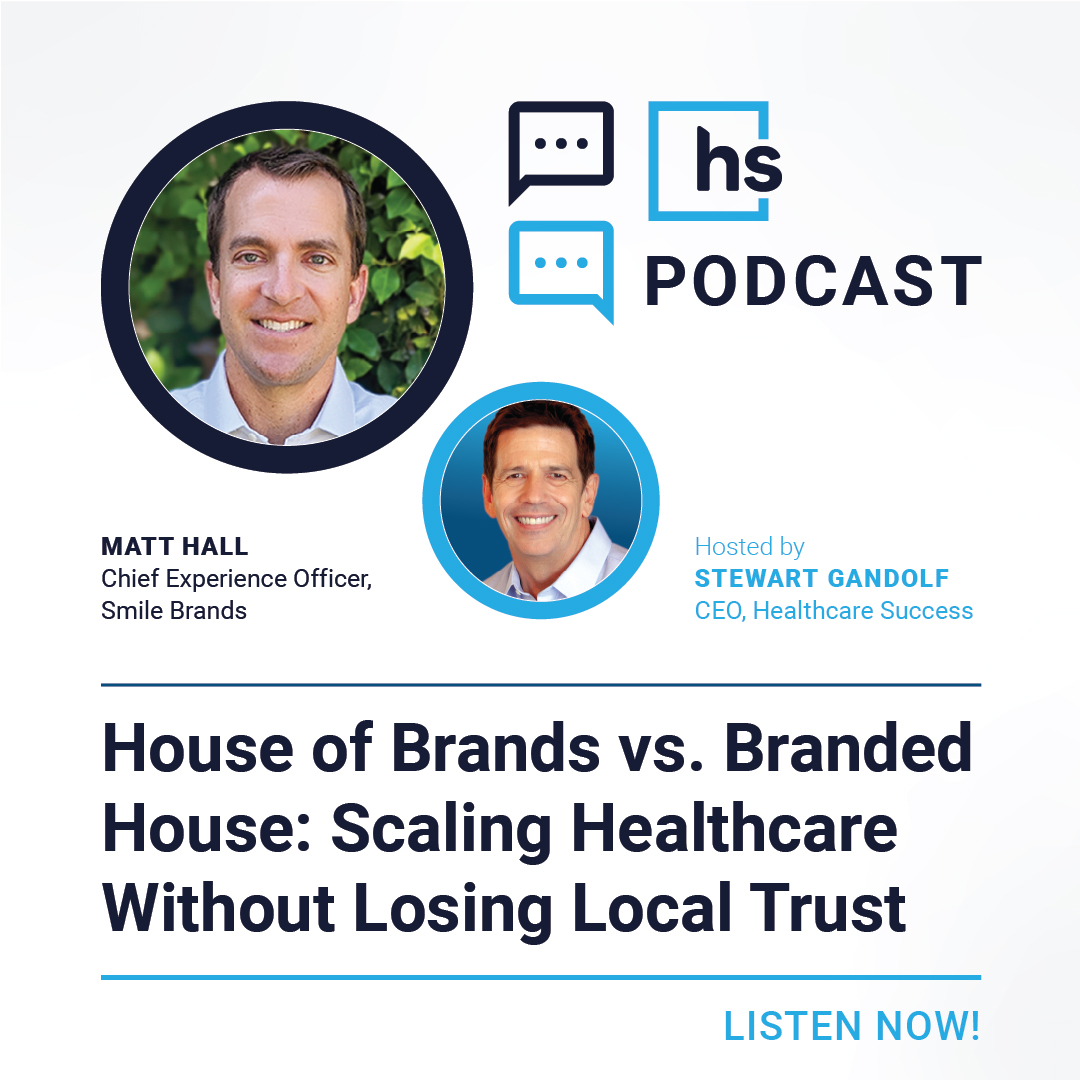
Healthcare organizations scaling across multiple locations face a persistent strategic tension: how to achieve operational efficiency while maintaining the local trust essential for patient retention. For leaders in the dental, dermatology, and multi-site healthcare sectors, the decision between a “branded house” model—where all locations operate under one name—and a “house of brands” model—where each practice retains its local identity—represents a fundamental business choice that dictates marketing, culture, and long-term value.
According to Matt Hall, Chief Experience Officer at Smile Brands, the most successful platforms often find that sustainable growth depends on balancing centralized infrastructure with local autonomy. Hall, who has held leadership roles at Pacific Dental Services, Platinum Dermatology Partners, and Smile Brands, emphasizes that healthcare remains a deeply local service. While enterprise-level resources can improve clinical and operational standards, the patient experience is ultimately defined by the relationship with local providers and staff.
Strategic Tradeoffs: Branded House vs. House of Brands
The choice of brand architecture is not merely a marketing decision; it is a core business strategy that influences everything from recruitment to patient acquisition. A “branded house” strategy, exemplified by organizations like Chick-fil-A, leverages a single, consistent identity across all locations. This model maximizes brand recognition and allows for highly efficient, centralized marketing efforts. However, the risk lies in appearing too corporate or detached from the specific needs of a community.


Conversely, a “house of brands” approach allows individual practices to maintain the names and identities that patients already trust. This model was a cornerstone of the growth strategy at Pacific Dental Services, which operated hundreds of uniquely named offices. By keeping local brands, the organization minimized the friction often associated with acquisitions. The primary challenge, however, is the operational complexity of managing marketing and digital presence for hundreds of distinct entities, requiring robust, scalable technology and sophisticated, localized digital marketing strategies.
Hall notes that successful organizations often move toward a hybrid model. For example, the creation of “Smile Generation” provided an umbrella brand that endorsed independent practices without erasing their local names. This dual approach allows the organization to benefit from the trust of a local brand while providing patients with the assurance of a standardized, high-quality clinical framework.
The Role of Culture in Multi-Site Scaling
Beyond brand architecture, culture serves as the primary determinant for the success of acquisitions and de novo growth. When an organization acquires a practice that has operated independently for decades, the integration process often hinges on leadership alignment and cultural fit. Financial metrics are critical, but they do not account for the human element—the staff and providers who are the face of the practice.
Hall identifies the “people, processes, and systems” framework as the key to scaling without sacrificing quality. Centralized governance should provide clear frameworks for clinical excellence and operational efficiency, but it must stop short of rigid control. Local teams require the flexibility to tailor their environment, community involvement, and patient interactions to their specific demographic. This local empowerment is what prevents a large, multi-billion-dollar organization from feeling like a sterile, impersonal chain.
Practical steps for leaders in this space include:
- Empowering Local Leadership: Ensuring that lead doctors and practice managers are champions of both the enterprise culture and the local community.
- Environmental Personalization: Using office decor and local outreach to reflect the community, which helps patients view the practice as an authentic member of the neighborhood.
- Assessing Cultural Fit: Incorporating “people-first” assessments during due diligence to identify whether an incoming practice team will thrive within the larger organizational framework.
Scaling Through Technology and Modernization
As healthcare organizations grow to encompass hundreds of locations, the human element must be supported by modern infrastructure. Digital transformation—including the implementation of unified practice management systems, automated patient communication, and emerging AI tools—is becoming a necessity for maintaining consistency at scale. These technologies allow for centralized support while freeing up local staff to focus on patient care rather than administrative tasks.

However, Hall emphasizes that technology is an enabler, not a replacement for the fundamentals. The most efficient systems are useless if they are not adopted by the right people, guided by the right processes, and supported by a culture that prioritizes the patient experience. The goal of modernization is to eliminate the variability that leads to inconsistent care, ensuring that every patient, regardless of their location, receives a high standard of service.
What Happens Next
The evolution of multi-location healthcare continues to be driven by private equity investment and the pursuit of operational excellence. As platforms mature, the focus is shifting from simple geographic expansion to the optimization of existing networks. Future growth will likely involve deeper integration of data analytics to refine local marketing and the continued professionalization of practice management through standardized, technology-enabled workflows.
For executives and operators, the next phase of development will involve navigating the balance between AI-driven efficiency and the human-centric nature of healthcare. As these organizations refine their brand architectures, the winners will be those that can successfully prove that scale and community connection are not mutually exclusive, but rather complementary drivers of long-term enterprise value.