
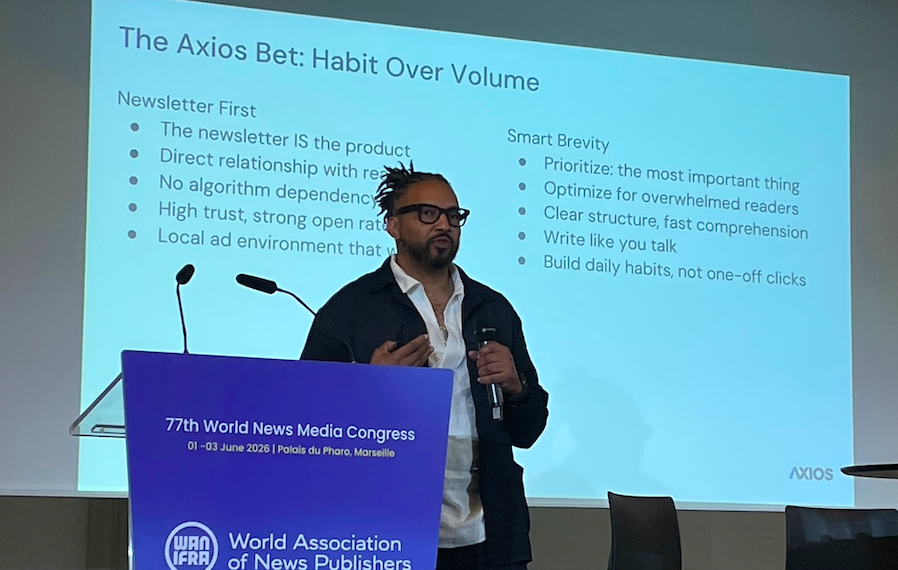
Axios is expanding its footprint in the United States, adding two new local markets this June as part of a continued strategy to prioritize concise, community-focused journalism. The media organization, which was acquired by Cox Enterprises for $525 million in August 2022, currently operates in 37 U.S. markets and plans to launch dedicated coverage for Fort Lauderdale and Hollywood, Florida, on June 22, according to company statements. The expansion underscores a commitment to the “Smart Brevity” editorial model, which relies on email newsletters as its primary distribution channel rather than social media platforms.
The company maintains its leadership under co-founders Jim VandeHei, Mike Allen, and Roy Schwartz, who previously held instrumental roles at Politico. Their current strategy focuses on high-efficiency newsrooms, typically staffed by two to four reporters per market, to deliver essential daily updates directly to subscribers’ mobile devices. This approach aims to capture reader attention early in the day, focusing on “1 big thing” and “why it matters” in every story, a format the founders also detailed in their book on the subject.
The Strategy Behind Smart Brevity
At the core of the organization’s operational model is the concept of Smart Brevity, a writing style designed to maximize information retention while minimizing the time required for consumption. By utilizing bullet points and highlighted “why it matters” sections, the editors aim to ensure that readers feel more informed after engaging with a piece of content. Delano Massey, Managing Editor of Axios Local, noted that the model is built on the premise that readers have not lost interest in local news, but rather that their consumption habits and appetites have shifted toward more efficient, intelligent delivery.
The decision to avoid reliance on third-party social media platforms is a deliberate business choice. By focusing on email newsletters, the organization retains a direct connection to its audience, viewing the inbox as a more reliable and stable distribution channel than algorithmic news feeds. This structure allows for a lean newsroom model, enabling the company to maintain operations in dozens of markets without the overhead of massive, traditional editorial teams. The focus remains on community-specific reporting that avoids duplicating the efforts of other local news outlets, instead seeking to provide unique, actionable insights for residents.
Revenue and Operational Efficiency
To sustain its growth, the company employs a multi-faceted revenue model that includes sponsorships, advertising, and voluntary reader contributions. This diversification is essential for supporting the localized newsletter infrastructure while maintaining the editorial independence of each market. The efficiency of the local newsrooms—often consisting of fewer than five journalists—is a key component of the company’s scalability. By keeping newsrooms small and focused, the organization can enter new markets with lower initial costs while maintaining a consistent quality of reporting.
.JPG/1200px-Fort_Lauderdale-Hollywood_International_Airport_(cropped).JPG "Revenue and Operational Efficiency")
The expansion into the South Florida region, including the upcoming debut in Fort Lauderdale and Hollywood, follows a pattern of targeted growth in high-density or underserved areas. Each market is supported by a dedicated website, but these serve primarily as archives or landing pages for content that is fundamentally designed for the inbox. By emphasizing the “big picture” in newsletters of approximately 1,000 words or less, the company aims to become a primary morning utility for its subscribers.
Why Local News Matters for the Model
The organization’s approach to local news is intentionally selective. Rather than covering every routine event, such as a localized fire that might be documented by multiple other outlets, the editorial teams prioritize stories that highlight the intersection of community life, culture, and policy. This strategy is designed to make the content distinctive and necessary, rather than redundant. The goal is to provide a service that makes the reader feel smarter about their specific community in a way that is easily shareable with others.

As the company prepares for its June 22 launch in the new Florida markets, it continues to monitor engagement metrics to refine its newsletter subject lines and lead headlines. These elements are considered vital for ensuring open rates in an increasingly crowded digital landscape. By focusing on the “why it matters” element, the organization seeks to convert casual readers into daily, habitual users who rely on the service for their essential daily news updates.
The next major milestone for the organization involves the successful rollout of the two South Florida markets. Future growth will likely continue to follow this pattern of identifying markets where direct email engagement can replace traditional, less efficient news consumption habits. Readers interested in following the progress of these local expansions can find updates and sign up for newsletters through the official company portal. We encourage you to share your thoughts on the evolution of local news delivery in the comments section below.